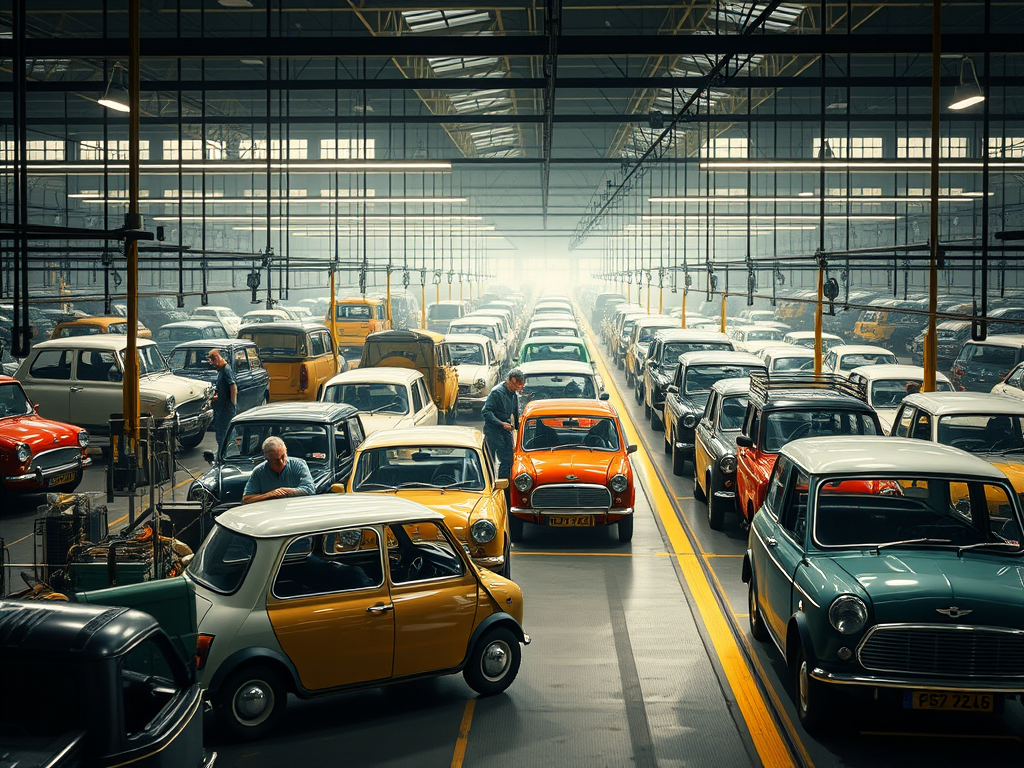
British Leyland was the giant industrial group that once dominated Britain’s motor industry, and nowhere was it more important than at Longbridge in Birmingham. For much of the late twentieth century, British Leyland was one of the country’s largest employers and a central force in the economic life of the West Midlands.
The company was created in 1968 when the government encouraged a merger between the British Motor Corporation and Leyland Motors. The aim was to form a single national champion that could compete with large American, German and Japanese car manufacturers. This brought together famous brands such as Austin, Morris, MG, Rover, Triumph and Jaguar under one corporate roof.
Longbridge became one of British Leyland’s main production centres. The factory produced millions of cars that became part of everyday British life, including the Austin Mini, Austin Allegro, Austin Metro and later Rover models. At its height, tens of thousands of workers were employed on the site, and whole communities in south Birmingham depended on the plant for their livelihoods.
However, British Leyland was a deeply troubled organisation. It had inherited too many brands, too many factories and too many overlapping models, while lacking the investment needed to modernise production. Industrial disputes, quality problems and fierce competition from foreign car makers weakened the company throughout the 1970s.
By 1975, British Leyland was on the brink of collapse and was effectively nationalised by the British government. This saved the company and protected thousands of jobs in Birmingham and across the Midlands, but it also led to years of restructuring, factory closures and painful cuts. Longbridge survived, but many other plants across Britain were shut.
Despite its problems, British Leyland produced some iconic vehicles. The Mini became one of the most successful small cars in the world, while the Metro was launched in 1980 as a modern replacement for older models and was seen as a symbol of British industrial renewal.
By the late 1980s and 1990s the group was gradually broken up and rebranded, eventually becoming Rover Group under new ownership. Yet British Leyland left a permanent mark on Birmingham. It shaped the lives of tens of thousands of families, defined the identity of Longbridge and played a central role in Britain’s struggle to maintain a competitive car industry in the modern age.




Leave a Reply