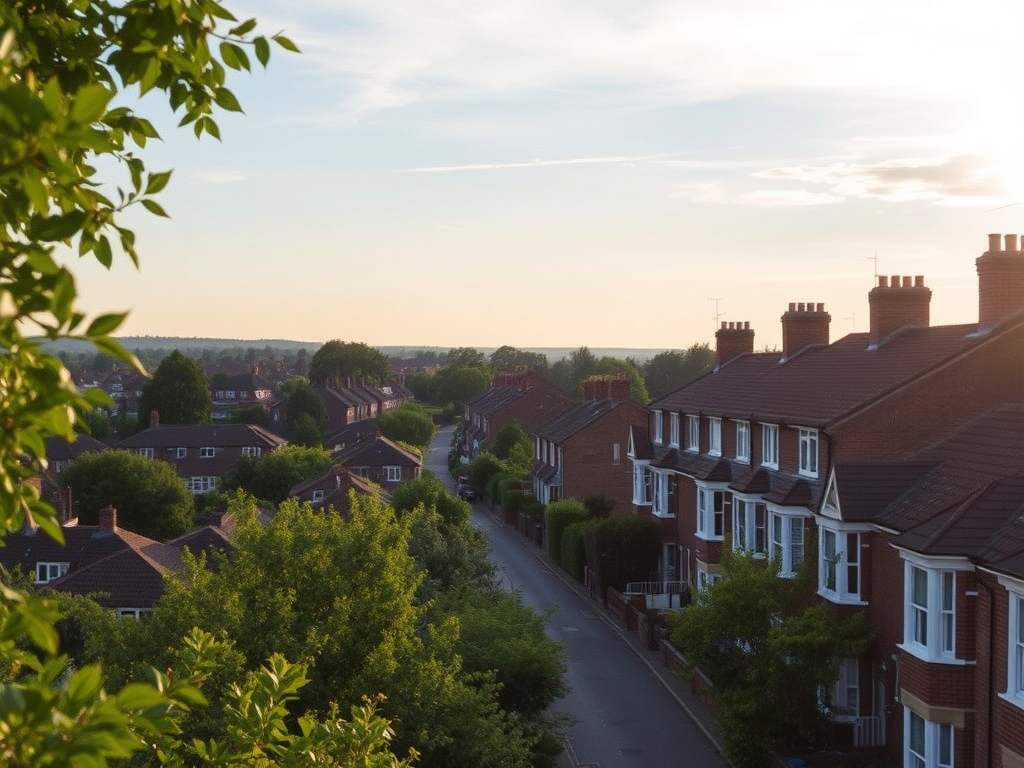
Highter’s Heath is a district in south Birmingham, lying between Kings Heath, Brandwood and Stirchley. It occupies gently rising ground between the Alcester Road South and the green corridors that run through Brandwood and Moseley, giving it a position that bridges some of Birmingham’s most distinctive suburbs.
The name Highter’s Heath reflects the area’s origins as open common land on higher ground, used for grazing and small-scale farming. For centuries this heathland lay on the edge of the old villages of Kings Heath and Moseley, forming part of the rural landscape that supplied Birmingham with food and raw materials before the city expanded southwards.
Highter’s Heath began to be built over in the late nineteenth and early twentieth centuries as Birmingham’s population grew and new suburbs spread out from the city centre. Streets of terraced houses and semi-detached homes replaced fields and open ground, creating a residential district for working and lower-middle-class families, many of whom were employed in the nearby industries of Stirchley, Bournville and the wider south Birmingham manufacturing belt.
One of the area’s defining influences has been its proximity to Bournville and the Cadbury works, one of Birmingham’s most famous industrial sites. For much of the twentieth century, Cadbury provided stable employment for many local families, and the social and economic life of Highter’s Heath was closely tied to the rhythms of the chocolate factory and its associated businesses.
The district also sits close to important green spaces, including Highbury Park and Moseley Bog, preserving something of the wooded and heathland landscape that once defined this part of Birmingham. These areas provide a direct link between Highter’s Heath’s rural past and its modern suburban character.
Today Highter’s Heath remains a settled residential area, shaped by its historic position between Birmingham’s industrial powerhouses and its great suburban estates. It is a place where the city’s expansion, its manufacturing heritage and its surviving green spaces all come together.







Leave a Reply