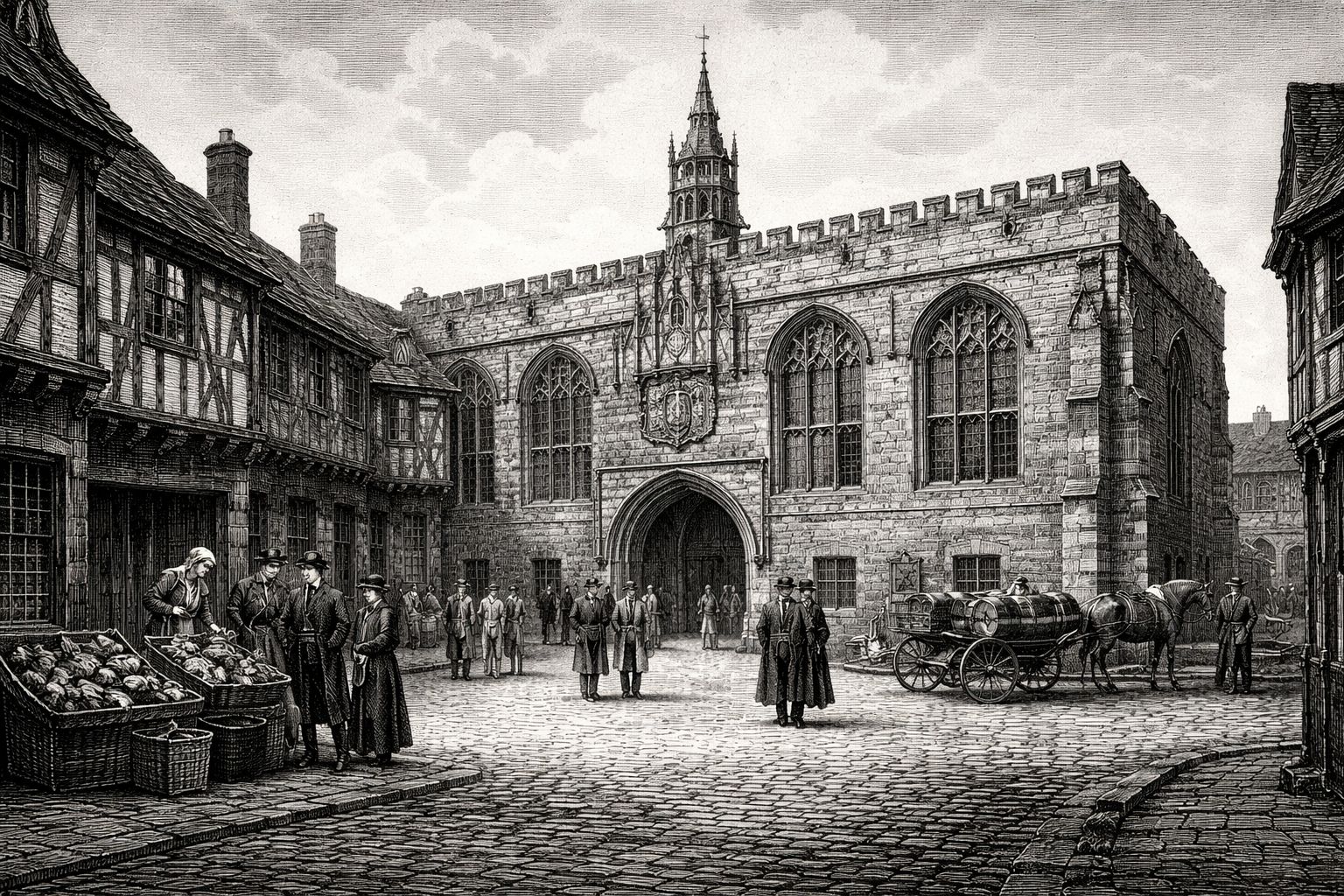
St Mary’s Guildhall is one of Coventry’s most remarkable and best-preserved medieval buildings, standing beside the old cathedral ruins in the historic heart of the city. For more than six centuries it has been the ceremonial, political and social centre of Coventry, reflecting the city’s rise from a medieval trading hub to a major centre of wealth and influence.
The Guildhall was built mainly in the fourteenth and fifteenth centuries by Coventry’s powerful merchant guilds, particularly those involved in the cloth and wool trade. At a time when Coventry was one of England’s most prosperous cities, the guilds needed a grand building to conduct business, host visitors and display their status. The result was a richly decorated hall that rivalled the great civic buildings of London and York.
The most famous space inside is the Great Hall, a vast timber-roofed chamber that remains largely intact. Its hammer-beam roof is one of the finest in the country, and the walls are lined with medieval and Tudor stained glass showing kings, queens, saints and local dignitaries. The hall was used for banquets, official meetings and royal visits, and it hosted some of the most important events in Coventry’s history.
St Mary’s Guildhall was closely linked to the English monarchy. Kings such as Henry VI, Edward IV and Henry VII all stayed here when visiting Coventry, and Mary, Queen of Scots was briefly held in the Guildhall in 1569 while under guard during her captivity in England. These royal connections underline just how important Coventry once was in national affairs.
Beyond the Great Hall, the Guildhall contains a network of historic rooms, council chambers and undercrofts that reveal how Coventry was governed. For centuries, the city’s mayors, councillors and guild leaders met here to run the affairs of one of medieval England’s great trading cities. In many ways, the Guildhall was the real seat of power in Coventry long before modern town halls existed.
Unlike much of Coventry’s medieval architecture, St Mary’s Guildhall survived the bombing of the Second World War largely intact. While the cathedral next door was destroyed, the Guildhall’s thick stone walls and sturdy roof protected its priceless interiors, making it one of the few places where visitors can still experience Coventry’s pre-war and medieval character at first hand.
Today St Mary’s Guildhall is open to the public as a museum, historic venue and cultural space. It hosts exhibitions, events, concerts and ceremonies, while its Great Hall remains one of the most impressive medieval interiors in Britain. Together with the ruins of the old cathedral and the modern new cathedral, it forms the centrepiece of Coventry’s historic quarter.
More than just a beautiful building, St Mary’s Guildhall tells the story of Coventry at its height — a proud, wealthy and influential city whose merchants and guilds once stood at the forefront of English trade. Its survival gives Coventry a tangible link to that golden age and makes it one of the city’s most precious historic treasures.







Leave a Reply