The Coventry Blitz stands as one of the most devastating and defining events in the city’s long history. It was not just a single air raid but a carefully planned and brutally executed attack that aimed to break Coventry’s industry, its morale and its medieval heart. What happened in November 1940 reshaped the city forever and left a legacy that still defines Coventry’s identity today.
During the early months of the Second World War, Coventry had become a prime target for the German Luftwaffe. The city was one of Britain’s most important industrial centres, producing aircraft engines, vehicles, machine tools and munitions that were vital to the war effort. Its factories were spread across the city, often hidden among residential streets, making Coventry both strategically important and difficult to defend without risking civilian lives.
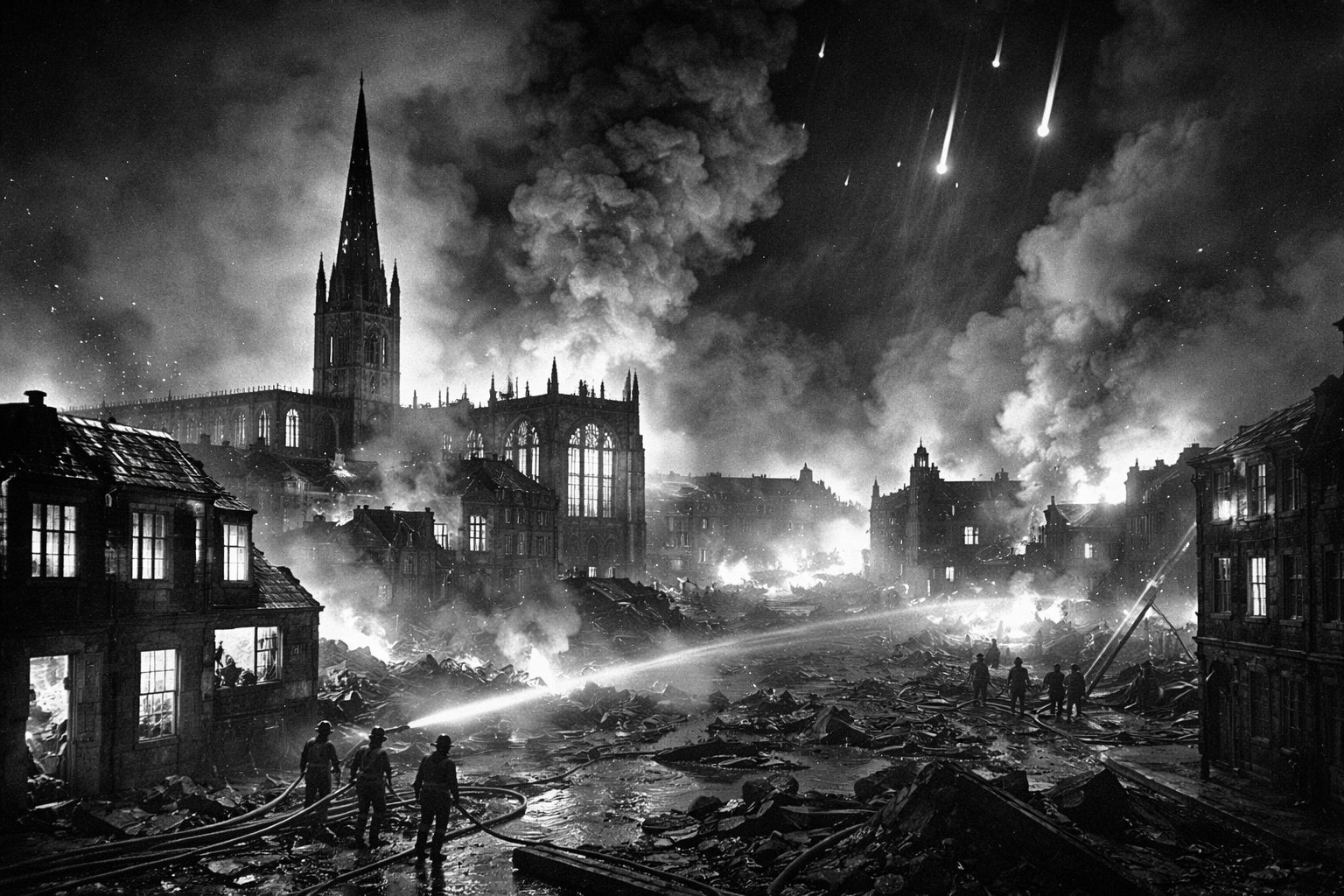
On the evening of 14 November 1940, German bombers began a concentrated attack under a plan known as Operation Moonlight Sonata. Pathfinder aircraft first dropped flares to light up the city, marking it for the waves of bombers that followed. Over the next eleven hours, Coventry was subjected to a relentless combination of high-explosive bombs, which shattered buildings and water mains, and incendiary bombs, which started thousands of fires. This deadly pairing was designed to overwhelm emergency services and turn large areas of the city into a firestorm.
The medieval city centre was particularly vulnerable. Coventry still had a dense core of timber-framed buildings, narrow streets and historic structures. As fires took hold, they spread rapidly from building to building. Water supplies were cut by bomb damage, making it almost impossible for firefighters to control the flames. By the early hours of the morning, much of central Coventry was ablaze.
The most famous casualty of the raid was Coventry Cathedral, then the medieval Church of St Michael. Incendiaries set its vast wooden roof on fire, and by dawn the interior had been completely destroyed, leaving only the outer walls, tower and spire standing. Around it, streets that had survived for centuries were reduced to rubble.
The human cost was severe. Around 550 people were killed and thousands more injured, while tens of thousands were made homeless as entire neighbourhoods were wiped out. Factories, shops, homes, churches and historic buildings were destroyed or badly damaged. It was one of the worst air raids suffered by any British city during the war.
Yet Coventry’s response to the disaster was remarkable. Rescue work began almost immediately, and essential factories were quickly brought back into operation. Within days, production resumed in many plants, denying Germany the industrial knockout it had hoped to achieve. Spiritually and culturally, the city also chose a powerful path. Instead of clearing away the ruins of the cathedral, Coventry decided to preserve them as a memorial. From the burned timbers of the roof, a simple Cross of Nails was made, symbolising forgiveness and reconciliation rather than revenge.
After the war, Coventry was rebuilt on a bold new plan. Much of the old medieval street pattern was replaced by modern roads, shopping precincts and new housing. This made Coventry one of Britain’s first truly modern cities, but it also meant the loss of much of its ancient urban fabric. The construction of the new Coventry Cathedral beside the ruins of the old one embodied this mixture of remembrance and renewal.
Today, the Coventry Blitz is remembered not only for the scale of destruction, but for the values that emerged from it. The city became internationally known for its commitment to peace and reconciliation, forging links with former enemy cities and promoting dialogue in the aftermath of war. The ruins of the old cathedral, open to the sky, remain one of the most powerful wartime memorials in Europe.
The night of 14–15 November 1940 changed Coventry forever, but it also gave the city a unique voice. Out of fire and rubble came a message that has endured for generations: that even in the face of devastating loss, reconciliation and rebuilding are possible.





Leave a Reply