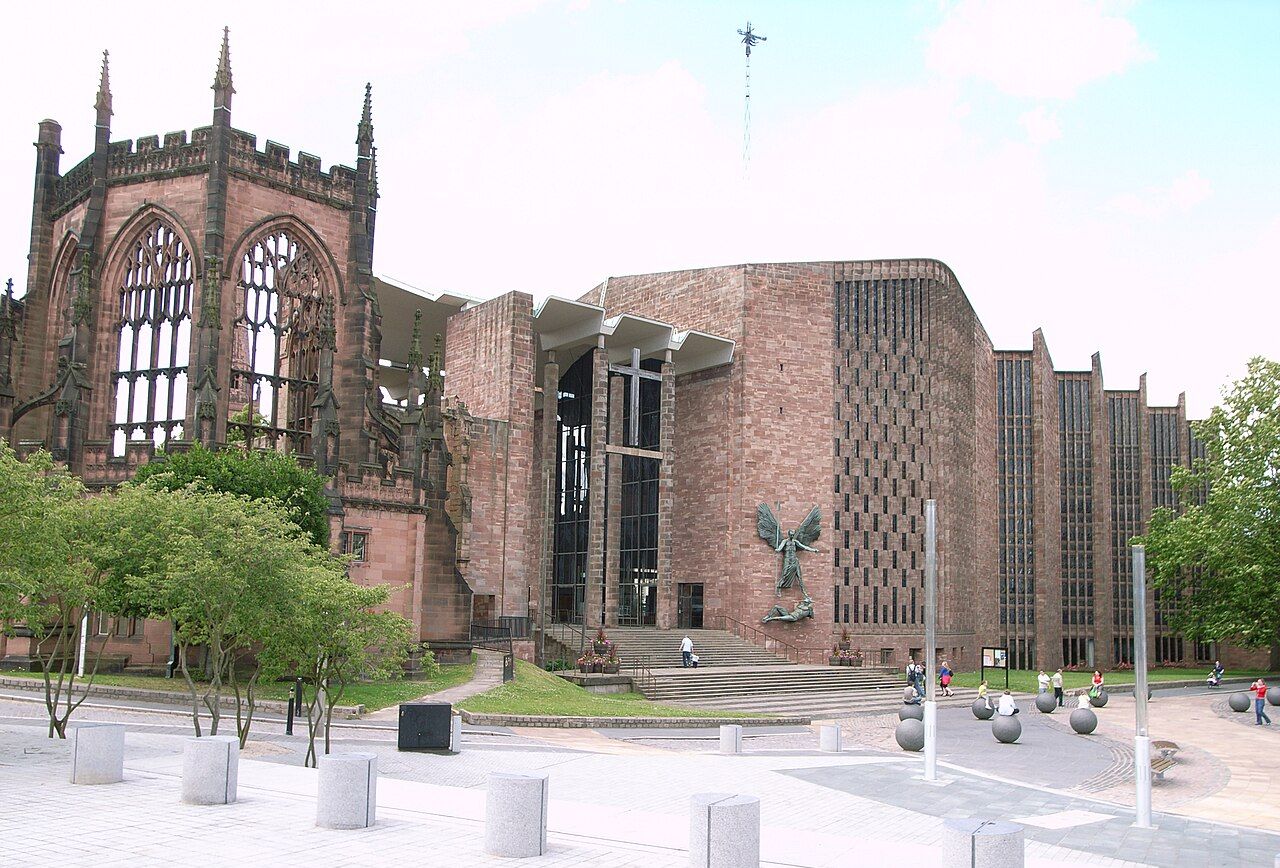
Coventry Cathedral Nikater, Wikimedia Commons, CC BY-SA 3.0.
Coventry’s new cathedral stands beside the ruins of the medieval church as one of the most powerful architectural statements in modern Britain. Officially known as St Michael’s Cathedral, it was built not simply to replace what was lost in the Second World War, but to express a new vision of faith, reconciliation and renewal in a world shaped by conflict.
After the destruction of the old cathedral in the bombing of 1940, Coventry made a remarkable decision. Rather than rebuilding the medieval church as it had been, the city chose to preserve its ruins as a permanent memorial and build a new cathedral alongside them. An international architectural competition was held, and the winning design came from Sir Basil Spence, whose bold and modern vision captured the spirit of a city looking forward rather than back.
Construction began in the 1950s, and the cathedral was consecrated in 1962. Instead of copying historic styles, Spence designed a building that was unmistakably of its time, using clean lines, modern materials and dramatic spaces to create a sense of light and openness. The cathedral was deliberately positioned so that it faces the ruins of the old building, creating a powerful relationship between past and present, destruction and renewal.
One of the most striking features of the new cathedral is its use of modern art. The vast tapestry of Christ in Glory, designed by Graham Sutherland, dominates the east end and is one of the largest tapestries in the world. It shows Christ surrounded by the symbols of the four Evangelists and sets a powerful visual focus for worship. The building also incorporates work by leading artists of the time, including stained glass by John Piper, engraved glass by John Hutton and sculpture by Jacob Epstein, making the cathedral as much a gallery of modern sacred art as a place of worship.
The cathedral’s long processional entrance, flanked by tall, slender walls and a striking bronze screen, is designed to lead visitors gradually from the noise of the city into a space of calm and reflection. Inside, the layout encourages a sense of gathering and community, reflecting new ideas about worship that emerged in the mid-twentieth century.
Beyond its architecture, the new cathedral carries a deep symbolic role. It is closely linked to Coventry’s international mission of reconciliation, which grew out of the wartime destruction and the decision to respond not with bitterness but with forgiveness. The Cross of Nails, created from the ruins of the old cathedral, became the centre of a worldwide network of peace and reconciliation, and the new cathedral was designed to embody those values in its very fabric.
Today Coventry Cathedral is recognised as one of the most important religious buildings of the twentieth century. It stands not just as a place of worship, but as a global symbol of peace, resilience and the power of rebuilding after devastation. Together with the ruins of the old cathedral beside it, it forms one of the most moving and meaningful architectural landscapes in Britain.







Leave a Reply