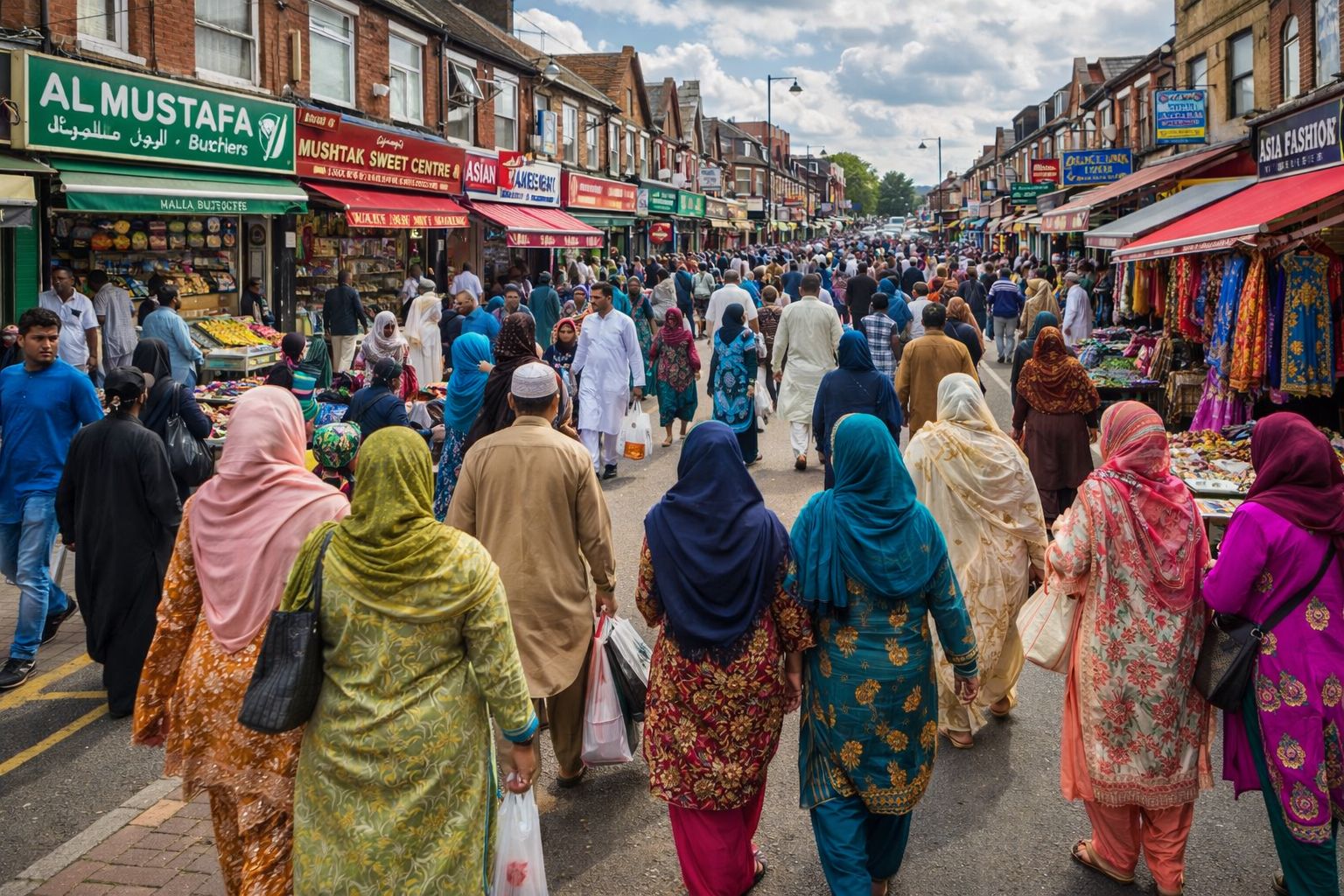
Sparkhill is an inner-city district of south Birmingham, lying between Sparkbrook, Moseley, Balsall Heath and Hall Green. It developed mainly in the late nineteenth and early twentieth centuries as Birmingham expanded rapidly beyond its original core, turning what had once been farmland and scattered rural properties into a dense, urban residential area. The name Sparkhill reflects its origins as higher ground on the edge of the old village of Sparkbrook, overlooking the River Rea valley and the roads leading south out of the city.
Sparkhill is also known in popular culture as the fictional setting of the BBC sitcom Citizen Khan. The comedy, which follows the life of Mr Khan and his family, portrays Sparkhill as a lively, multicultural neighbourhood and even refers to it as “the capital of British Pakistan.” Although much of the series was filmed in studios, the show’s association with Sparkhill has given the area wider recognition across the UK and contributed to its identity as a vibrant, diverse part of Birmingham.
Much of Sparkhill’s housing was built during the Victorian and Edwardian periods, when Birmingham’s booming industries created a huge demand for homes close to factories, workshops and the city centre. Long streets of red-brick terraced houses were laid out in a grid pattern, providing solid, well-built accommodation for working families. Many of these houses survive today, giving the area a strong architectural character rooted in the industrial age of Birmingham’s growth.
One of Sparkhill’s most significant historic features is Sarehole Mill, which lies on its eastern edge beside the River Cole. This eighteenth-century watermill is famous for its association with J. R. R. Tolkien, who lived nearby as a child and drew inspiration from the mill and the surrounding countryside for his later writing. The mill and its green surroundings now form part of a protected heritage site, offering a rare glimpse of the rural landscape that once extended across this part of Birmingham before urbanisation took over.
Sparkhill has long been known for its cultural diversity and its role as a first point of settlement for many migrant communities. From the mid-twentieth century onwards it became home to large numbers of people from South Asia, the Caribbean and later from Africa and the Middle East, who brought with them new businesses, places of worship and social traditions. The result is a vibrant local economy of shops, cafés and services, particularly along streets such as Stratford Road, which forms one of the main arteries through the district.
Religious and community buildings are an important part of Sparkhill’s landscape, reflecting its diverse population. Mosques, churches and community centres occupy many former Victorian chapels and halls, giving new life to older buildings while maintaining their presence in the streetscape. This pattern of adaptation has allowed Sparkhill to retain much of its historic fabric while continuing to serve the needs of a changing population.
Today Sparkhill remains a densely populated, lively part of Birmingham, closely connected to the city centre and to neighbouring areas such as Moseley and Sparkbrook. Its combination of Victorian housing, historic landmarks like Sarehole Mill and a strong, multicultural community gives it a distinctive character, rooted in both Birmingham’s industrial past and its role as a modern, global city.





Leave a Reply