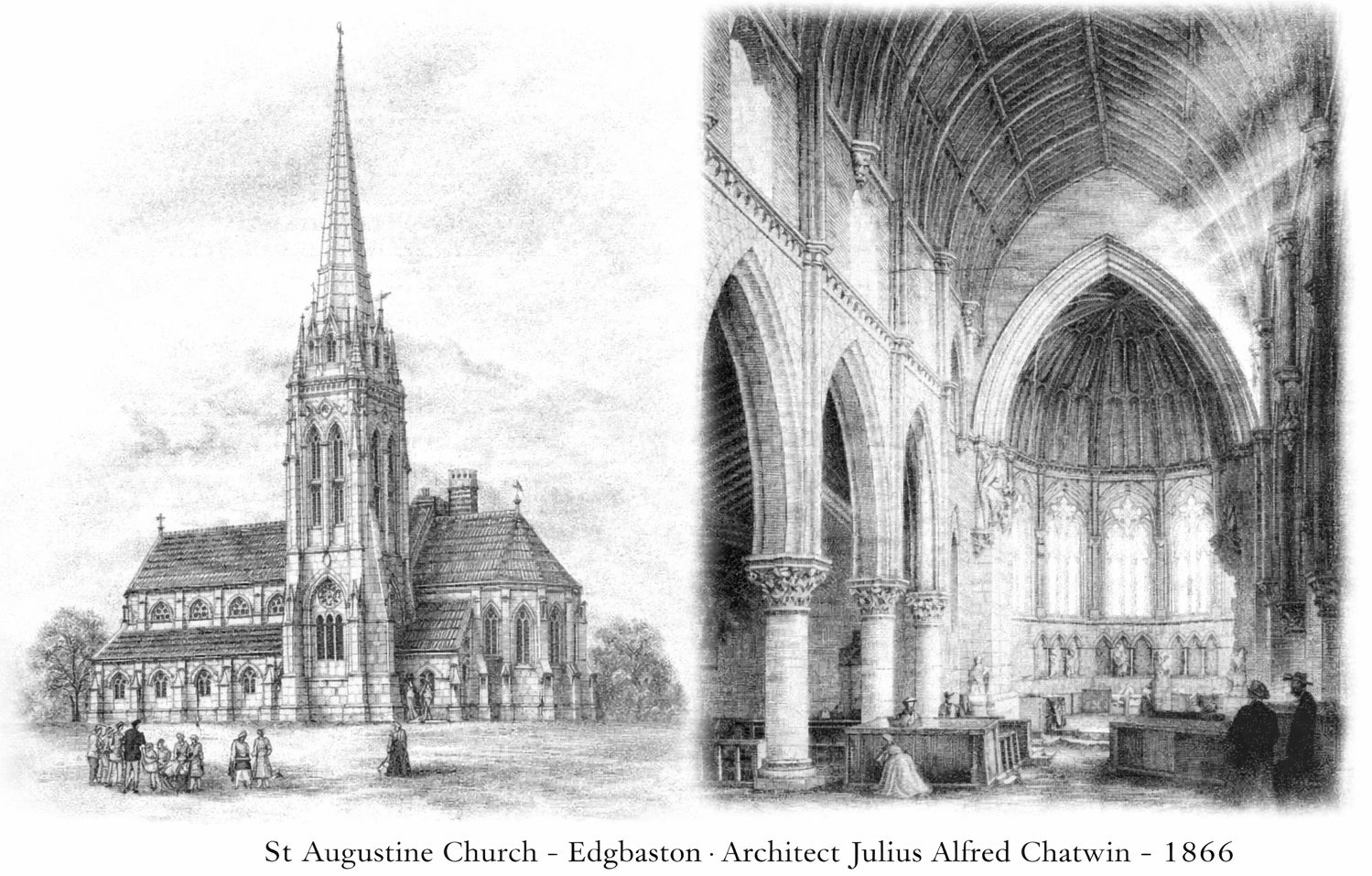
St Augustine Church is one of Edgbaston’s most important historic churches and one of the finest examples of Victorian Gothic architecture in Birmingham. It stands on Lyttelton Road in what is now a conservation area, its tall spire and stonework giving it a landmark presence within this part of the city.
The church was built during a period when Edgbaston was expanding rapidly as a prosperous residential suburb in the mid-19th century. In 1864, land was given and funding provided by Joseph Gillott, a wealthy Birmingham pen manufacturer and patron of the arts, to create a new Anglican church for the growing community. An architectural competition was held and was won by Julius Alfred Chatwin, one of Birmingham’s leading Victorian architects, who designed the building in a bold Gothic Revival style inspired by medieval English churches.
Work began in the late 1860s and the main body of the church was completed and opened in 1868. Built of sandstone with decorative limestone banding, the church was designed to be both imposing and richly detailed, reflecting the confidence and ambition of Victorian Birmingham. The tall tower and spire were added a few years later in 1876, rising to around 185 feet and becoming one of the tallest church spires in the city, visible from a wide area.
Inside, St Augustine Church is especially notable for the richness of its decoration. The chancel ceiling is painted with religious scenes, while the stone carvings, columns and arches show a high level of Victorian craftsmanship. Much of the stained glass was produced by leading Birmingham firms, adding colour and light to the interior. The carved capitals on the nave pillars represent the months of the year and the seasons, linking the building symbolically to the natural cycle of time. The altar and reredos form a strong visual focus, with design influences drawn from classical religious art.
Over the years the church has been carefully developed and extended. A Lady Chapel was added in the early 20th century, and further alterations and additions were made around the church’s centenary in the 1960s, including a new baptistry and entrance areas that respected the original Victorian design. These changes allowed the church to continue serving a modern congregation while preserving its historic character.
Music has always played an important role at St Augustine Church. It was one of the first Anglican churches in Birmingham to introduce a surpliced choir, and it has maintained a strong choral and musical tradition ever since. This has helped to give the church a reputation not just as a place of worship, but also as a centre of cultural and community life.
In the churchyard stands the Edgbaston War Memorial, which commemorates local men who lost their lives in the First World War, later extended to include those who died in the Second World War. This gives the church an additional role as a place of remembrance as well as worship.
Today, St Augustine Church remains an active parish church serving Edgbaston and the surrounding areas. Alongside its religious role, it is also valued as one of Birmingham’s most beautiful Victorian buildings, reflecting the city’s history, craftsmanship and civic pride during the height of its expansion.






Leave a Reply