Spaghetti Junction: Birmingham’s Gravelly Hill Interchange
Spaghetti Junction is the popular name for the Gravelly Hill Interchange, the vast multi-level road junction in north-east Birmingham where the M6 meets key routes into and around the city. For many people it is Birmingham’s most recognisable piece of modern infrastructure: a tangle of sweeping flyovers and looping slip roads carrying tens of thousands of vehicles every day. Behind the nickname is a story that mirrors Birmingham’s post-war ambition, its industrial logistics, and the reality of designing a motorway network through an already crowded urban landscape.
Why it was built
By the 1950s and 1960s, Birmingham and the wider West Midlands had become one of Britain’s busiest industrial and commercial regions. Car making, engineering, distribution and heavy manufacturing depended on fast movement of parts and goods, yet the older road network was never designed for the volume of traffic created by a motor age. The government’s national motorway programme aimed to connect Britain’s major cities and ports, and the M6 became the backbone route for the Midlands. Birmingham needed a way to feed major roads into the motorway, carry long-distance traffic past the city, and also link the city’s own inner routes without choking residential streets.
The location at Gravelly Hill was strategically unavoidable. It sits at a pinch point where Birmingham’s built-up districts, existing main roads, canals, rail lines and the River Tame corridor all converge. The interchange had to do an enormous job in a very tight and complicated space, and that is why the final design became so large, so layered and so visually dramatic.
Planning and construction
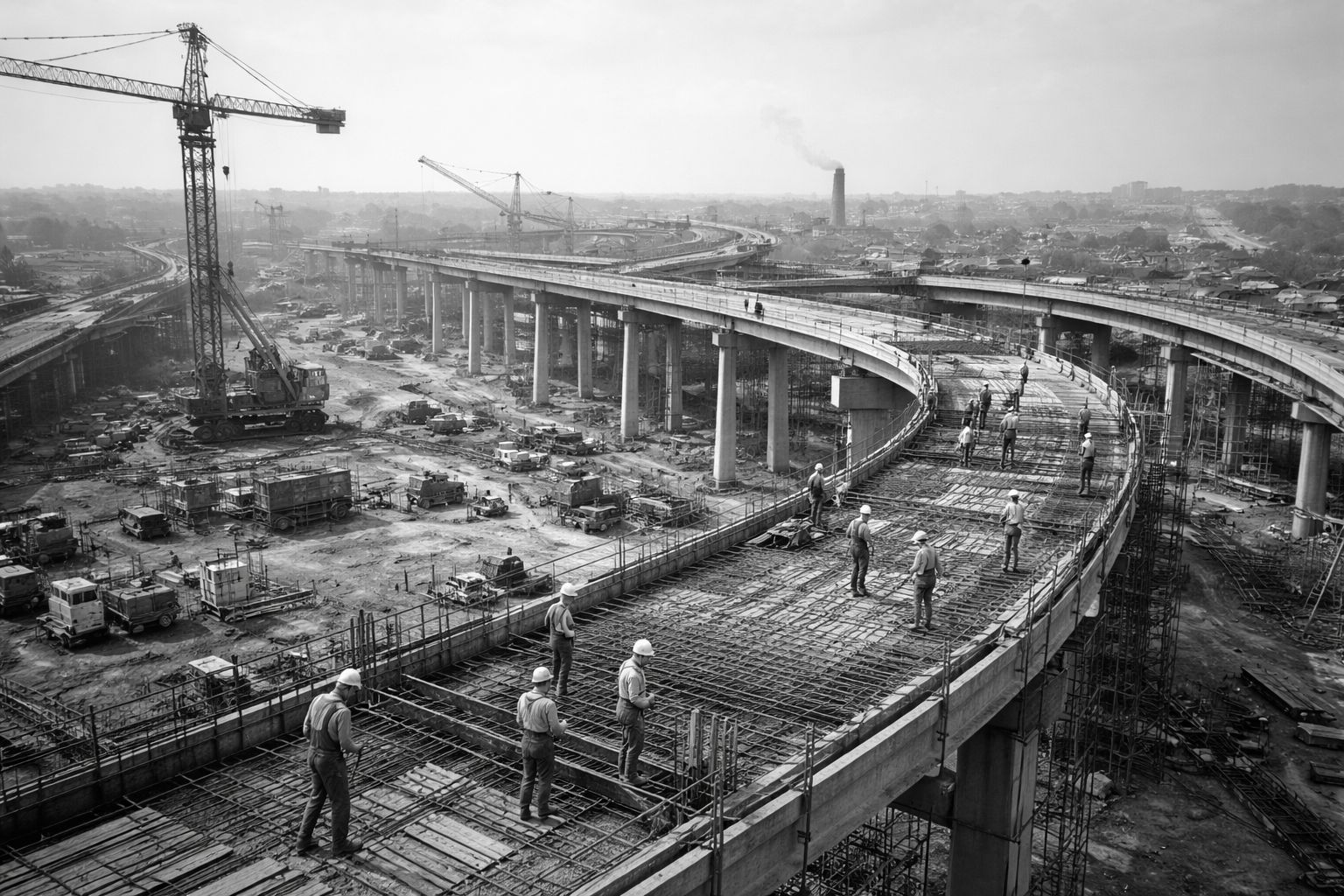
Spaghetti Junction was conceived during the main burst of British motorway building in the 1960s, when engineers were increasingly confident about multi-level interchanges that could keep traffic flowing without crossings or traffic lights. Work began in the late 1960s, and the interchange opened to traffic in 1972. Its construction involved major earthworks, deep foundations, extensive concrete structures, and the careful threading of new roads through existing railways, waterways and industrial land.
The junction was designed not simply as a motorway connection but as a complete traffic machine. It had to merge and separate fast-moving flows safely, give access to Birmingham’s inner road system, and accommodate routes heading north, south, east and into the city. When it opened, it was celebrated as a statement of modern engineering as well as a practical solution to severe congestion.
What it connects
The Gravelly Hill Interchange is more than one junction: it is effectively a meeting point for Birmingham’s regional and national movement. It links the M6 to the A38(M) Aston Expressway, one of the main motorway-style routes into the city centre. It also connects to the A34 and other major roads serving Aston, Perry Barr, Erdington and beyond. Beneath and alongside the roads run important rail routes, and close by are the canals and the River Tame, which historically formed an industrial transport corridor long before the motorways arrived.
This combination makes the interchange a kind of modern successor to Birmingham’s older transport logic. Where canals and rail once tied the region together, Spaghetti Junction became a road-era equivalent: an engineered node built to keep the city’s economy moving.
The nickname and its cultural impact
The name “Spaghetti Junction” is informal, but it stuck because it perfectly describes the view: multiple elevated layers of curving road, one above another, intertwining like strands of pasta. It quickly entered popular culture and became a symbol of Birmingham itself—sometimes admired as bold and futuristic, sometimes criticised as harsh and concrete-heavy, but always instantly recognisable.
For locals, it also became a kind of reference point, a landmark that tells you where you are in the city. For drivers, it has long been a place associated with Birmingham’s scale and busyness: the moment you know you’ve arrived in the Midlands.
How it serves Birmingham today
In the present day, Spaghetti Junction remains one of the most important interchanges in the UK motorway network. The M6 is still a primary national route for freight and long-distance travel, and the West Midlands remains a major centre for manufacturing, distribution and logistics. The interchange helps carry traffic that is not even trying to reach Birmingham, while also feeding vehicles into the city and out towards the Black Country, Staffordshire, Coventry and the national network.
It also supports Birmingham’s modern economy in ways that go beyond commuting. Distribution centres, industrial estates, retail supply chains and service industries depend on predictable road access. The junction’s role in keeping those flows moving is one reason it continues to matter even as cities rethink transport priorities.
Maintenance, safety and the realities of a mega-structure
A structure of this scale is never “finished” in the simple sense. Like most major motorway infrastructure built in the late twentieth century, Spaghetti Junction has required ongoing inspection, resurfacing, waterproofing and concrete repairs over the decades. Traffic volumes are far higher than the designers of the 1960s could truly have imagined, and modern safety standards are more demanding. That has meant periodic works, lane closures and upgrades designed to extend its lifespan and keep it safe.
Despite the complexity, the basic concept remains sound: separating traffic flows onto different levels and slip roads reduces conflicts and allows high capacity. The interchange’s continuing use is proof that, for all the jokes about spaghetti, it performs the job it was built to do.
A modern Birmingham landmark
Spaghetti Junction is often discussed purely as a driver’s challenge or a curious tangle of concrete, but its deeper importance is historical. It represents the moment Birmingham fully entered the motorway age, when national planning reshaped local geography and when engineering was used to solve the pressures of industrial scale. It also shows how transport has always defined Birmingham—from rivers and canals, to railways, and then to motorways.
More than fifty years after it opened, the Gravelly Hill Interchange remains a working piece of infrastructure, a symbol of the city’s connection to the national economy, and a reminder that Birmingham’s identity has always been tied to movement, making and getting things from one place to another.







Leave a Reply