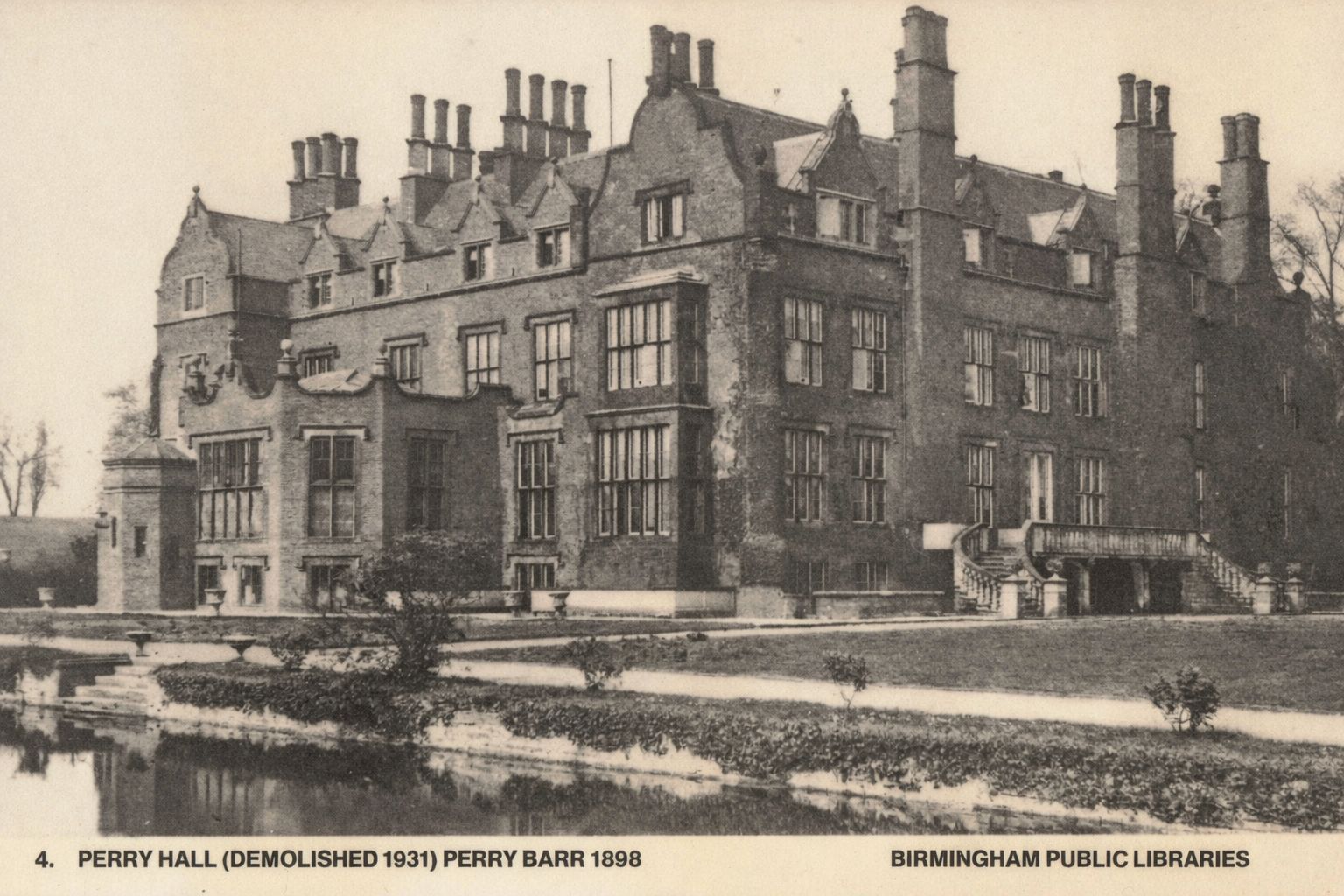
It’s worth saying first that people often call it “Perry Barr Hall”, but the historic house you mean is almost always Perry Hall, the old moated manor that stood in Perry Barr.
Perry Hall was a substantial, late-Tudor country house set within a large estate beside the River Tame. The hall is usually dated to the late sixteenth century (often given as 1569, though some accounts place its main build a few years later). What made it especially distinctive in Birmingham’s landscape was that it was moated – essentially a manor house defended and defined by water, giving it the feel of an older rural England that survived right on the edge of a rapidly growing industrial city.
Over the centuries the hall passed through a number of local landowning hands, but it became most closely associated with the Gough family, who held Perry Hall for generations and were key figures in the area’s estate life. Like many old manor houses, it was not a single “frozen” Tudor building: it evolved. Various improvements and alterations were made over time, and in the nineteenth century the house and its setting were adapted to suit changing tastes and the practical realities of running an estate. By the early twentieth century, however, the old pattern of country-house living was fading, and Perry Hall was no longer thriving as a private family home.
The decisive change came in the late 1920s as Birmingham expanded northwards. With the city’s growth and the pressure for new housing and public land, the estate was acquired by the local authority and the hall’s future was effectively sealed. The building was demolished around the turn of the 1930s (you will see dates ranging from the late 1920s to 1931, reflecting a drawn-out process rather than a single clean moment). Outbuildings lingered briefly, but they too disappeared soon after.
So, does anything remain today? Not the hall itself. What survives is the shape of the place. The most tangible remnant is the hall’s moat, which lives on in the park landscape and is remembered locally through the park’s water features. The wider estate footprint survives in the form of public open space – the area long known as Perry Hall Playing Fields / Perry Hall Park – and in the surrounding street patterns and neighbourhood development that replaced the old private grounds. Even without standing masonry, the hall still has a presence: the name “Perry Hall” persists on maps and in local memory precisely because it once anchored the district.







Leave a Reply