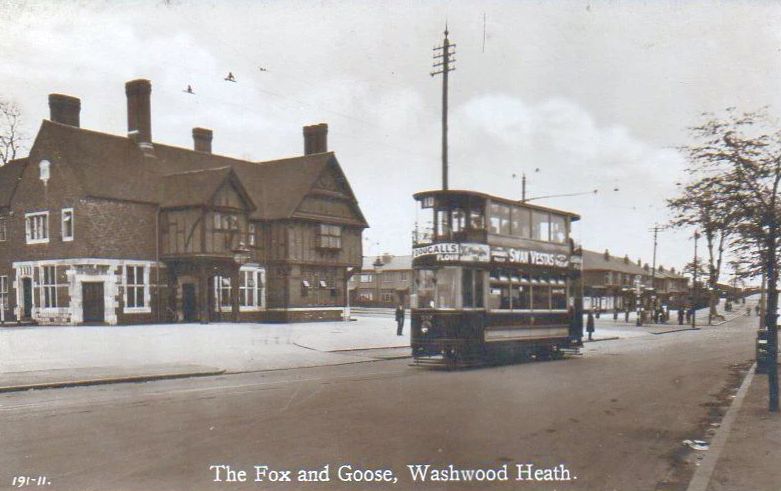
Washwood Heath lies to the north-east of Birmingham’s inner city, between Ward End, Saltley and Hodge Hill, and has long been shaped by transport routes and industry. The area takes its name from low-lying, marshy ground that once covered much of the district, where shallow pools and scrubland made it unsuitable for farming until large-scale drainage and enclosure took place. For centuries it remained largely rural, dotted with farms and small cottages, before Birmingham’s rapid expansion in the nineteenth century absorbed it into the growing city.
The arrival of canals and railways transformed Washwood Heath into a strategic industrial zone. The Birmingham and Fazeley Canal ran close by, linking the area to the wider Midlands network, while later railway lines connected it directly to the city centre and to factories in Aston, Saltley and Small Heath. This made Washwood Heath particularly attractive to manufacturers needing good transport links for coal, steel and finished goods. Rows of terraced houses soon appeared to house workers, many of whom were employed in engineering, metalworking and vehicle production.
One of the most important industrial sites in the area was the Metro-Cammell works, officially the Metropolitan-Cammell Carriage and Wagon Company. This vast factory complex became internationally famous for building railway carriages, trams and later military vehicles. During the Second World War it produced tanks and armoured vehicles, making the district a key part of Britain’s war effort. The works dominated Washwood Heath for much of the twentieth century and provided employment for generations of local families.
Nearby, the extensive rail sidings and depots around Washwood Heath and Saltley were vital to Birmingham’s industrial economy. They handled everything from coal and steel to manufactured goods, linking the city’s factories to ports and markets across Britain. Even after heavy industry declined, the area remained an important rail hub, later becoming known for its role in maintaining and storing rolling stock.
The residential parts of Washwood Heath developed alongside this industrial base. Streets of modest Victorian and Edwardian housing grew up, along with schools, churches and local shops that served a strongly working-class population. Over time, the area became increasingly diverse, with communities from South Asia, the Caribbean and elsewhere settling there, particularly after the 1950s and 1960s. This diversity is now one of the defining features of the district.
LDV (originally Leyland DAF Vans) was a British van manufacturer based in Washwood Heath, Birmingham, where its factory produced a range of light commercial vehicles, including the Pilot, Convoy and Maxus models. The Washwood Heath plant on Drews Lane was the centre of LDV’s manufacturing operations until production was suspended in 2008 and the company went into administration in 2009.
In recent years, Washwood Heath has been at the centre of major changes linked to Birmingham’s future transport ambitions. Parts of the old rail and industrial land have been earmarked for use as a high-speed rail depot connected to HS2, reflecting the area’s long association with railways and heavy engineering. While this has been controversial locally, it also highlights how Washwood Heath continues to play a strategic role in the city’s infrastructure, just as it did during the canal and steam age.
Although many of the great factories have gone, Washwood Heath still retains the character of a place shaped by industry, transport and hard work. Its surviving railway lines, industrial estates and tightly knit streets are reminders of its past, while its busy shops, mosques, schools and community centres show how it has adapted and renewed itself. Like many parts of east Birmingham, it is an area where history and modern life sit side by side, rooted in a strong sense of place forged over more than a century of change.






Leave a Reply