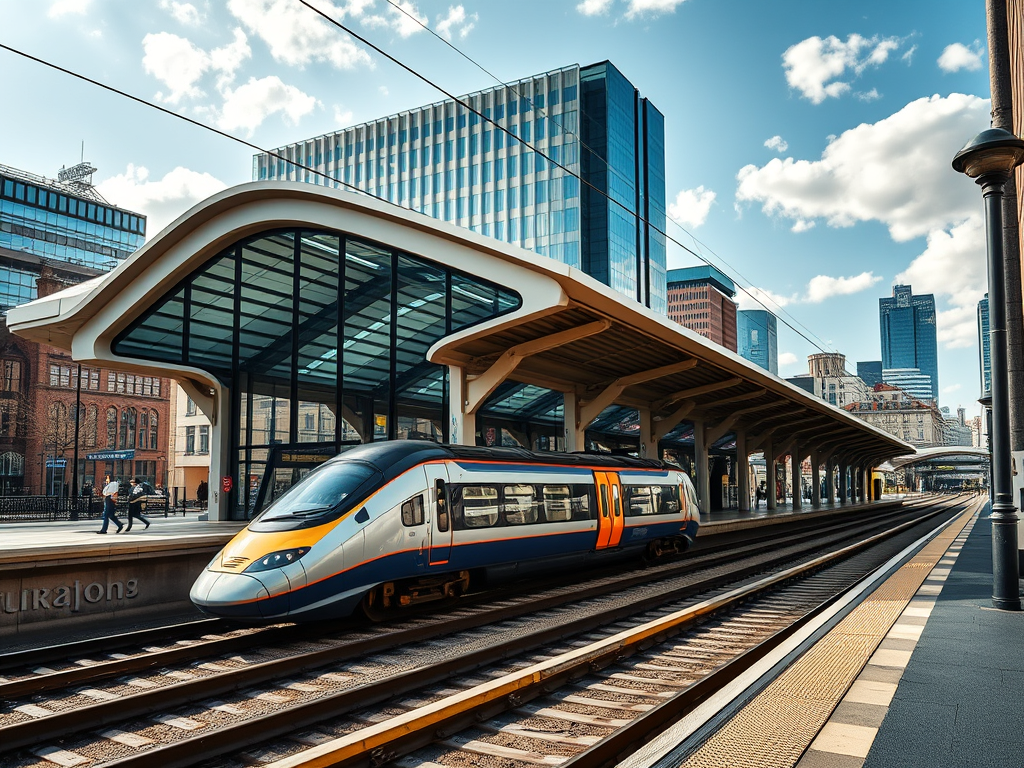
High Speed Two, commonly known as HS2, is the largest and most ambitious rail infrastructure project undertaken in Britain since the Victorian era. Conceived to address chronic capacity constraints on the existing rail network, HS2 was designed not simply as a faster railway, but as a long-term solution to overcrowding, regional imbalance and the need for modern, low-carbon transport in a densely populated country.
The idea for HS2 emerged in the late 2000s, when it became clear that the West Coast Main Line – the principal rail route linking London, Birmingham, Manchester and Glasgow – was operating close to full capacity. Unlike many European countries, Britain had not built a new mainline railway for over a century, instead repeatedly upgrading Victorian infrastructure. HS2 was proposed as a new, purpose-built line that would take long-distance, high-speed services off the existing network, freeing up space for local and freight trains while dramatically reducing journey times between major cities.
The original plan for HS2 was highly ambitious. It was divided into phases, with Phase One running from London to Birmingham, Phase Two extending northwards in two branches to Manchester and Leeds. Over time, political decisions and rising costs led to major changes. The eastern leg to Leeds and the later Manchester extension were cancelled, leaving HS2 as a high-speed line between London and Birmingham only. Despite this reduction, the Birmingham connection remains central to the project’s purpose and impact.
In Birmingham, HS2 will terminate at Birmingham Curzon Street Station, a new city-centre station built close to Moor Street and Digbeth. This is historically significant, as Curzon Street was the site of Birmingham’s original railway terminus in the 1830s. The new station is intended not just as a transport hub but as a catalyst for regeneration, forming the heart of a wider redevelopment area that includes new offices, homes, public spaces and improved links across the city centre.
The arrival of HS2 is expected to change Birmingham in several important ways. Journey times to London will be reduced to under 50 minutes, strengthening Birmingham’s position as a national business and cultural centre rather than a peripheral city. Improved connectivity is expected to attract investment, support job creation and encourage companies to locate in Birmingham while maintaining close links to the capital. The Curzon Street development area alone is projected to deliver thousands of new jobs and homes, reinforcing long-term regeneration plans for Digbeth and the eastern city centre.
Construction of HS2 is exceptionally complex, which goes a long way towards explaining both its cost and the length of time it has taken. Britain is a crowded island with dense urban areas, existing railways, roads, utilities and environmentally sensitive landscapes. HS2 has required extensive tunnelling under London, major viaducts, deep cuttings, complex land acquisition and the diversion of utilities that have been in place for decades or even centuries. Much of the route passes through already busy or protected land, leaving little room for simple, straight-line construction.
The engineering challenges are compounded by modern legal and environmental requirements. Unlike Victorian railways, HS2 has had to navigate extensive consultation, planning inquiries, environmental assessments and legal challenges. These processes are time-consuming but are now unavoidable in major infrastructure projects. In addition, the project has suffered from changing political priorities, redesigns, inflation in construction costs and shortages of specialist skills, all of which have contributed to delays.
Cost has been one of the most controversial aspects of HS2. Early estimates placed the full network at around £30–40 billion, but as the project developed this rose substantially. With the cancellation of the northern extensions, current estimates for the London–Birmingham line alone are in the region of £60–70 billion. Critics argue that this represents poor value for money, while supporters point out that Britain is effectively building a brand-new mainline railway through some of the most constrained land in Europe, something not attempted since the nineteenth century.
As of now, HS2 between London and Birmingham is under construction, with major civil engineering works well advanced. The official target is for services to begin in the early 2030s, although exact dates remain subject to change. While this long timescale has fuelled frustration, large infrastructure projects of comparable scale in other countries have also taken decades from conception to completion.
Public criticism often focuses on the idea that Britain “cannot even build a high-speed railway”. In reality, HS2 highlights how technically demanding such a project is in a modern, densely developed country with strict planning, environmental and legal frameworks. The challenge is not a lack of engineering capability, but the difficulty of delivering major infrastructure through already crowded land while balancing cost, disruption and long-term benefit.
Whether HS2 ultimately delivers everything once promised remains a subject of debate. However, its arrival in Birmingham at Curzon Street will mark a profound change in the city’s connectivity and urban landscape. Even in its reduced form, HS2 represents a once-in-a-generation investment that will shape Birmingham’s economy, transport and development for decades to come.





Leave a Reply