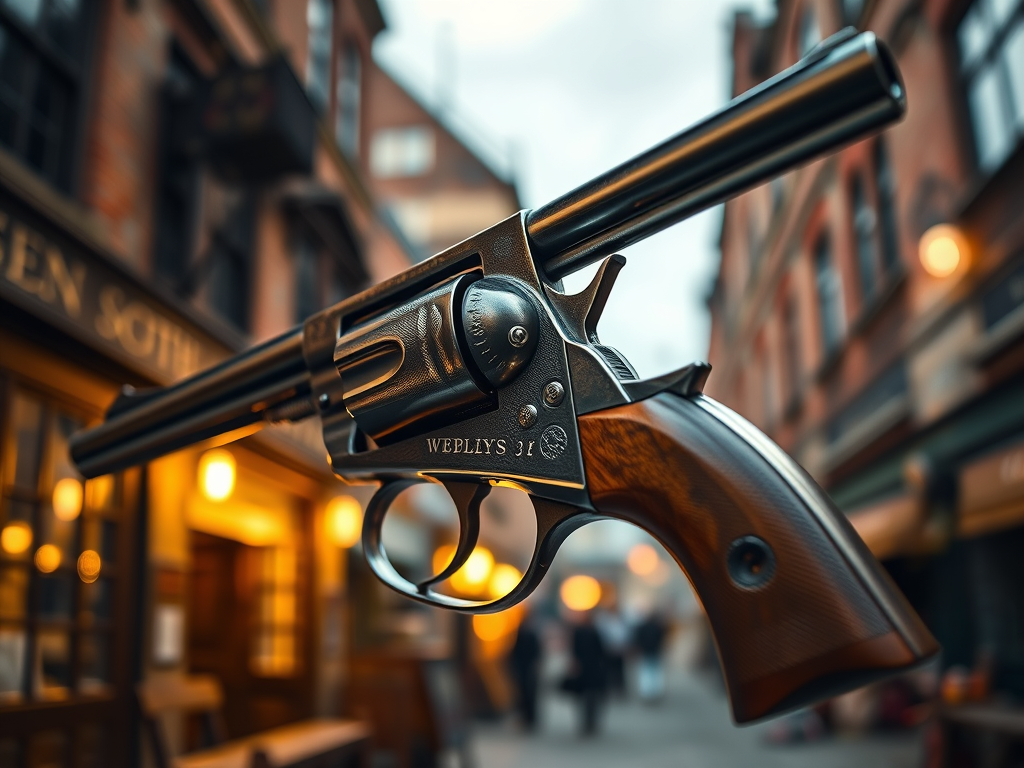
The Webley & Scott name is one of the most famous to emerge from Birmingham’s gun-making tradition and is closely tied to the city’s role as the centre of Britain’s small-arms industry. For more than a century, Webley & Scott produced firearms that were used by civilians, sportsmen, police forces and armies around the world, becoming synonymous with reliability, craftsmanship and Birmingham engineering.
Webley’s origins lie in the early nineteenth century. The company traces its roots to William Davis, a Birmingham gunmaker working in the 1830s, but it was under the leadership of Philip Webley that the business truly took shape. By the mid-1800s, Webley had established himself as a leading manufacturer of firearms, operating from Birmingham at a time when the city’s Gun Quarter was thriving. This area, centred around Steelhouse Lane, Weaman Street and surrounding streets, was home to hundreds of specialist workshops supplying barrels, locks, frames and finished weapons.
Webley became particularly famous for its revolvers. In the late nineteenth century, the company developed a series of solid-frame and top-break revolvers that were robust, simple to use and well suited to military service. These qualities led to Webley revolvers being adopted by the British armed forces. From the 1880s through to the First World War, Webley revolvers were the standard sidearm of British officers, and the name became inseparable from Britain’s imperial military presence.
In 1897, Webley merged with W & C Scott & Son, another major Birmingham gunmaker, to form Webley & Scott. The merger brought together two of the city’s most respected firearms manufacturers and significantly increased production capacity. The combined company operated large factories in Birmingham, most notably in the Aston area, and employed large numbers of skilled workers. At its height, Webley & Scott was one of the largest arms manufacturers in the world.
Beyond military revolvers, Webley & Scott also produced a wide range of sporting firearms, including shotguns and air pistols. The company became particularly well known for high-quality shotguns, many of which were exported across the British Empire and beyond. Its air pistols and air rifles also gained a strong reputation and helped introduce generations of young people to shooting sports.
During the First World War and Second World War, Webley & Scott played a crucial role in Britain’s war effort. The company’s Birmingham factories were heavily involved in arms production, turning out revolvers and other equipment at scale. This wartime output reinforced Birmingham’s strategic importance as a manufacturing centre and placed Webley & Scott at the heart of national defence.
After the Second World War, however, the company faced increasing challenges. Military demand declined sharply, and changes in firearms legislation reduced the civilian market. At the same time, Birmingham’s traditional gun trade was under pressure from overseas competition and the rising costs of maintaining large-scale manufacturing in the city. Gradually, firearms production in Birmingham became less viable.
By the late twentieth century, Webley & Scott had withdrawn from most firearms manufacturing in Birmingham. The company’s historic factories closed, and skilled gunmaking in the city entered terminal decline. Parts of the business were sold or reorganised, and the original Webley & Scott operation effectively ceased to exist as a Birmingham manufacturer.
The Webley name, however, did not disappear entirely. Today, Webley survives primarily as a brand, most commonly associated with air pistols and air rifles rather than firearms. These products are no longer manufactured in Birmingham, and ownership of the name has passed through various hands. While the brand retains its British heritage identity, it no longer represents a major manufacturing presence in the city that gave it its reputation.
Webley & Scott’s legacy remains deeply embedded in Birmingham’s industrial history. The company stands as a symbol of the city’s once-dominant gun trade, where skilled craftsmanship and mass production coexisted in a dense network of workshops and factories. From imperial service revolvers to sporting guns and air pistols, Webley & Scott helped define an era when Birmingham supplied the world with precision-made weapons, leaving a lasting mark on both the city and British manufacturing history.






Leave a Reply