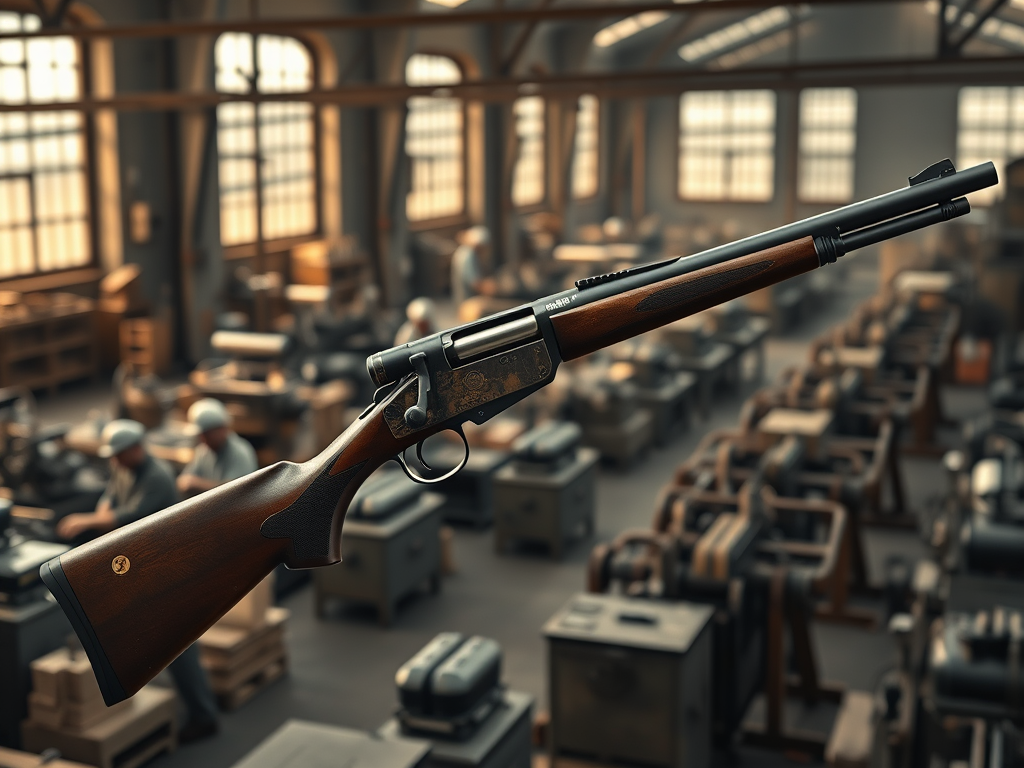
The Birmingham Small Arms Company, universally known as BSA, was one of the most important defence manufacturers in British history and a cornerstone of Birmingham’s industrial identity. Although today the name is often associated with motorcycles, BSA’s origins, scale and long-term significance lie far more firmly in firearms, ammunition and defence procurement, fields in which the company played a decisive national and international role for over a century.
BSA was founded in 1861 in Birmingham by a group of local gunmakers at a time when Britain urgently needed to modernise its small-arms production. The Crimean War had exposed serious weaknesses in how military weapons were supplied, and the government encouraged the consolidation of Birmingham’s traditionally fragmented gun trade. BSA was created to bring large-scale, standardised arms manufacture to a city already renowned for skilled gunmaking. From the outset, the company worked closely with the British government, producing rifles to War Office specifications.
The company’s main factories were established in Small Heath, an area that became synonymous with BSA for generations. The Small Heath works grew into one of the largest arms factories in the world, producing military rifles, machine guns and later ammunition at immense scale. BSA rifles became standard issue for the British Army, most famously the Lee–Metford and Lee–Enfield series, which armed British and Commonwealth forces from the late nineteenth century through both World Wars. Few Birmingham-made products ever had such global reach or strategic importance.
Beyond rifles, BSA expanded into ammunition manufacture, producing cartridges in vast quantities for military use. This capability made the company indispensable during times of conflict. During the First World War, BSA became a critical part of Britain’s war machine, operating around the clock to supply arms and ammunition. The Second World War saw an even greater mobilisation, with BSA producing not only small arms and ammunition but also a wide range of military equipment, including machine tools and components essential to aircraft and vehicle production.
Although BSA did diversify into motorcycles, bicycles and other civilian products in the early twentieth century, these activities were originally a means of stabilising the business during peacetime. Defence production always remained central to the company’s identity and profitability. BSA functioned as both a manufacturer and a major defence contractor, deeply embedded in Britain’s procurement system and closely aligned with government priorities.
After the Second World War, however, the nature of defence manufacturing began to change. Demand for small arms declined, procurement became increasingly centralised, and defence technology shifted towards aerospace, electronics and missile systems. Traditional firearms manufacturing, even at BSA’s scale, was no longer the dominant pillar of defence spending. At the same time, the company’s sprawling industrial structure became increasingly difficult to manage in a changing global economy.
By the 1960s and 1970s, BSA was struggling. Motorcycle losses are often cited, but more broadly the company faced structural problems common to many British conglomerates: underinvestment, management complexity and intense international competition. In 1977, the remnants of BSA’s defence-related businesses were absorbed into British Aerospace, marking the end of BSA as an independent industrial and defence manufacturer. This transition reflected a national shift away from traditional arms production towards aerospace-led defence industries.
The absorption into British Aerospace effectively closed the chapter on BSA as a Birmingham-based defence giant. The Small Heath works, once one of the most strategically important arms factories in the world, eventually ceased production and were redeveloped, erasing much of the physical presence of the company from the city’s landscape.
However, the BSA name did not vanish entirely, which often causes confusion. BSA-branded air rifles are still manufactured in Birmingham’s Gun Quarter today, but this operation is not the same company as the historic Birmingham Small Arms Company. The modern BSA air rifle business operates under different ownership and corporate structures, using the historic name and legacy rather than representing a direct continuation of the original industrial giant. While it maintains a connection to Birmingham gunmaking tradition, it does not carry the scale, defence role or government integration of the original BSA.
BSA’s true legacy lies in its transformation of Birmingham from a city of small workshops into a centre of industrial-scale defence manufacturing. For over a century, it armed British forces, supported the Empire, and anchored one of the largest industrial workforces in the Midlands. Its eventual absorption into British Aerospace was not a failure in isolation, but part of a wider reorganisation of Britain’s defence industry in the late twentieth century. Today, BSA stands as one of the most significant names in Birmingham’s industrial and military history, symbolising both the city’s engineering power and the profound changes that reshaped British manufacturing.






Leave a Reply