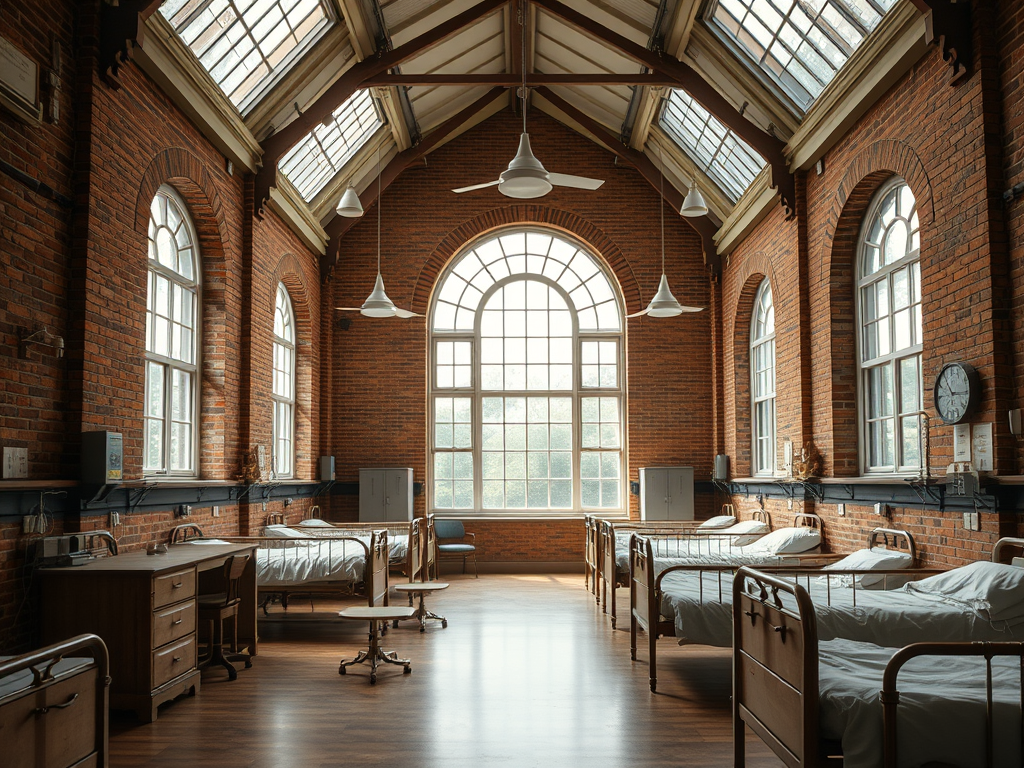
What many people remember as the “Children’s Hospital in Edgbaston” was the long-standing Birmingham Children’s Hospital site on Ladywood Middleway, close to Five Ways and the Edgbaston boundary. This site formed a major part of Birmingham’s medical history for much of the twentieth century and is closely associated with generations of children and families from across the city and the wider Midlands.
Birmingham Children’s Hospital was originally founded in 1862 as the Birmingham and Midland Free Hospital for Sick Children. As demand for specialist children’s healthcare grew, the hospital outgrew its early premises and, in 1917, moved to a purpose-built facility on Ladywood Middleway. Designed and constructed in the early twentieth century, the new hospital reflected contemporary ideas about healthcare, with large wards, generous windows for light and air, and a scale intended to serve a rapidly expanding industrial city. For many decades, this Edgbaston-side hospital was the principal centre for paediatric care in Birmingham.

At its peak, the hospital treated thousands of patients each year and became one of the city’s most important specialist medical institutions. It was a major employer and a familiar landmark on Ladywood Middleway, with its distinctive frontage forming part of the city’s inner-ring landscape. Over time, however, medical practice changed dramatically. Advances in paediatric medicine required more specialised intensive care units, modern operating theatres, improved infection control and facilities for families that the early twentieth-century building could no longer easily accommodate.
By the late twentieth century, it was clear that the Ladywood Middleway site was no longer suitable for modern children’s healthcare. The decision was taken to relocate Birmingham Children’s Hospital back to the Steelhouse Lane area of the city centre, where larger and more adaptable hospital buildings could be developed. In 1998, the hospital officially moved to its current site, marking the end of the Edgbaston-side building’s role as a functioning hospital.
Following the move, the Ladywood Middleway hospital complex was closed and most of the buildings were demolished. However, the main frontage of the former hospital was retained as part of the redevelopment, preserving a visible link to the site’s medical past. This approach allowed the historic street presence of the building to remain, even as its function changed completely.
The site was redeveloped as Broadway Plaza, a major mixed-use leisure complex. Today it houses a cinema, restaurants, fitness facilities, hotel accommodation and residential units. Behind the retained façade, the former hospital grounds have been transformed into a modern entertainment and lifestyle destination, reflecting Birmingham’s wider shift from heavy institutional and industrial uses to service, leisure and residential development.
Although the hospital itself is long gone from Ladywood Middleway, its legacy remains important. The retained façade serves as a reminder of a time when the site was dedicated to children’s care, and the story of its transformation mirrors broader changes in Birmingham’s urban landscape. From a purpose-built children’s hospital to a modern leisure complex, the site encapsulates more than a century of the city’s social, medical and architectural history.



Leave a Reply