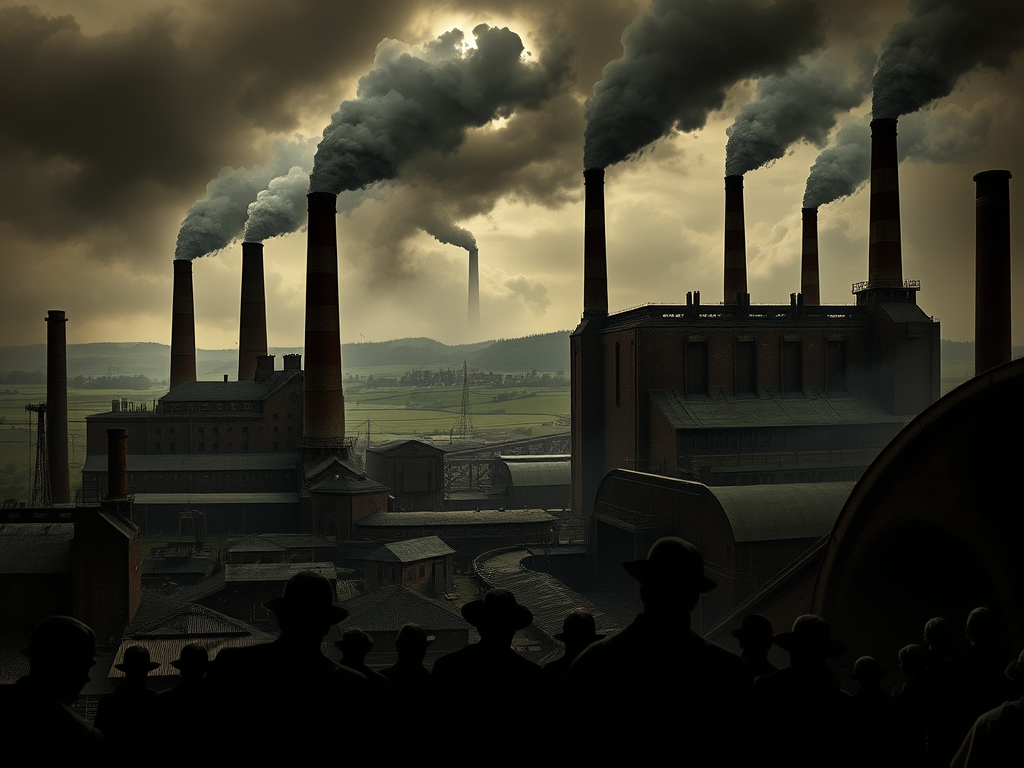
The origins of the phrase “Dark Satanic Mills”
The phrase “Dark Satanic Mills” comes from the opening lines of a short but powerful poem written in 1804 by William Blake, later titled Jerusalem. Blake wrote the poem during the early years of the Industrial Revolution, at a time when Britain was undergoing profound social, economic and environmental change. Although the words are often quoted today as a direct attack on factories, Blake’s meaning was more complex and rooted in both spiritual and social concerns.
Blake lived in an age when industrialisation was transforming England’s landscape. Traditional rural life was giving way to expanding towns filled with workshops, mills and furnaces. Coal smoke darkened the skies, rivers became polluted, and working conditions in many early factories were harsh and dangerous. Child labour, long hours and low pay were common. These changes disturbed Blake deeply, not only because of their physical impact on the land and people, but because he believed they reflected a wider moral and spiritual decline.
In Jerusalem, Blake contrasts an idealised vision of England, often interpreted as a symbol of innocence, creativity and spiritual harmony, with a new industrial reality that he saw as oppressive and dehumanising. The “mills” in his poem are not described in technical detail, but as dark and satanic, language chosen deliberately to suggest something soulless and destructive. For Blake, these mills represented systems that reduced human beings to mechanical parts, valued profit over imagination, and crushed individual freedom.
It is important to understand that Blake was not simply condemning machinery itself. He was deeply suspicious of what he saw as rigid systems of thought, authority and control. In this sense, the “mills” were also metaphorical. They stood for institutions and ideologies that imposed order at the expense of creativity and compassion. Industrial factories became the most visible symbol of these forces, but they were part of a broader critique of modern society.
Over time, the phrase “Dark Satanic Mills” became closely associated with the physical mills and factories of the Industrial Revolution, particularly in industrial regions such as Birmingham, the Black Country, Lancashire and Yorkshire. As towering brick mills, smoking chimneys and sprawling industrial districts came to dominate the landscape, Blake’s words seemed increasingly prophetic. Victorian reformers and later historians adopted the phrase as a shorthand for the worst excesses of early industrialisation.
The phrase gained further prominence because Jerusalem was later set to music and became one of England’s most recognisable patriotic hymns. This created a striking tension. The same poem that celebrates hope, renewal and the building of a better England also contains one of the most famous critiques of industrial society ever written. That contrast has helped keep the phrase alive in public memory.
Today, “Dark Satanic Mills” is often used loosely to describe grim factories or polluting industries, but its original meaning was broader and more philosophical. Blake was warning against a society that prioritised mechanical efficiency and material gain over human dignity, imagination and spiritual well being. His words emerged from a specific historical moment, yet they continue to resonate whenever rapid technological change raises questions about who benefits, who suffers and what is lost along the way.
If you would like, I can also produce a companion piece linking this phrase directly to Birmingham and the Black Country, or a shorter version suitable for a sidebar or educational insert on your Industrial Revolution articles.







Leave a Reply