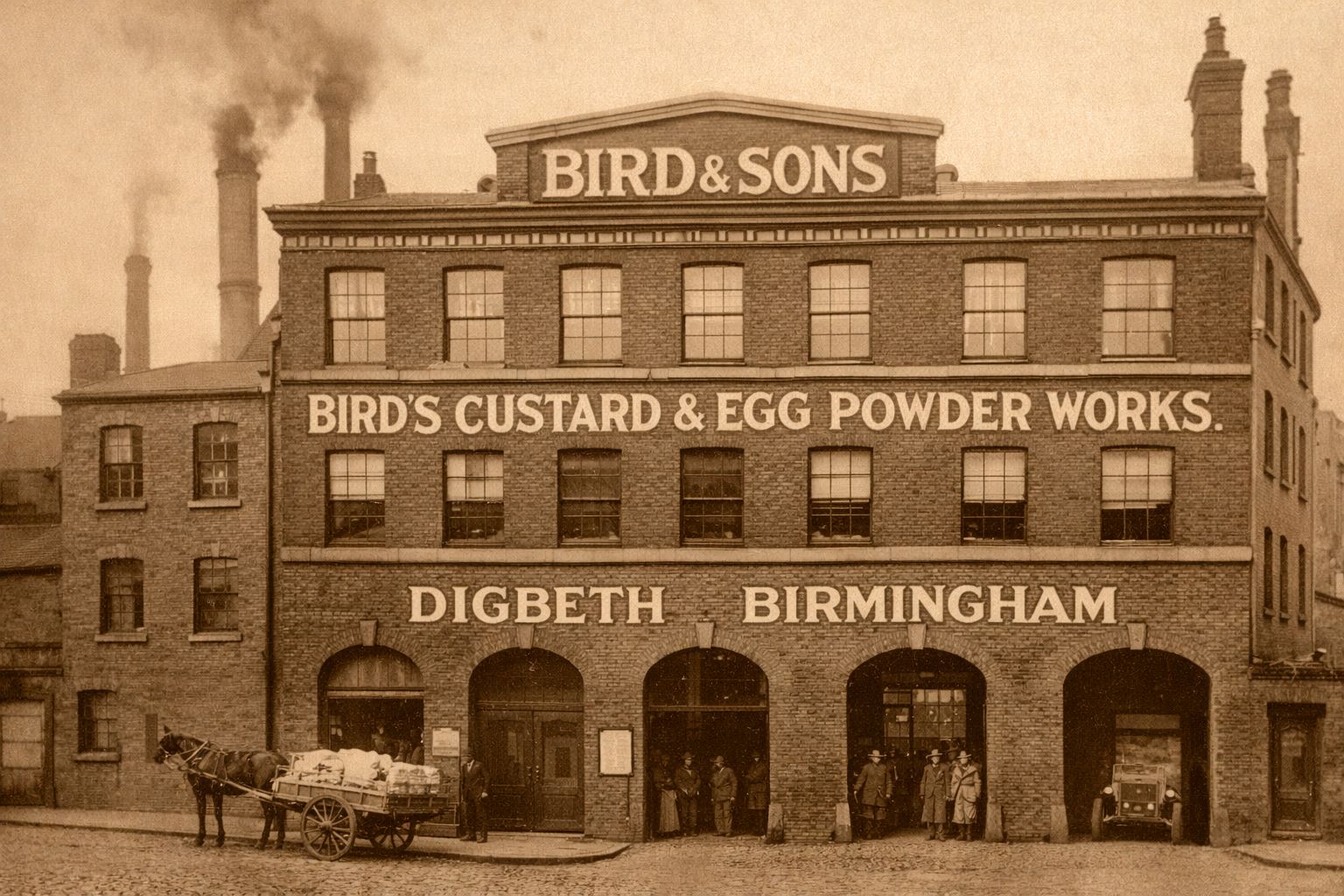
From a chemist’s experiment to a Birmingham icon
Bird’s Custard is one of those brands that feels woven into British life, yet its story begins in a very specific place and time: Birmingham in the 1830s. Long before it became a staple of school dinners, Sunday puddings and trifle bowls, it started as a practical solution created by a Birmingham chemist for someone he loved.
A Birmingham invention born from necessity
In 1837, Alfred Bird, a chemist working in Birmingham, developed an egg-free custard because his wife Elizabeth could not eat eggs. Traditional custard relied on eggs to thicken, so Bird used a different thickening method to create a smooth, custard-like sauce without the allergen. The story goes that it was later served to guests at a dinner party and, whether by accident or by design, people liked it enough for Bird to realise it had commercial potential.
That moment is important because it captures something very Birmingham: a combination of practical problem-solving and quiet invention that turns into industry.
From local product to national brand

What began as a household solution soon became a business. The custard powder was produced and sold more widely, and Bird’s name became associated with a new kind of convenient food that still tasted like comfort. Alfred Bird did not stop at custard either. His work in food innovation also included other products designed around dietary needs, helping establish the Bird company as part of a growing Victorian market for packaged goods.
As the nineteenth century progressed, Bird’s became a recognised household name. The brand’s success also reflected the growth of Birmingham itself, a city expanding rapidly through manufacturing, trade and a confident new consumer culture.
The Digbeth factory and “The Custard Factory” legacy

The Birmingham connection became even more physical and visible in the early twentieth century with the construction of the Bird’s Custard factory complex in Digbeth, close to the city centre. Built for the Bird family business, it was a serious industrial operation, producing custard at scale and employing large numbers of local people. For generations, it was part of the working life of the city, tied to the rhythms of Birmingham labour and the practical output of its factories.
This is also where Bird’s history leaves Birmingham a second legacy. The old Digbeth factory site later became known as the Custard Factory, now one of Birmingham’s best-known creative and independent business hubs. In other words, even after the custard production moved on, the idea of “custard in Birmingham” stayed behind, attached to a place that continues to shape the city’s identity.
Change, relocation and the modern era
Like many long-running British brands with industrial roots, Bird’s production evolved over time. Operations eventually moved away from Birmingham as the food industry modernised and consolidated, and manufacturing shifted to other locations. What remained, however, was the powerful identity of the product and its origin story, still closely associated with Birmingham in popular memory.
In the present day, Bird’s Custard remains a major British brand, now owned by Premier Foods. It continues to be sold widely and has expanded into a broader range of dessert products and formats, while still trading on the original promise: a reliable, comforting custard that generations recognise instantly.
Why Bird’s still matters to Birmingham
Bird’s is more than a food product in Birmingham’s story. It represents a particular kind of local achievement: innovation emerging from everyday life, turning into a lasting national brand. It also links two versions of Birmingham together. There is the Birmingham of Victorian invention and factory growth, and there is the modern Birmingham where former industrial spaces are repurposed into creative districts, studios, cafés and independent businesses. Few brands can claim to have left both a household staple and a physical landmark behind.
From a small chemist’s experiment in 1837 to a brand still found in kitchens today, Bird’s Custard remains one of Birmingham’s most distinctive contributions to British everyday culture. And if you ever find yourself in Digbeth, surrounded by art, music, small businesses and that unmistakable Birmingham energy, it is worth remembering that the place was once built for something very different. It was built to make custard.







Leave a Reply