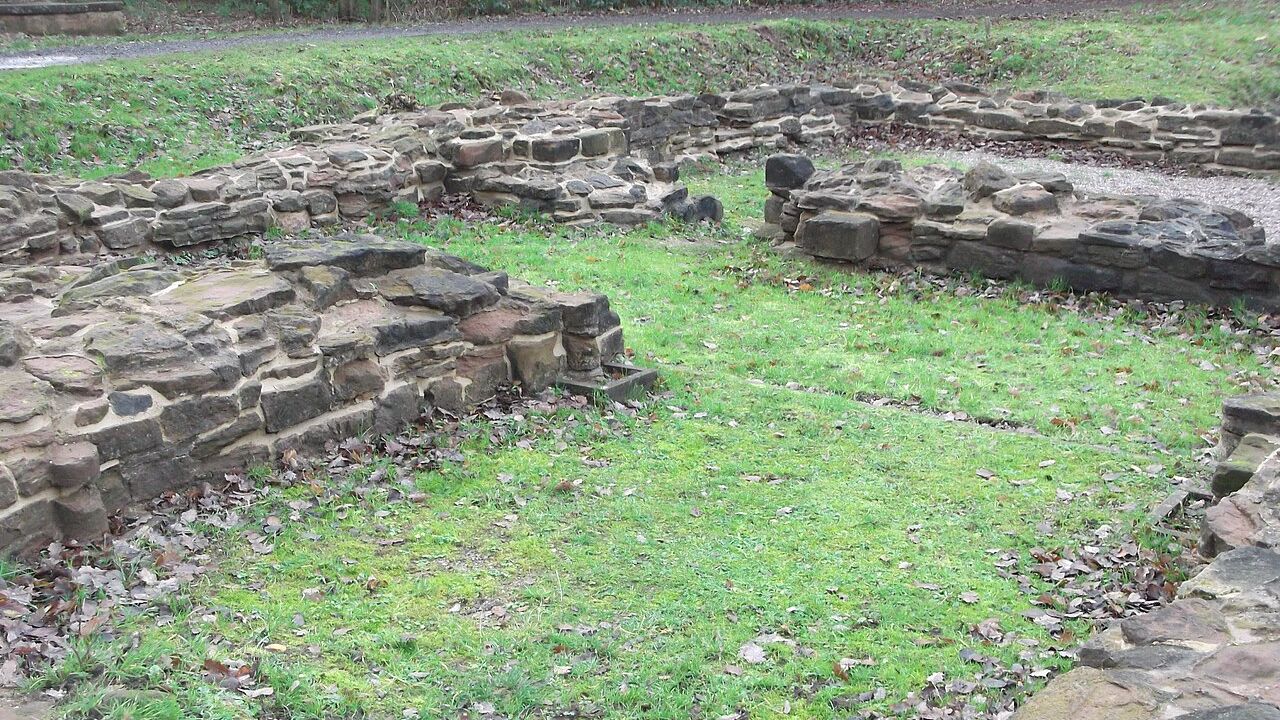
Image credit: Sjwells53, Sandwell – south chapels 02, CC BY-SA 3.0
Sandwell Priory is one of the most historically significant sites in the borough of Sandwell and the place from which the area takes its name. Situated within Sandwell Valley, between West Bromwich and Great Barr, the priory occupies a quiet, green setting that contrasts sharply with the surrounding urban landscape. Although only limited remains survive today, the site represents an important chapter in the medieval history of the West Midlands.
The priory was founded in the 12th century, around 1160, as a Benedictine monastery. It was established as a dependent house, or “cell”, of Worcester Cathedral Priory, meaning it was not fully independent but managed on behalf of the parent monastery. The religious community at Sandwell was relatively small, typically housing only a handful of monks, but it played a central role in managing land, agriculture and spiritual life in the surrounding area.
During the medieval period, Sandwell Priory controlled a substantial estate within the valley. The monks were responsible for farming, woodland management and water resources, helping to shape the landscape that is still recognisable today. The priory church would have stood at the heart of the complex, alongside domestic buildings, cloisters and service areas, forming a self-contained religious settlement.
Sandwell Priory remained active for nearly four centuries, but its fortunes came to an abrupt end in the 16th century during the Dissolution of the Monasteries under Henry VIII. In 1535, the priory was dissolved, its lands seized by the Crown and later granted or sold to private owners. The monastic buildings were largely dismantled, with stone reused elsewhere, leading to the gradual disappearance of the complex.
Over time, the priory site faded from view, becoming part of the agricultural landscape and later absorbed into the expanding industrial and residential areas of the Black Country. Archaeological investigations in the 19th and 20th centuries confirmed the location of the priory and uncovered foundations and structural remains, allowing historians to better understand its layout and significance.
Today, Sandwell Priory survives as scheduled ancient monument remains within Sandwell Valley Country Park. Although only fragments of walls and earthworks are visible, interpretation boards help visitors understand the importance of the site and its role in shaping the area. The priory’s legacy is preserved not only through archaeology, but also in the very name Sandwell, which derives from “Sandy Well” and became associated with the monastic settlement.
Sandwell Priory is significant as the spiritual and historical origin of the borough, linking modern Sandwell to its medieval past. While modest in scale compared to larger monasteries, its influence on land use, place-names and local identity has been enduring. Today, the quiet ruins within Sandwell Valley offer a rare glimpse into monastic life and provide a powerful reminder of the area’s deep historical roots.







Leave a Reply