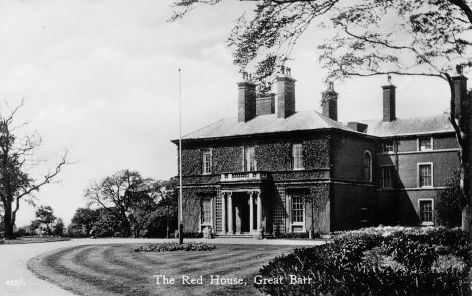
The Red House is a historic building located in Great Barr, an area that lies within the City of Birmingham, not Sandwell. Although it is close to the Sandwell boundary and often mistakenly associated with the borough, Great Barr is administratively part of Birmingham, with a small section extending into Walsall. The Red House and its surrounding parkland therefore belong firmly within Birmingham’s historic landscape.
The building dates from the late 17th or early 18th century and takes its name from the distinctive red brick used in its construction. It was built as a country residence at a time when Great Barr was a rural area on the edge of open countryside, well away from the industrial centres that would later dominate the Black Country and Birmingham.
During the 18th and 19th centuries, the Red House passed through several private owners and remained a substantial private dwelling set within landscaped grounds. As Birmingham expanded rapidly during the industrial era, the surrounding farmland was gradually developed, transforming the area from rural estate to suburban neighbourhood. Despite this change, the Red House survived as a visible reminder of Great Barr’s pre-industrial past.
In the 20th century, the building and its grounds were acquired for public use, and the surrounding land became Red House Park, a valued green space serving the local community. The house itself has been used for various civic and community purposes over time, reflecting a wider trend of historic buildings being adapted for modern needs rather than demolished.
Architecturally, the Red House is notable for its simple but dignified brick façade, traditional proportions, and surviving period details. While not as grand as some country houses, it represents the type of comfortable rural residence once common on the outskirts of major towns before urban expansion overtook them.
Today, the Red House stands as an important local landmark in Great Barr, valued for both its historic character and its role within a public park. Its survival highlights the layered history of the Birmingham suburbs and serves as a clear example of a site that is often mistakenly linked to Sandwell, but is in fact part of Birmingham’s heritage.







Leave a Reply