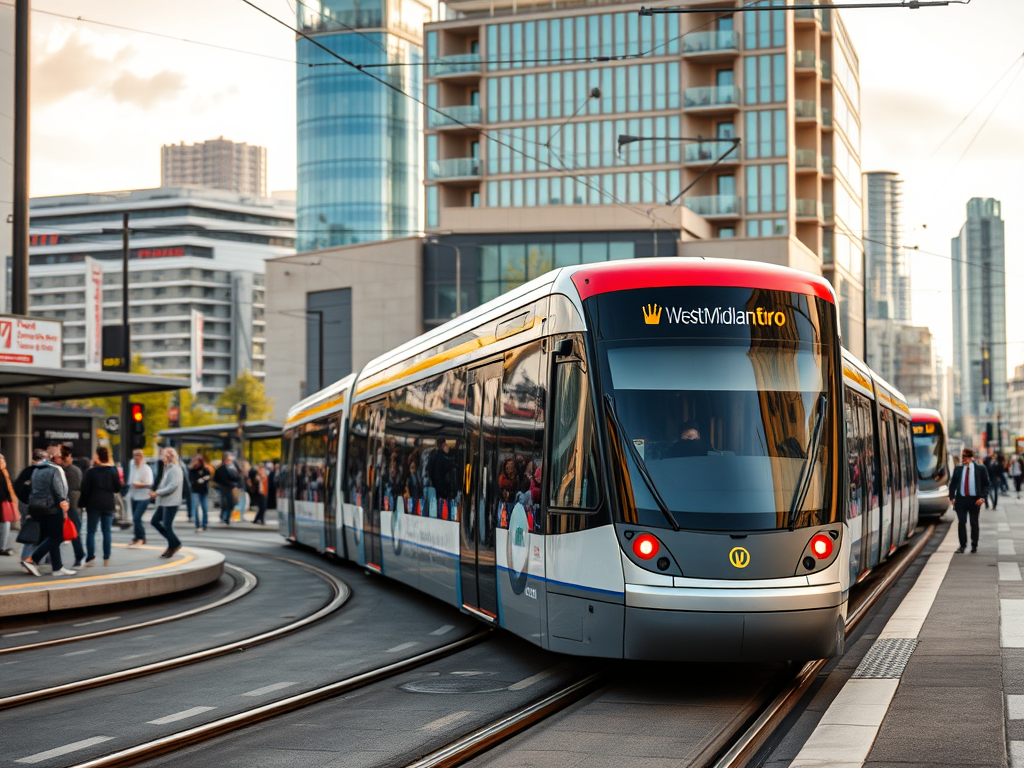
The West Midlands Metro is a modern light rail tram system that serves Birmingham, Wolverhampton and much of the wider Black Country, providing a fast and sustainable alternative to road travel. Although trams were once common across the region in the late nineteenth and early twentieth centuries, they disappeared in the 1950s as buses and cars took over. By the 1980s, however, congestion and urban decline led transport planners to look again at trams as a way of regenerating town centres and improving connectivity across the West Midlands.
The idea of a new tram network emerged from regional transport planning during the 1980s under what was then the West Midlands Passenger Transport Executive. A formal proposal for a modern light rail system was produced in 1988, with a vision to reuse old railway corridors and link major urban centres. After years of funding negotiations and design work, a private consortium was awarded the contract to build and operate the first line in 1995, using much of the former Great Western Railway route between Birmingham and Wolverhampton.
The system opened to passengers on 30 May 1999 under the name Midland Metro. Its original route ran from Birmingham Snow Hill to Wolverhampton city centre, passing through key Black Country towns such as West Bromwich, Wednesbury and Bilston. This restored a high-capacity fixed-route public transport link to an area that had lost its traditional rail services decades earlier and quickly proved popular with commuters and shoppers alike.
For its first decade the Metro remained largely unchanged, but a major shift began in the 2010s when plans were made to bring trams directly into Birmingham’s main commercial core. The line was extended from Snow Hill through the city streets to reach New Street Station and later the city’s main shopping and business districts. These street-running extensions transformed the Metro from a suburban line into a true urban tramway, placing stops right where people actually wanted to go.
At the same time, the original fleet of trams was replaced with a new generation of larger, more reliable vehicles, improving capacity and passenger comfort. Further extensions followed, including a major southern expansion to Edgbaston Village, which opened in 2022, linking the Metro to one of Birmingham’s most prestigious and rapidly growing districts. At the northern end, a new route into Wolverhampton railway station opened in 2023, giving the Metro a direct interchange with national rail services.
The Metro is now in the process of becoming a much larger network rather than a single line. One of the most important new projects is the extension from Wednesbury to Brierley Hill via Dudley, which is bringing trams back to parts of the Black Country that have not had a rail connection for decades. In Birmingham, new lines are being built towards Digbeth and the future HS2 station at Curzon Street, creating new links between the city centre, major redevelopment zones and national high-speed rail.
From its beginnings as a single route on an old railway line, the West Midlands Metro has grown into one of the most ambitious urban transport projects in the UK. It now plays a central role in reshaping how people move around Birmingham and the Black Country, supporting regeneration, reducing car dependency and reconnecting towns that were once at the heart of Britain’s industrial economy.




Leave a Reply