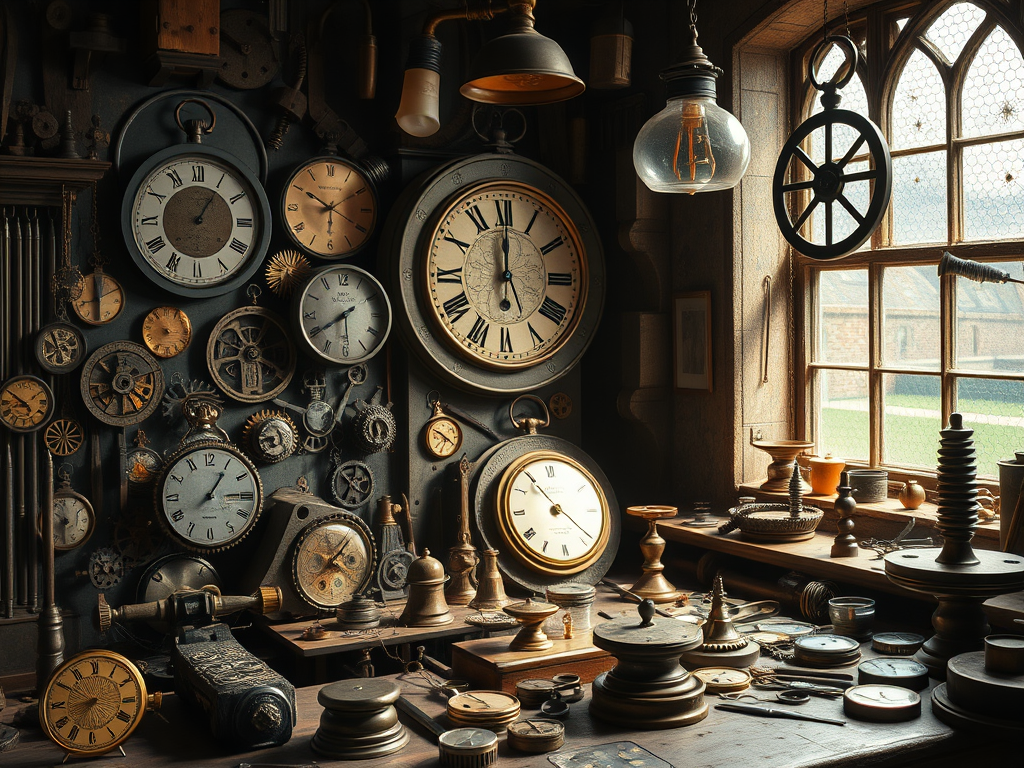
Coventry’s reputation as a city of makers is usually told through cars, bicycles and ribbons, but for nearly two centuries it was also one of Britain’s most important centres for watch and clock making. Long before mass-production transformed timekeeping, Coventry developed a dense network of skilled craftsmen and small workshops producing high-quality components and finished watches. By the nineteenth century the trade had become one of the city’s defining industries, exporting timepieces across Britain and overseas and helping to build Coventry’s wider culture of precision engineering.
The roots of Coventry watchmaking reach back into the eighteenth century, when individual master watchmakers and small family firms worked within the city’s courts and narrow streets. Instead of one giant factory, the Coventry trade traditionally operated as a highly specialised “ecosystem”: different workshops handled different stages—movement making, escapements, cases, dials, gilding and finishing—before completed watches were assembled and sold. This system produced remarkable skill and flexibility, but it also made the industry vulnerable when competitors began producing complete watches in large factories.
Among the most influential Coventry names was Rotherham & Sons, whose origins can be traced to the mid-1700s through the Vale business, before evolving into the Rotherham firm in the nineteenth century. Rotherhams became one of the best-known Coventry watch manufacturers and one of the few local businesses to push hard towards more modern production methods. Like many Midlands engineering firms, it also turned to war work in the twentieth century, reflecting how closely precision timekeeping skills overlapped with wider industrial manufacturing. Rotherhams remained an emblem of Coventry’s watchmaking identity long after the city’s older craft-based system began to fade.
Another major Coventry firm was H. Williamson, closely associated with the production of clocks and the push toward more organised factory-style output. Coventry also saw the development of companies created specifically to solve supply-chain problems in the British watch trade. A key example was the Coventry Watch Movement Manufacturing Company, established in the late nineteenth century to reduce reliance on movement supplies from elsewhere in England and to strengthen local production capacity. This was part of a broader attempt by Coventry makers to modernise and compete in an industry that was rapidly changing.
On the clock side, Coventry was linked to well-known branded lines such as Astral and Empire, names associated with the company English Clock and Watch Manufacturers Ltd in Coventry. In the early 1930s that business was acquired by Smiths, the large British maker of clocks, watches and instruments, which went on to use those trade names extensively. This matters because it shows how Coventry’s timekeeping heritage fed into bigger national firms as the industry consolidated and shifted away from small-city workshop networks.
Coventry’s watch and clock industry declined for familiar reasons. Swiss and American mass production made it harder for Britain’s fragmented workshop system to compete on price, while two world wars redirected skills and factory capacity into other engineering priorities. Later, the rise of cheap imports and the “quartz revolution” of the late twentieth century accelerated the collapse of many traditional mechanical watch businesses across the UK. By the time Coventry was globally recognised for its motor industry, large-scale watchmaking had already been badly weakened.
Even so, Coventry still has visible and meaningful remnants of this heritage. The most direct is the Coventry Watch Museum, a small specialist museum in a historic court off Spon Street, which preserves tools, movements, watches and the story of the people who made them. It’s one of the best places to understand how Coventry’s trade worked at street level—how a city could be full of tiny specialist workshops and yet produce world-class timepieces. Coventry’s broader museum collections also retain watches, tools and archives connected to the trade, reflecting how important timekeeping once was to the city’s economy and identity.
There is also a modern “echo” of the old industry. The Rotherham name, for example, continues in Coventry through a successor engineering business that celebrates the historic watchmaking connection by producing commemorative timepieces, while remaining rooted in precision manufacture. In that sense, the city’s watch and clock story has not vanished entirely—it has shifted from being a mass employer to a specialist heritage and precision-engineering legacy.
Taken together, Coventry’s watch and clock making history is a classic Coventry story: skilled hands, small workshops, technical innovation and global reach, followed by hard industrial change and reinvention. Cars may have become the headline later on, but long before that Coventry helped Britain keep time—and you can still see traces of that world today if you know where to look.






Leave a Reply