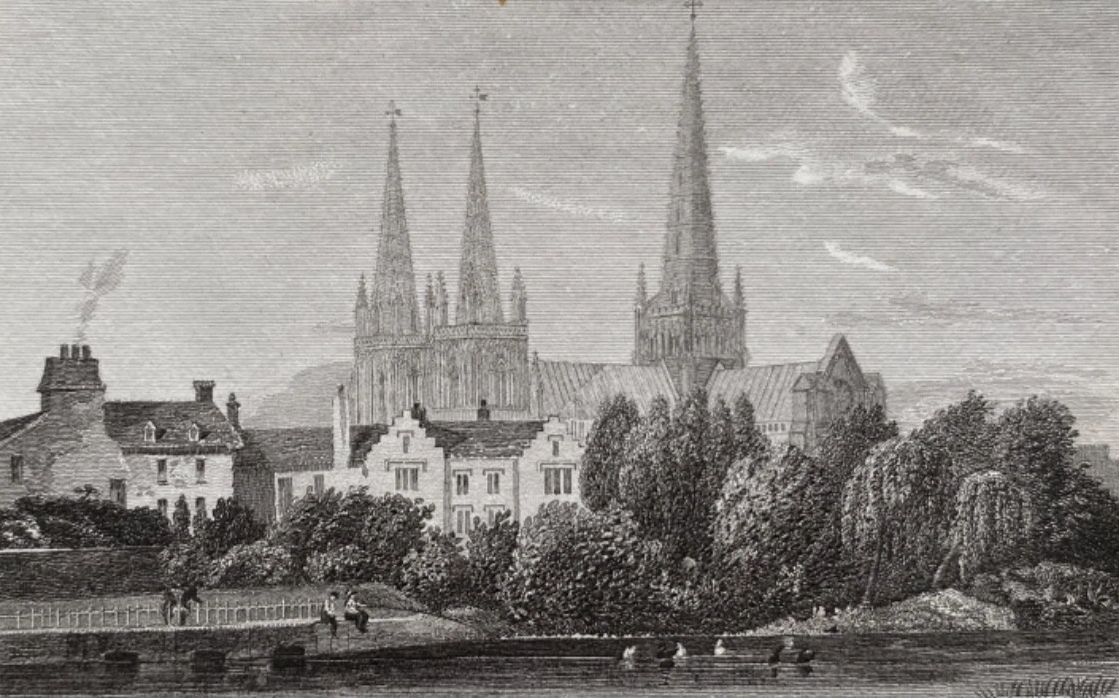
Lichfield is a historic cathedral city lying just to the north of Birmingham and the Black Country, on the edge of the West Midlands conurbation. Although it remains administratively part of Staffordshire, it has long been closely connected to Birmingham, Sutton Coldfield, Tamworth and the wider urban region through transport, employment and commuting. In many ways, Lichfield functions as the northern gateway to the greater Birmingham metropolitan area, combining the character of a traditional cathedral city with the realities of modern suburban life.
The city’s origins go back over 1,300 years. Lichfield became one of the most important centres of early Christianity in England when St Chad established his bishopric here in the seventh century. From that time onward, the city developed around the cathedral and its close, forming a religious and administrative hub that survived Viking raids, Norman conquest and the upheavals of the Middle Ages. Lichfield’s unique distinction of having a three-spired medieval cathedral makes it one of the most architecturally important cities in the Midlands and one of the finest Gothic buildings in England.
During the medieval period, Lichfield was a wealthy and influential ecclesiastical centre, supported by pilgrimage, trade and its position on important road routes linking the Midlands to the north of England. The cathedral close, with its moats, walls and grand houses, formed a self-contained religious community, while the surrounding town grew as a market centre serving rural Staffordshire. Despite periods of decline and damage, including during the English Civil War, the city retained its historic core and much of its medieval street pattern.
In the eighteenth and nineteenth centuries, Lichfield became known not only for its cathedral but also for its cultural life. The city was the birthplace of Samuel Johnson, one of England’s greatest writers and thinkers, and his legacy still shapes Lichfield’s reputation. While Birmingham grew into a vast industrial city, Lichfield developed more quietly as a genteel market town and cathedral city, but its proximity to the industrial Midlands ensured it remained economically connected to the region’s growth.
The twentieth century brought major change. As Birmingham, Walsall and Sutton Coldfield expanded, Lichfield increasingly became part of their commuter belt. New housing estates were built, roads were improved, and rail connections strengthened, allowing thousands of people to live in Lichfield while working in Birmingham and the Black Country. This transformed the city from a largely self-contained county town into a key part of the wider West Midlands urban system.
Despite this growth, Lichfield has preserved an unusually high quality historic environment. The cathedral close, Beacon Park, the city’s museums and its Georgian and Victorian streets give it a character that is very different from the industrial towns to the south. At the same time, modern developments, retail centres and transport links reflect its role as a functioning town in a large metropolitan region.
Today, Lichfield sits at the point where the historic heart of Staffordshire meets the modern West Midlands conurbation. It offers the advantages of a cathedral city, with green spaces, heritage and cultural life, while also serving as an important residential and commercial centre for people working across Birmingham, Sutton Coldfield, Tamworth and the Black Country. In this way, Lichfield remains both proudly distinct and deeply connected to the wider Birmingham region that now surrounds it.







Leave a Reply