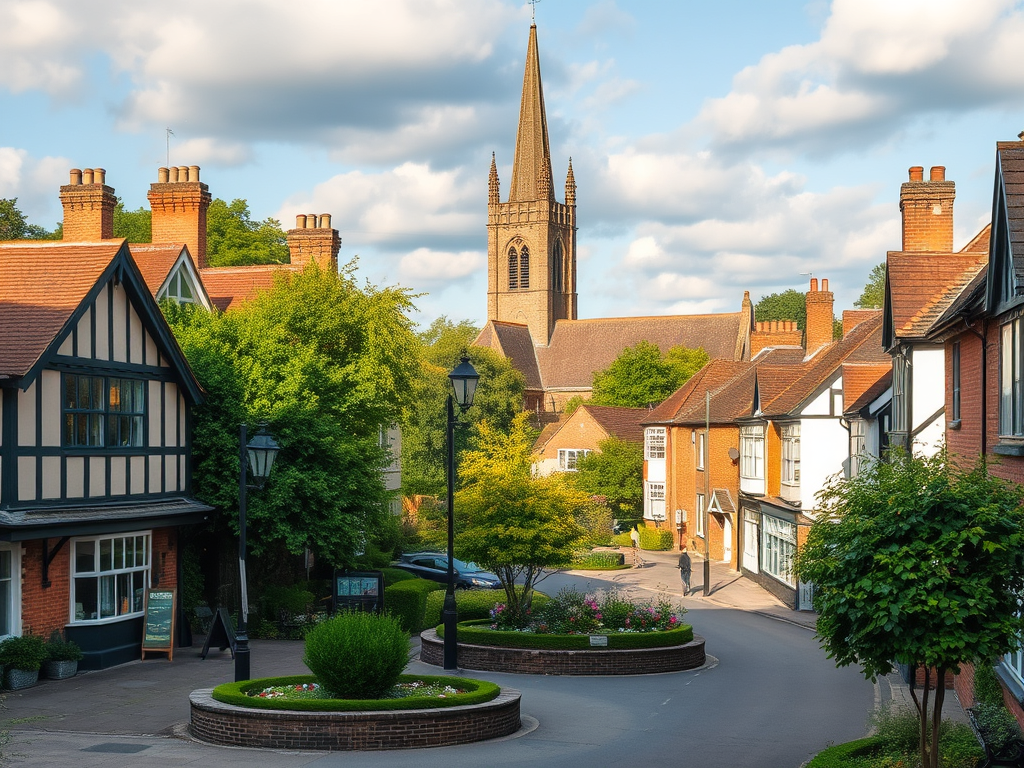
Knowle is one of the oldest and most distinctive settlements in the Solihull area, lying just to the south-east of Solihull town centre between Bentley Heath, Dorridge and the open Warwickshire countryside. Unlike many parts of the modern West Midlands, Knowle has never lost its identity as a village, and its historic centre still revolves around a traditional High Street, village green and medieval church.
The name Knowle comes from Old English and refers to a small hill or knoll, a reference to the slightly raised ground on which the village stands. Knowle was already established by the Middle Ages, and it grew in importance after the construction of St John the Baptist Church in the early fourteenth century. This large and impressive church, built in a style more typical of a town than a village, suggests that Knowle was already a prosperous and well-supported community at that time. The church remains the most important historic building in the area and dominates the village skyline to this day.
For centuries Knowle was a rural settlement serving the surrounding farms and estates. Its position on old coaching routes between Birmingham, Warwick and Stratford-upon-Avon gave it steady trade, and inns, blacksmiths and shops developed along what is now Knowle High Street. Unlike many villages that were swallowed by later development, Knowle retained its core, and its pattern of buildings, lanes and green spaces remains recognisably medieval in layout.
The arrival of the railway in nearby Dorridge in the nineteenth century changed Knowle’s fortunes. Like Shirley and Solihull, it became attractive to people who worked in Birmingham but wanted to live in greener surroundings. Large Victorian and Edwardian houses were built around the old village, creating a blend of historic core and leafy suburban expansion. Even so, Knowle never became just another housing estate. Its High Street continued to function as a village centre, with independent shops, cafés, pubs and services rather than large shopping malls.
One of Knowle’s defining features is the Knowle Green, a traditional village green that lies beside the High Street and the church. This open space reinforces Knowle’s rural character and provides a visual reminder of the village’s origins as a small agricultural community. The surrounding buildings, many of them listed, give the centre of Knowle a character that is very different from the modern developments of Solihull town centre.
Administratively, Knowle is part of the Metropolitan Borough of Solihull, but it has always retained a strong identity separate from both Solihull and Birmingham. It has long been regarded as one of the most desirable places to live in the area, combining good transport links with historic character, green space and a strong sense of community.
Today Knowle stands as one of the best examples of a historic Warwickshire village that has successfully adapted to life inside the West Midlands conurbation. Its medieval church, village green and traditional High Street give it a depth of heritage that sets it apart, while its proximity to Solihull, Shirley and Birmingham ensures it remains a thriving and highly sought-after place to live.







Leave a Reply