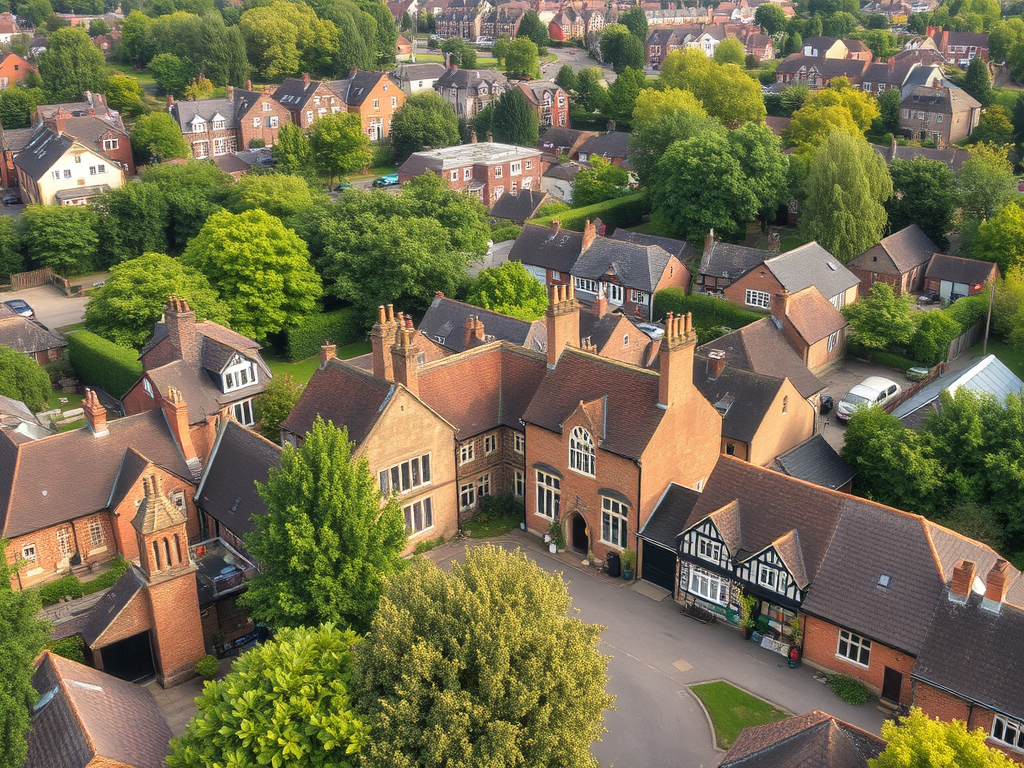
Walmley is a long-established district of Sutton Coldfield, lying to the east of the town centre between Wylde Green, Minworth and the edge of Sutton Park. Unlike some parts of Sutton Coldfield that developed mainly in the Victorian era, Walmley has much older roots as a rural village, with its name thought to derive from Old English, reflecting a woodland clearing or meadow belonging to an early settler. For centuries it existed as a small agricultural community of farms, cottages and open fields on the edge of Sutton Chase.
The old village core of Walmley grew up around Walmley Church of England Primary School and the nearby crossroads, where a small cluster of buildings, inns and shops served the surrounding countryside. Even as Sutton Coldfield began to expand in the nineteenth century, Walmley remained relatively rural, separated from the main town by parkland and farmland. This gave it a more village-like character than areas such as Four Oaks or Boldmere.
It was during the twentieth century, particularly in the interwar and post-war periods, that Walmley was transformed into a suburban district. Large housing estates were built across former fields, providing homes for families moving out of Birmingham and from older parts of Sutton Coldfield. Despite this expansion, parts of the original village layout can still be traced in the pattern of roads and in the survival of some older buildings.
Walmley’s location gives it strong links both to Sutton Coldfield and to the industrial and commercial areas around Minworth and the River Tame valley. It has long provided a quieter residential environment for people working in these nearby employment centres, while still being close to Sutton Park, whose eastern boundary lies not far from the heart of the district.
Today Walmley remains a largely residential area, with a mixture of older village streets and twentieth-century housing estates. Its blend of rural origins, suburban growth and proximity to green space makes it a distinctive part of Sutton Coldfield, reflecting a different side of the town’s history from the grander villas of Four Oaks or the busy centres of Mere Green and Boldmere.







Leave a Reply