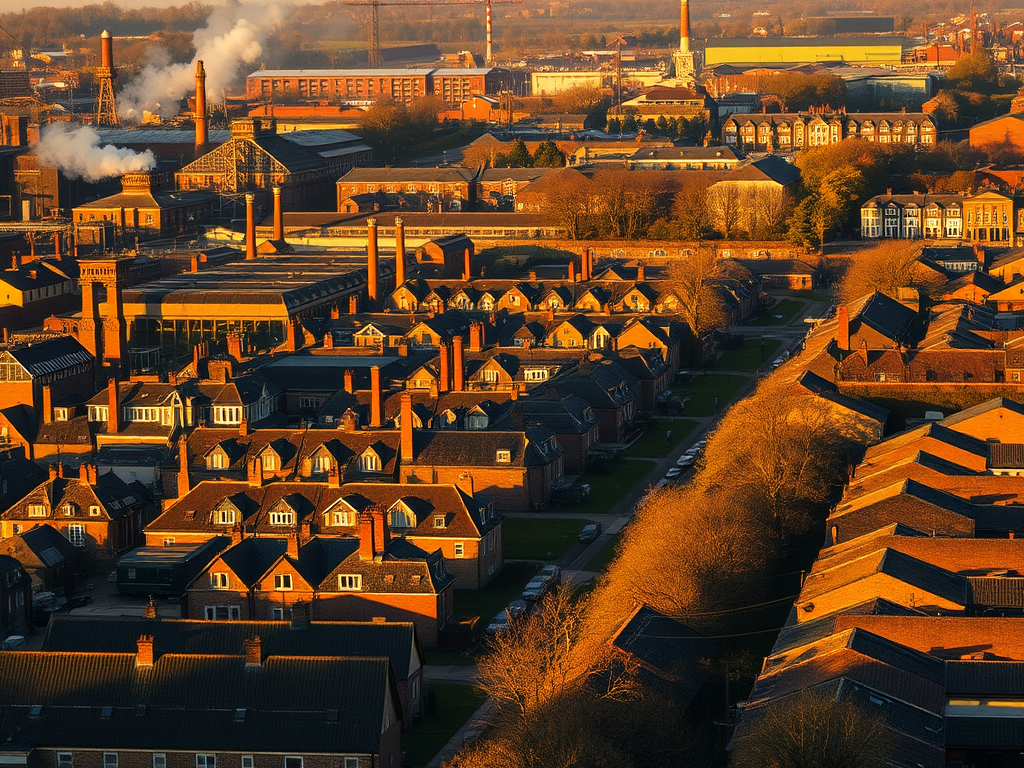
Victorian Birmingham was one of the fastest-growing and most dynamic cities in the world. Between the early nineteenth century and the end of Queen Victoria’s reign in 1901, Birmingham was transformed from a large market town into a vast industrial metropolis. Its population exploded, its boundaries spread outward into former farmland and villages, and its factories supplied goods not just to Britain but to the entire globe. The city became known as the “workshop of the world,” producing everything from buttons and jewellery to steam engines, guns and railway equipment.
For the working class, life in Victorian Birmingham was shaped by long hours, hard labour and crowded living conditions. Most people worked in factories, workshops, foundries or on the railways, often for ten to twelve hours a day, six days a week. Wages were low and employment could be insecure, with illness or injury quickly plunging a family into poverty. Many workers lived in dense rows of back-to-back houses in districts such as Digbeth, Aston, Small Heath and Hockley, where sanitation was poor and disease was common. Despite these hardships, Birmingham’s working people built strong communities around churches, pubs, markets and street life, and the city became a centre for trade unionism and political reform.
The middle classes experienced a very different Birmingham. Shopkeepers, clerks, teachers, managers and professionals benefited from the city’s booming economy and expanding commercial sector. As transport improved, many moved away from the smoky industrial core into new suburbs such as Edgbaston, Moseley and Handsworth, where larger houses, cleaner air and leafy streets offered a more comfortable lifestyle. Education, self-improvement and civic pride were important values, reflected in Birmingham’s libraries, schools, museums and concert halls, many of which were built during this period.
At the top of society were Birmingham’s industrialists, merchants and landowners, who lived in a world of wealth and privilege. Successful manufacturers built grand houses and country estates on the edge of the city, entertaining guests, sponsoring charities and influencing local politics. Men like Joseph Chamberlain and other civic leaders helped shape Birmingham into a model Victorian city, investing in public utilities, parks and institutions. Their wealth came directly from the factories and workshops below, but their lives were worlds apart from those of the workers who powered their fortunes.
As Birmingham grew, it physically expanded far beyond its original medieval core. Villages such as Aston, Handsworth, Erdington, Harborne and Perry Barr were gradually absorbed into the urban sprawl, their fields replaced by streets, factories and railway lines. Canals and later railways tied the city together, allowing raw materials to arrive and finished goods to be shipped across the country and overseas. New housing estates, public buildings and industrial zones reshaped the landscape at an astonishing speed.
By the end of the Victorian era, Birmingham had become a modern industrial city, marked by both extraordinary opportunity and deep inequality. It was a place where fortunes could be made, ideas exchanged and industries built, but also a city of poverty, pollution and struggle for many of its inhabitants. The legacy of Victorian Birmingham still shapes the city today, in its street patterns, its suburbs, and the proud tradition of industry and innovation that helped make it one of Britain’s most important urban centres.



Leave a Reply