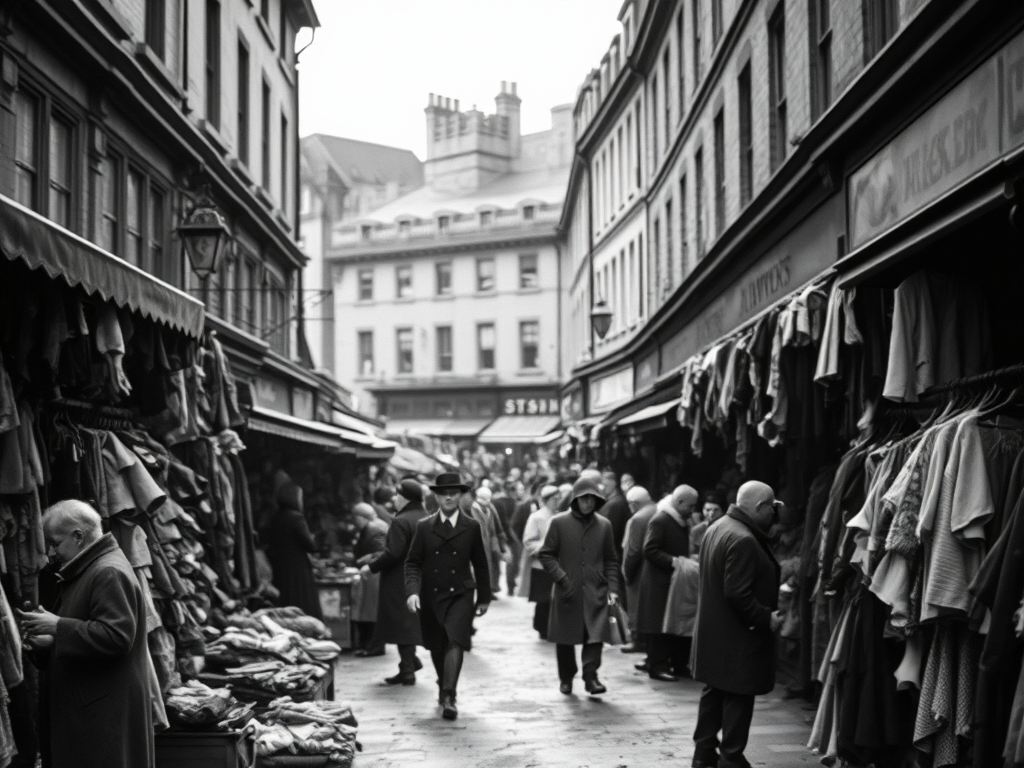
Jamaica Row was once one of the most distinctive and lively streets in Birmingham, forming part of the dense network of courts, alleys and trading yards that filled the area between Digbeth, the Bull Ring and the old markets. Its name probably dated from the eighteenth century, when imported goods from the Caribbean passed through Birmingham’s growing trading economy, but by the Victorian period Jamaica Row had become best known as the heart of the city’s rag trade.
The Birmingham Rag Market was not a single building but a whole district, and Jamaica Row sat at its centre. From the mid-nineteenth century onwards hundreds of small dealers, hawkers and merchants operated from tiny shops, sheds and yards selling second-hand clothes, cloth offcuts, scrap fabric, shoes, belts and every imaginable kind of reusable material. Nothing was wasted. Old coats were stripped for buttons, worn dresses were cut into cleaning rags, and usable fabric was resold to tailors, upholsterers and manufacturers. The area was noisy, crowded and chaotic, but it played a vital role in Birmingham’s industrial economy, supplying cheap raw materials to workshops across the city.
Jamaica Row and the surrounding streets were also home to a large working-class population. Families lived in cramped back-to-back houses above or behind the shops, often combining home life with trading from the same premises. The streets were known for their intense street life, with barrows, shouting traders and customers flowing in from Digbeth, Deritend and the Bull Ring. For many poorer Brummies, the rag market was where clothes were bought, sold and repaired, long before cheap mass-produced fashion existed.
By the mid-twentieth century, however, the area was in decline. Slum clearance programmes, changing shopping habits and the growth of modern clothing factories made the rag trade less important. City planners regarded Jamaica Row and the surrounding streets as insanitary, overcrowded and unsuitable for modern Birmingham. From the 1950s onwards large parts of the district were compulsorily purchased and demolished as part of a sweeping programme to remake the city centre.
By the 1960s and 1970s almost all of Jamaica Row had disappeared. The tight web of alleys and market yards was replaced by new road schemes, modern retail developments and the expanded Bull Ring. What had once been one of the busiest and most characterful trading quarters in Birmingham was erased, leaving little trace on the modern map.
Today Jamaica Row survives only in old maps, photographs and the memories of those who knew the old markets. The story of the rag market is a reminder that Birmingham’s wealth was built not only on big factories and famous brands, but also on small traders, street markets and the endless recycling of everyday goods in places like Jamaica Row, where almost nothing was ever thrown away and everything had a value.



Leave a Reply