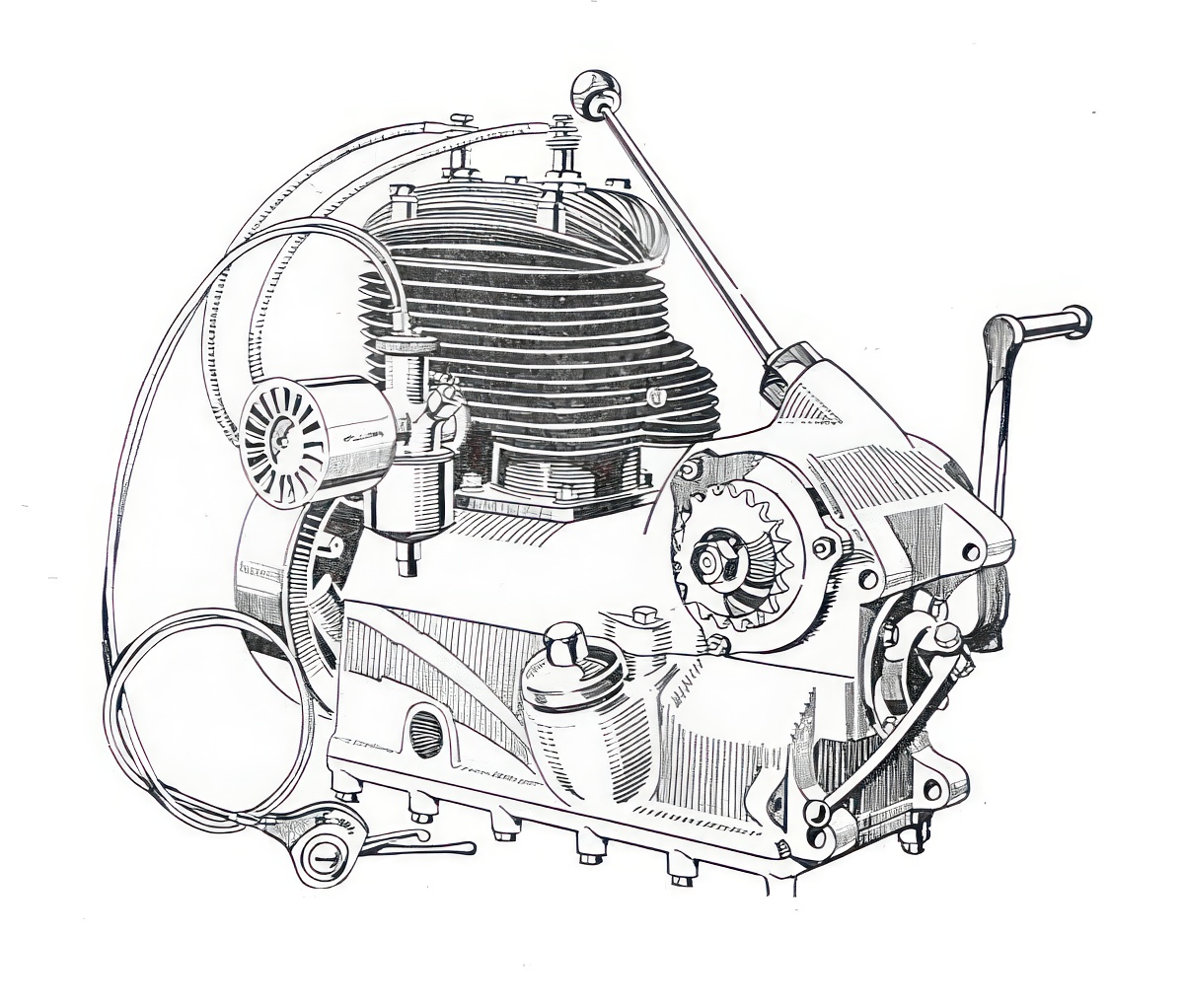
The Villiers Engineering Company was one of Birmingham’s most important and influential engineering firms, playing a central role in the development of small engines and motorised transport in Britain during the twentieth century. Closely associated with the city’s industrial character, Villiers became a household name through its engines, which powered everything from motorcycles and scooters to lawnmowers, generators and light industrial machinery.
Villiers was founded in 1898 by John Marston, an established Birmingham industrialist best known for the Sunbeam Cycle and Motor Car Company. The company was named after Villiers Street in Wolverhampton, near Marston’s existing operations, and was initially created to manufacture small engines to supply the rapidly expanding cycle and motorcycle industry. Birmingham, with its dense network of skilled engineers, metalworkers and component suppliers, provided the ideal environment for this type of precision manufacturing.

The company’s main production base was at Villiers Street factory in Wolverhampton, but Villiers was firmly part of the wider Birmingham and Black Country engineering economy. Its engines were supplied to countless manufacturers across Birmingham and the Midlands, including motorcycle makers such as AJS, Francis-Barnett, James and many others. In many cases, Villiers engines allowed small manufacturers to enter the market without the cost of developing their own power units, helping to sustain Birmingham’s reputation as the workshop of the world.
Villiers specialised in lightweight, reliable two-stroke engines, which became the company’s hallmark. These engines were widely used in motorcycles, mopeds and scooters, particularly in the inter-war and post-war periods when affordable transport was in high demand. Beyond motorcycles, Villiers engines powered industrial pumps, agricultural machinery, lawnmowers, outboard motors and portable generators, making the company a major supplier to both consumer and industrial markets.

During the Second World War, Villiers played an important role in Britain’s war effort. Its factories were involved in producing engines and components for military use, contributing to the wider mobilisation of Birmingham and the Midlands as a centre of wartime manufacturing. Like many engineering firms in the region, Villiers adapted its peacetime expertise to meet the demands of conflict, reinforcing its strategic importance.
After the war, Villiers reached the height of its influence. The demand for inexpensive motorised transport helped drive sales, and Villiers engines became synonymous with dependable British engineering. However, by the 1960s and 1970s the company faced increasing competition from overseas manufacturers, particularly from Japan, whose engines were often more advanced and cheaper to produce. Changes in consumer expectations, combined with rising costs and industrial difficulties in Britain, placed growing pressure on the business.
In an attempt to survive, Villiers became part of a series of mergers and restructurings. In the late 1960s, Villiers merged with Associated Motor Cycles to form Villiers–AMC, and later became part of Norton Villiers Triumph. These moves were intended to consolidate Britain’s struggling motorcycle industry, but they ultimately failed to reverse its decline. By the late 1970s, engine production had ceased, factories closed, and the Villiers name disappeared from manufacturing.
Although the company itself no longer exists, the Villiers name has not entirely vanished. It lives on through surviving engines, classic motorcycles and the work of enthusiasts and restorers who continue to preserve and celebrate Britain’s motorcycling heritage. Villiers engines are still recognised for their simplicity and robustness, and they remain a familiar sight at vintage rallies and exhibitions.
Villiers Engineering Company was deeply significant to Birmingham and the wider Midlands, not only as a manufacturer but as an enabler of hundreds of other firms. By supplying reliable engines to countless small and medium-sized manufacturers, Villiers helped sustain a complex industrial ecosystem that defined Birmingham for much of the twentieth century. Its rise and fall mirror the broader story of British manufacturing, from innovation and dominance to decline in the face of global competition, leaving behind a lasting legacy in the history of engineering.







Leave a Reply