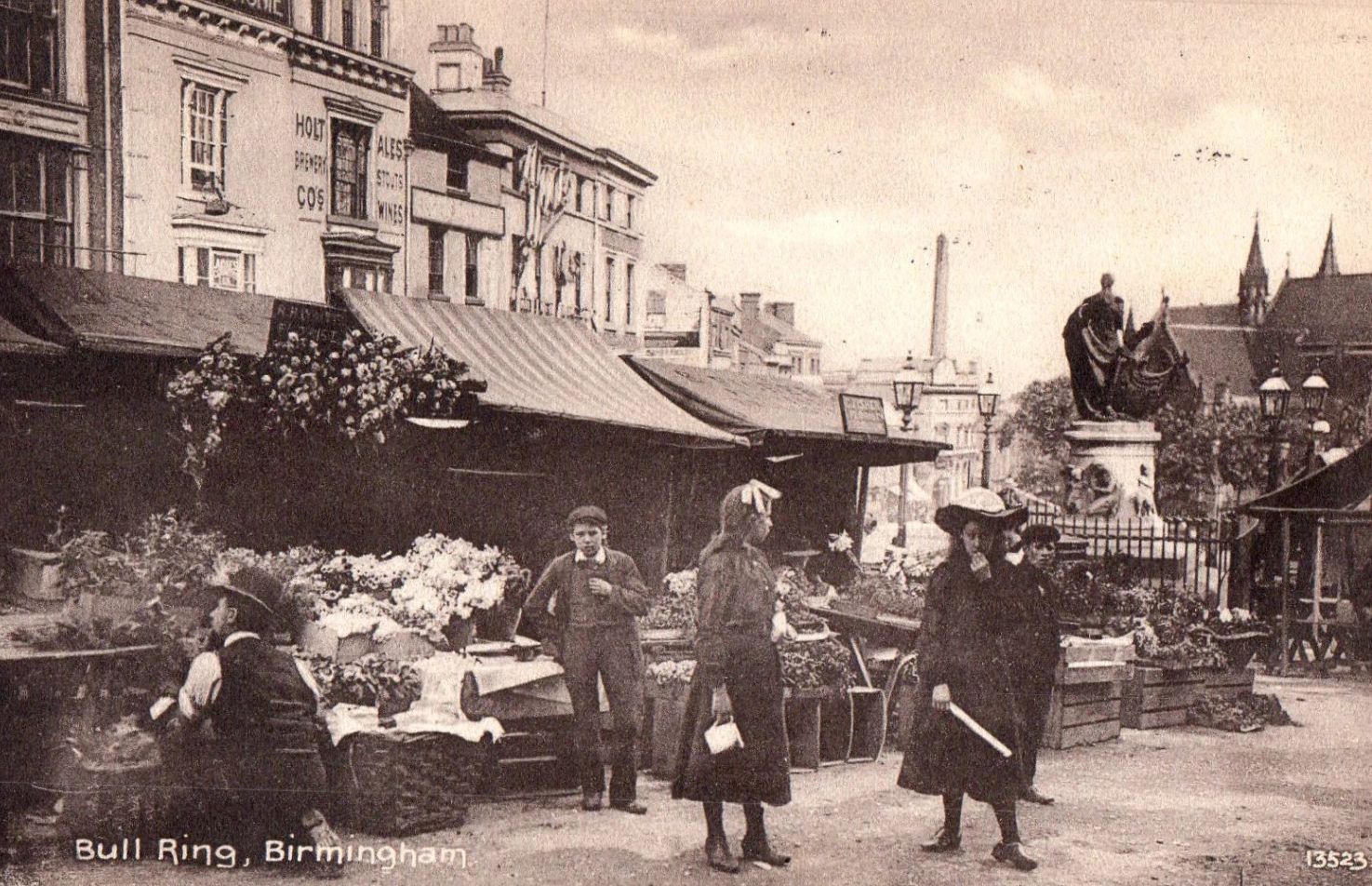
The Bull Ring is one of the most historically significant places in Birmingham, not simply as a modern shopping destination but as the original centre of the town’s commercial life. Long before Birmingham became an industrial city, the Bull Ring was the focal point around which trade, religion and daily life revolved, and its name reflects practices that date back to the medieval and early modern periods.

The origins of the name “Bull Ring” lie in the granting of market rights and later licences connected with animal trading and entertainment. After Birmingham was granted a market charter in 1166, the area around what is now the Bull Ring developed as the main open market space. By the sixteenth century, a licence had been granted for the baiting of bulls, a common but brutal public spectacle of the time, where bulls were tethered to an iron ring fixed into the ground and attacked by dogs. These events were associated with market days and large gatherings, and the iron ring used for the practice gave the area its enduring name. Although bull-baiting was eventually outlawed in the nineteenth century, the name “Bull Ring” remained firmly embedded in local usage.

For centuries, the Bull Ring functioned as Birmingham’s primary market place. It was here that traders from surrounding villages brought goods to sell, helping to establish Birmingham as a commercial centre well before industrialisation took hold. The market developed alongside St Martin’s Church, which stood as the parish church overlooking the trading area. Together, the church and market formed the spiritual and economic heart of the town, anchoring Birmingham’s early growth.

As Birmingham expanded rapidly during the Industrial Revolution, the Bull Ring became increasingly busy and congested. By the nineteenth and early twentieth centuries it was a dense area of stalls, streets, small shops and traffic, reflecting the city’s explosive growth. Despite changes to buildings and road layouts, the Bull Ring remained synonymous with trade and retail, even as conditions became increasingly chaotic by modern standards.

Major change came after the Second World War, when large parts of Birmingham city centre were redeveloped. The traditional open markets and surrounding streets of the Bull Ring were swept away in the post-war rebuilding programme, and in the 1960s the first enclosed Bull Ring Shopping Centre was constructed. Although controversial at the time, this redevelopment deliberately retained the historic name, acknowledging the site’s long association with commerce.
The modern Bull Ring shopping centre, redeveloped again and reopened in 2003, still occupies the historic location of the old market area. Its position next to St Martin’s Church is not accidental; it reflects continuity rather than coincidence. While the form of trade has changed from open stalls and livestock markets to global retail brands, the site itself remains Birmingham’s traditional trading heart. The retention of the name “Bull Ring” for the shopping centre was a conscious decision to preserve that historical connection, even as the architecture and purpose of the space evolved.
Today, the Bull Ring stands as a blend of old and new, where a modern shopping complex sits on ground that has been central to Birmingham’s life for nearly a thousand years. Its name is a reminder of the city’s origins as a market town, the sometimes harsh realities of past customs, and the enduring importance of the site as a place of exchange, gathering and activity.





Leave a Reply