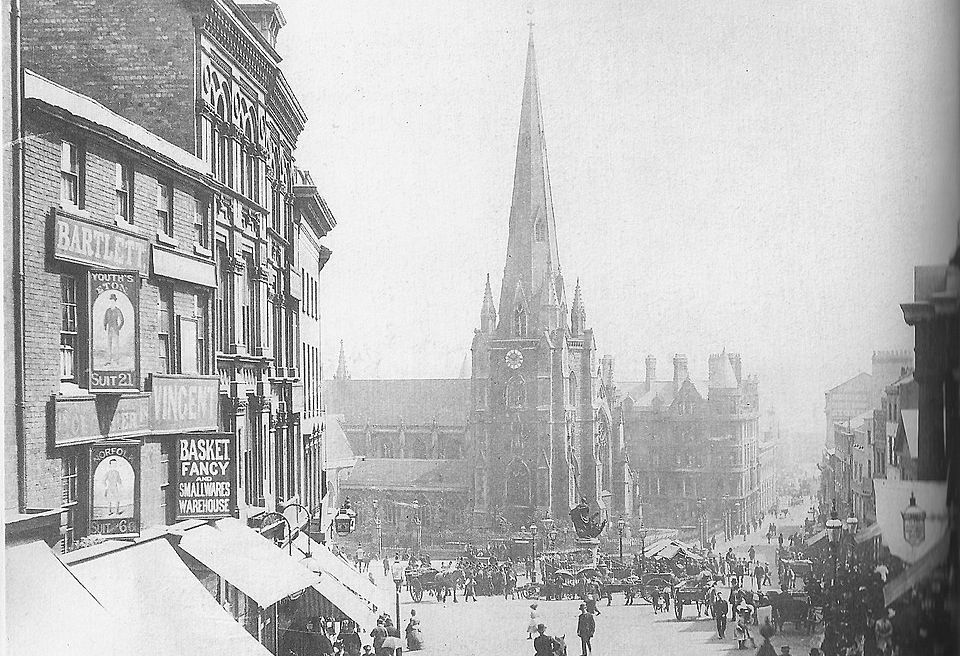
St Martin’s Church in the Bull Ring is one of the most historically important buildings in Birmingham, standing at the very birthplace of the town and reflecting almost a thousand years of continuous worship, community life and urban change. Its position beside Birmingham’s historic market places it at the symbolic and physical heart of the city, where commerce, religion and daily life have intersected since the Middle Ages.
A church has stood on this site since at least the twelfth century, when the first Norman church was built close to the River Rea. This early church served the small but growing market settlement that developed following the grant of a market charter in 1166. As Birmingham expanded, St Martin’s became the parish church for the town, closely tied to its development as a centre of trade. Generations of residents would have known the church as a familiar landmark overlooking the Bull Ring, marking key moments in life such as baptisms, marriages and burials.
The medieval church was extensively rebuilt in the nineteenth century as Birmingham’s population and wealth grew rapidly during the Industrial Revolution. Between 1873 and 1875, St Martin’s was largely reconstructed in a Victorian Gothic style under the direction of architect J A Chatwin. While incorporating surviving medieval elements, the rebuilding gave the church much of its present appearance, including its striking exterior and richly detailed interior. This transformation reflected Birmingham’s confidence as a major industrial town and its desire to preserve historic continuity while embracing modernity.
St Martin’s suffered significant damage during the Second World War, particularly in the Birmingham Blitz, when bombing raids devastated large parts of the city centre. The surrounding Bull Ring area was heavily affected, and the church itself required extensive repair. Post-war restoration ensured the survival of the building at a time when many historic structures were lost, reinforcing its status as a symbol of resilience and continuity amid widespread destruction.

Further major changes came in the late twentieth and early twenty-first centuries with the redevelopment of the Bull Ring. As the area was transformed into a modern shopping and commercial centre, St Martin’s retained its place as a historic anchor within a changing urban landscape. Careful restoration and conservation work helped ensure that the church remained both structurally sound and visually prominent, standing in deliberate contrast to the surrounding modern architecture.
Today, St Martin’s Church continues to function as an active parish church while also serving a wider civic role. It is known for its involvement in social outreach, including support for homeless and vulnerable people, reflecting a long tradition of community service. The church is also used for concerts, exhibitions and public events, welcoming visitors, worshippers and tourists alike.
St Martin’s Church remains a powerful symbol of Birmingham’s origins and identity. From its medieval beginnings beside a market town to its survival through industrial growth, wartime destruction and modern redevelopment, it stands as a reminder that the city’s story began not with factories or canals, but with a church, a market and a community at the Bull Ring.







Leave a Reply