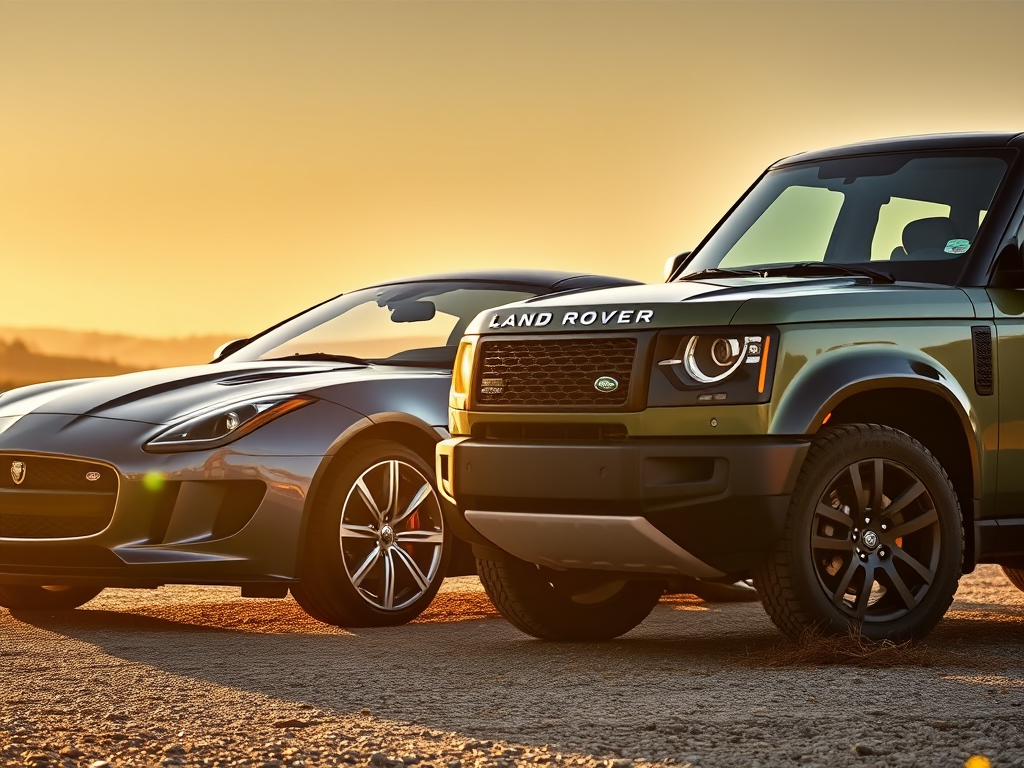
Jaguar Land Rover is one of the most significant automotive companies in modern British industrial history, representing both the survival and reinvention of the UK car industry in the late twentieth and early twenty-first centuries. Although the company in its current form is relatively recent, its roots stretch back more than a century through the separate histories of Jaguar and Land Rover, both of which are deeply connected to the West Midlands.
Jaguar Land Rover was formally created in 2013, but its foundations were laid much earlier. Jaguar originated in the 1920s and developed into a producer of luxury and performance cars, while Land Rover emerged in 1948 as a maker of rugged utility vehicles designed for agriculture, industry and military use. For much of the post-war period, both brands were part of the wider British motor industry and eventually came under the umbrella of British Leyland, the state-backed conglomerate formed in the late 1960s to rescue struggling manufacturers.
British Leyland proved unwieldy and troubled, and by the 1980s and 1990s the industry was being broken up and sold off. Jaguar was privatised in the 1980s and later acquired by Ford, while Land Rover also passed through Ford ownership after being separated from Rover Group. Although Ford invested heavily in both brands, neither achieved the long-term stability Ford had hoped for within its global portfolio.
A decisive turning point came in 2008, when Ford sold both Jaguar and Land Rover to Tata Motors of India. This marked the first time the two marques were brought together under single ownership in a focused, standalone automotive group. Tata’s approach differed significantly from previous owners: rather than subsuming the brands into a wider multinational structure, it allowed Jaguar and Land Rover to retain their British identity, design culture and engineering autonomy while providing long-term financial backing.
Under Tata ownership, Jaguar Land Rover underwent a dramatic transformation. Major investment flowed into research, development and manufacturing, much of it centred in the West Midlands. New and expanded facilities were developed, including advanced engineering centres and production plants, reinforcing the region’s role as the heart of Britain’s automotive expertise. This period saw the launch of highly successful models, particularly in the Land Rover range, which capitalised on growing global demand for premium SUVs.
Land Rover became the commercial backbone of the business, evolving from its utilitarian roots into a luxury off-road brand with strong appeal in international markets. Jaguar, meanwhile, focused on modernising its image, developing new aluminium platforms, performance saloons and sports cars, and later moving towards electrification. Together, the two brands repositioned Britain as a serious player in the global premium automotive sector.
Jaguar Land Rover also became one of the UK’s largest industrial employers, supporting tens of thousands of direct jobs and many more across the supply chain. Its continued presence helped preserve advanced manufacturing skills in the Midlands at a time when much of Britain’s traditional car industry had disappeared. The company became a symbol of how foreign ownership could coexist with national industrial identity when supported by sustained investment rather than short-term extraction.
In recent years, Jaguar Land Rover has faced new challenges. Global economic uncertainty, the impact of Brexit, supply chain disruption and the rapid transition to electric vehicles have all placed pressure on the business. In response, the company has embarked on a major strategic shift, committing to electrification and redefining Jaguar as a fully electric luxury brand, while Land Rover continues to develop electrified and hybrid versions of its core models.
Today, Jaguar Land Rover remains headquartered and largely engineered in Britain, with the West Midlands at the centre of its operations, even though it is owned by an international parent company. Its story is one of continuity through change: the survival of two historic British marques, their reinvention under new ownership, and their ongoing role in sustaining Britain’s automotive industry in a globalised world.
Jaguar Land Rover’s history demonstrates that while ownership structures may change, industrial heritage, skills and identity can endure. For Birmingham and the wider West Midlands, the company stands as the modern successor to a long tradition of vehicle manufacturing, linking the region’s industrial past with its technological future.




Leave a Reply