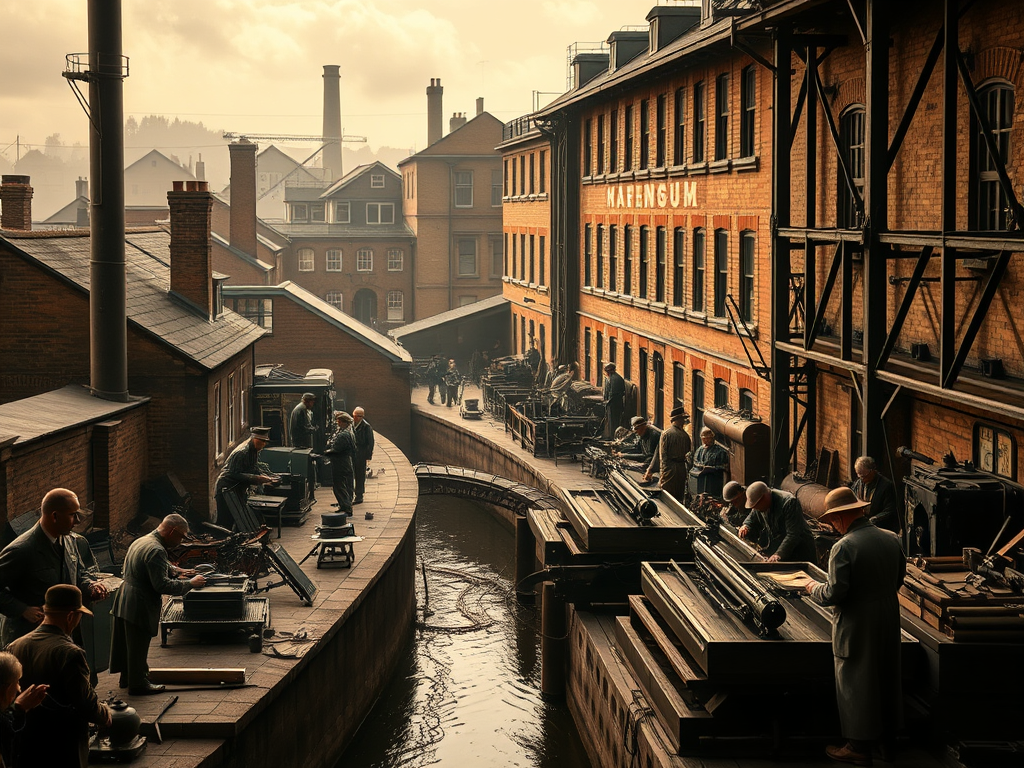
Small Heath is an inner district of Birmingham whose development reflects the city’s growth as an industrial centre. Originally semi rural land, it expanded rapidly during the nineteenth century as factories, canals and railways spread eastwards from the city centre. Rows of terraced housing were built for industrial workers, forming a close knit community shaped by engineering and manufacturing.
The area is most strongly associated with Birmingham Small Arms, whose factory complex made Small Heath internationally significant. BSA employed thousands and placed the district at the heart of Britain’s arms industry. During the First World War, rifles, machine guns and components produced in Small Heath equipped British forces, while many local men served at the front and women took on vital factory roles at home.
In the Second World War, Small Heath again played a key role as BSA supplied weapons, motorcycles and military equipment. Birmingham’s industrial importance made it a target during the Blitz, and daily life in Small Heath was shaped by air raids, blackouts and long hours of wartime production. Despite these pressures, manufacturing continued, underlining the resilience of the area and its workforce.
After the war, traditional industry declined and major employers closed, including BSA, marking the end of Small Heath’s era as a centre of heavy engineering. Post war migration brought new communities and cultures, reshaping the district’s character. Today, Small Heath is a densely populated and diverse part of Birmingham, where the physical traces of industry have largely faded but its wartime and industrial heritage remains an important part of local identity.





Leave a Reply