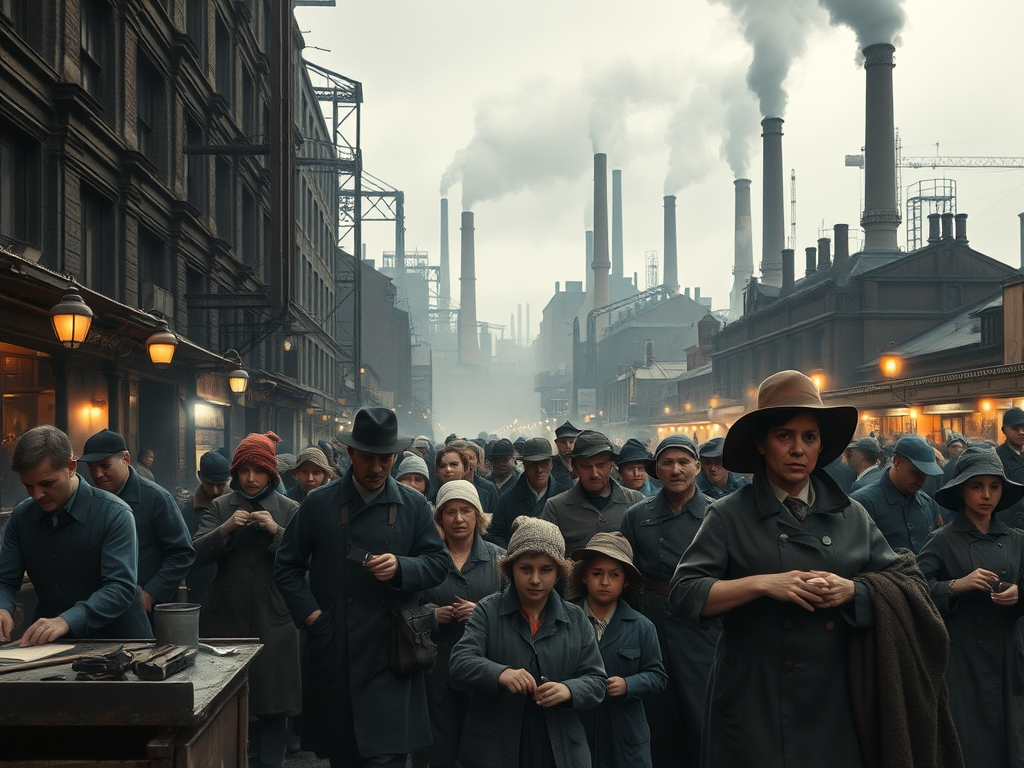
At the beginning of the twentieth century, Birmingham was one of the most important industrial cities in Britain. Known as the City of a Thousand Trades, it was a place of innovation, hard work, and sharp social contrasts. Between 1900 and 1910, Birmingham stood at a crossroads between Victorian traditions and the emerging modern Edwardian world.
Birmingham at the Turn of the Century
By 1900, Birmingham’s population had grown to well over half a million people. The city had expanded rapidly during the Industrial Revolution and was now a dense and energetic urban centre. Smoke from factories hung over many districts, while the sound of metalworking and machinery was a constant feature of everyday life.
Birmingham was internationally recognised for its manufacturing industries. Unlike many industrial towns dominated by a single trade, the city specialised in a wide range of products. These included tools, buttons, jewellery, firearms, bicycles, metal fittings, and countless small precision items. Much of this work was carried out in small workshops rather than vast factories, giving Birmingham its distinctive industrial character.
National Politics and Leadership
During this decade, Britain was governed by several Prime Ministers. At the start of the century, Arthur Balfour led the Conservative government. In 1905, the Liberals came to power under Sir Henry Campbell Bannerman, whose administration marked the beginning of significant social reform. After his death in 1908, Herbert Henry Asquith became Prime Minister and continued these reforms.
These political changes were important to industrial cities like Birmingham. Issues such as workers’ rights, poverty, housing, and old age security were increasingly debated at both local and national levels.
Work and Employment
For most Birmingham residents, life revolved around work. Long hours were common, often six days a week. Skilled craftsmen could earn respectable wages and took pride in their work, particularly in trades such as jewellery making, tool manufacture, and metal engraving. Unskilled workers faced lower pay, job insecurity, and physically demanding conditions.
Women and children were also part of the workforce. Women frequently worked in light manufacturing, domestic service, or home based piecework. Children were employed in factories and workshops, although compulsory education laws were gradually reducing child labour.
Trade unions and friendly societies played an important role in working life. They offered a degree of protection and support, including modest benefits during illness or unemployment, long before the creation of a state welfare system.
Housing and Living Conditions
Despite Birmingham’s economic success, housing conditions for many residents were poor. Large areas of the city were dominated by back to back houses built during the Victorian period. These homes were cramped, often damp, and lacked proper sanitation. Families commonly shared outdoor toilets and water supplies, and overcrowding was widespread.
Disease spread easily in such environments, and infant mortality rates were high in the poorest districts. Although the city council had begun efforts to clear slums and improve housing, progress was slow, and many families continued to live close to factories, canals, and polluted streets.
Transport and Everyday Life
The early years of the twentieth century brought visible changes to daily life. Electric trams were replacing horse drawn vehicles, making it easier for workers to travel across the city. Railways connected Birmingham to London and other major centres, reinforcing its role as a national transport hub.
Inside the home, life remained basic for most people. Coal fires were used for heating and cooking, electricity was rare in working class housing, and washing was done by hand, often in shared yards. Meals were simple and filling, based on affordable foods suited to large families.
Poverty, Welfare, and Survival
There was no comprehensive welfare system during this period. Support for the poorest was governed by the Poor Law, with the workhouse acting as the final refuge for those unable to support themselves. Conditions in the workhouse were deliberately harsh, and entry carried a strong social stigma.
Alongside official relief, charitable organisations and churches provided vital assistance. Soup kitchens and cheap food schemes helped families survive periods of unemployment or illness. Simple meals such as broth or tripe soup were common forms of nourishment for the poorest residents.
Religion and Community Life
Religion played an important role in Birmingham between 1900 and 1910, shaping community identity and social support. The Church of England was the largest denomination, with parish churches serving both affluent and working class districts.
Nonconformist churches were especially influential. Methodist chapels were numerous and closely linked to the working population, promoting education, temperance, and self improvement. Quakers, though smaller in number, had a lasting impact through their involvement in business, philanthropy, and social reform.
Other denominations, including Baptist, Congregationalist, Presbyterian, and Roman Catholic congregations, were well established. Catholic parishes in particular grew during this period, serving migrant communities and offering education and support.
Churches and chapels were central to welfare, running soup kitchens, relief funds, and visiting schemes. In a city with limited state support, religious institutions were often at the heart of community life.
Leisure, Culture, and Public Life
Despite the pressures of industrial life, Birmingham had a lively cultural scene. Public houses, music halls, and theatres provided entertainment and social interaction. Parks, libraries, and civic buildings reflected a strong sense of municipal pride and public responsibility.
Churches, chapels, clubs, and societies offered structured leisure and community involvement. For many residents, these institutions provided a welcome escape from the hardships of daily life.
A City on the Edge of Change
Between 1900 and 1910, Birmingham remained firmly rooted in its industrial past while beginning to move toward a more modern future. Improvements in transport, growing political awareness, and early social reforms pointed toward significant change.
Yet inequalities remained stark. Wealth and poverty existed side by side, and daily life varied greatly depending on occupation and income. Birmingham at the start of the twentieth century was a city of energy and ambition, but also one of struggle and resilience.
As the Edwardian era progressed, the city stood on the threshold of transformation, unaware that the coming First World War would soon reshape Birmingham and the lives of its people forever.






Leave a Reply