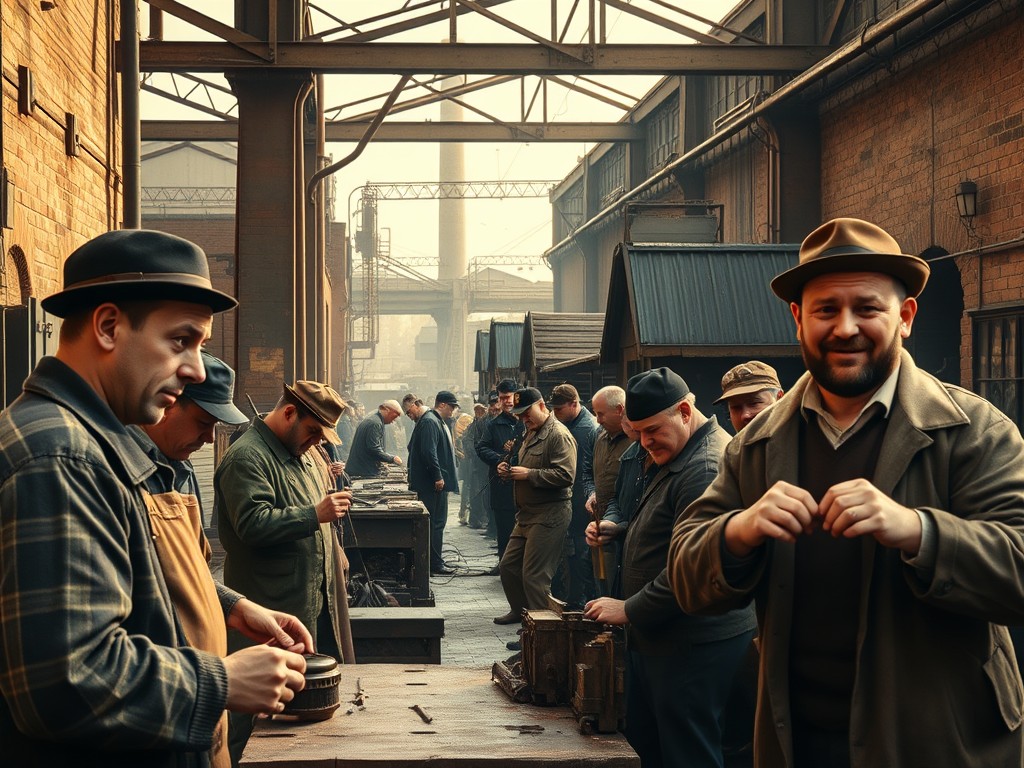
The White British community forms the historical foundation of Birmingham and has played a central role in shaping the city’s development, identity and character over many centuries. From its origins as a small market town to its rise as a global industrial centre, Birmingham’s growth has been driven largely by successive generations of local working people, traders, craftsmen and professionals.
Today, the White British population remains a significant part of Birmingham’s social fabric, living alongside many other communities and sharing in the city’s evolving multicultural identity.
Early history and settlement
Birmingham’s earliest population was overwhelmingly English, rooted in Anglo-Saxon and later medieval settlement. By the Middle Ages, the town had developed into a centre of trade and metalworking, attracting workers from surrounding rural areas.
Unlike many English cities, Birmingham did not develop around a cathedral or royal foundation. Instead, its growth was driven by enterprise, manufacture and private industry, creating a population defined by skill, adaptability and independence.
Industrial expansion and population growth
The Industrial Revolution transformed Birmingham dramatically. During the eighteenth and nineteenth centuries, the city expanded at an extraordinary rate, drawing tens of thousands of people from across England, Wales, Scotland and Ireland.
White British workers formed the backbone of Birmingham’s industries, including metalworking, engineering, jewellery, arms manufacture and later automotive production. Entire neighbourhoods were built to house factory workers, shaping districts such as Aston, Hockley, Small Heath, Smethwick, Ladywood and Handsworth.
Social structure and community life
Working-class life in industrial Birmingham was often hard, marked by long hours, poor housing and limited welfare. However, strong community bonds developed around streets, workplaces, churches, pubs, clubs and trade unions.
Nonconformist Christianity played a major role in shaping Birmingham’s moral and civic life, alongside Anglican and Catholic traditions. Education, self-improvement and civic responsibility were values strongly promoted within White British communities.
Twentieth-century change
The twentieth century brought significant social change. Two world wars, economic depression and post-war reconstruction reshaped Birmingham’s population and neighbourhoods.
From the mid-twentieth century onwards, Birmingham became a major destination for migrants from across the Commonwealth and Europe. As new communities arrived, the White British population gradually declined as a proportion of the total, though it remained numerically large.
Suburban expansion saw many White British families move to areas such as Kingstanding, Northfield, Bartley Green, Sheldon, Erdington and Sutton Coldfield, while inner-city districts became increasingly diverse.
Culture, identity and everyday life
White British culture in Birmingham has historically been expressed through local dialect, humour, music, sport and community traditions. Football clubs, social clubs, working men’s institutes and later youth cultures played an important role in shaping identity.
Birmingham has also been a centre for musical innovation across rock, metal, punk and electronic genres, many of which emerged from White British working-class backgrounds before becoming part of the city’s wider cultural mix.
Economic contribution and work
White British workers were central to Birmingham’s industrial success and later its service-sector economy. As manufacturing declined in the late twentieth century, many communities faced unemployment and economic change.
Over time, the White British population has adapted alongside other communities, with increasing participation in education, professional work, public services, small business ownership and the creative industries.
Civic life and shared future
The White British community has played a long-standing role in Birmingham’s local government, civic institutions and voluntary sector. As the city has become more diverse, many individuals and organisations have contributed to efforts aimed at social cohesion, regeneration and shared civic identity.
While traditional identities remain important to many, Birmingham’s White British community today exists within a broader multicultural context, shaped by interaction, change and shared experience.
Life today
Today, Birmingham’s White British community is diverse within itself, spanning multiple generations, social backgrounds and neighbourhoods. Its identity continues to evolve alongside the city as a whole.
The story of Birmingham cannot be told without recognising the foundational role of its White British population, just as the city’s present and future are defined by the shared contributions of all its communities.






Leave a Reply