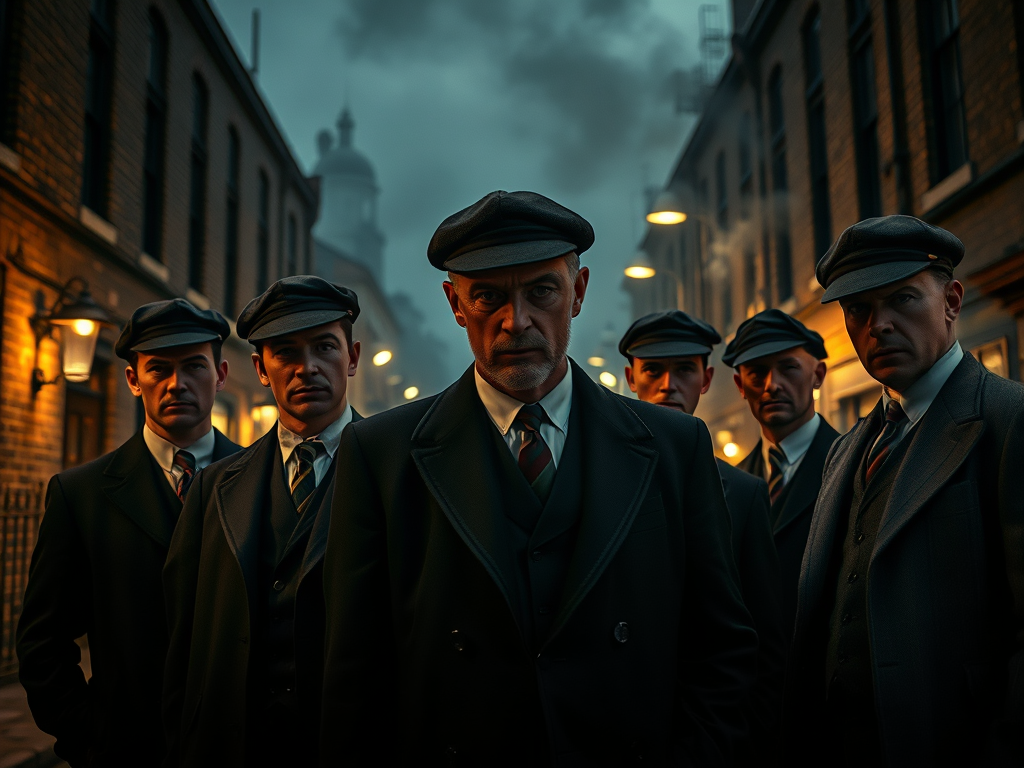
Peaky Blinders is one of the most successful and internationally recognised television dramas to emerge from Britain in recent decades. Set primarily in Birmingham in the aftermath of the First World War, the series combines historical crime, family drama and political themes, while drawing heavily on the city’s industrial past and underworld folklore.
Although stylised for television, Peaky Blinders is rooted in real historical conditions and local stories, and its connection to Birmingham and the wider West Midlands has been central to its identity.
Origins of the series
Peaky Blinders was created by Steven Knight, a Birmingham-born writer who grew up hearing stories about the city’s past from his family. The idea for the series came from tales told by his parents and grandparents about gangs operating in Birmingham during the late nineteenth and early twentieth centuries.
Knight set out to create a drama that reflected the industrial grit, ambition and social divisions of post-war Birmingham, while also exploring themes of trauma, power, class and identity.
The series first aired in 2013 and ran for six seasons, concluding in 2022, becoming a major cultural export for British television.
The real Peaky Blinders
The real Peaky Blinders were not a single organised crime family, as depicted in the series, but a loose grouping of youth gangs operating in Birmingham from the 1880s through to the early 1910s.
They were primarily based in working-class districts such as Small Heath, Bordesley Green, Cheapside and Digbeth. Members were typically young men from poor backgrounds, often involved in petty crime, street violence, gambling and intimidation.
The name “Peaky Blinders” is believed to derive from the peaked caps worn by gang members, combined with the term “blinder”, a local slang word meaning someone who dressed impressively. Despite popular myth, there is little historical evidence that razor blades were sewn into caps, as these were expensive and rare at the time.
The Peaky Blinders eventually lost influence as more organised gangs, such as the Birmingham Boys, emerged in the years leading up to the First World War.
How the television series differs from history
The television Peaky Blinders are set after the First World War, whereas the real gangs had largely faded by that point. The show relocates the gang’s peak influence to the 1920s in order to explore the impact of war, political unrest and industrial decline.
The fictional Shelby family and characters such as Tommy Shelby are inventions, though they draw inspiration from real Birmingham gang leaders and criminal networks.
This creative shift allowed the series to incorporate wider historical events, including:
- Post-war trauma and returning soldiers
- Labour unrest and union movements
- The rise of fascism and socialism
- Irish nationalism and organised crime
- The changing role of women
Birmingham and West Midlands filming locations
Although set largely in Birmingham, much of Peaky Blinders was filmed across the West Midlands and northern England, using locations that retained an industrial or historical character.
Digbeth, Birmingham
Digbeth is one of the most recognisable Birmingham locations associated with the series. Its brick viaducts, canals and former industrial buildings provided an authentic backdrop for street scenes, markets and gang activity.
Digbeth’s long association with industry and working-class life made it ideal for recreating early twentieth-century Birmingham.
Black Country Living Museum, Dudley
One of the most important filming locations was the Black Country Living Museum. Its reconstructed streets, shops, factories and canals were extensively used to depict Small Heath, industrial yards and market scenes.
The museum’s historic buildings allowed filming with minimal modern interference, making it central to the show’s visual authenticity.
Birmingham canals
Canal scenes were filmed along surviving sections of Birmingham’s historic canal network, reflecting the city’s role as a transport and industrial hub. These scenes reinforced the atmosphere of trade, smuggling and working-class life.
Smethwick and the Black Country
Parts of Smethwick, Tipton and surrounding Black Country areas were used for exterior scenes, benefiting from surviving Victorian and Edwardian industrial architecture.
Other UK locations
Some interior and exterior scenes were filmed outside the region, including stately homes and industrial sites in Liverpool, Manchester and Yorkshire, which doubled for London, countryside estates and overseas locations.
Cultural impact
Peaky Blinders had a major impact on Birmingham’s cultural profile. It renewed interest in the city’s industrial history and working-class heritage, and contributed to increased tourism, particularly in Digbeth and the Black Country Living Museum.
Fashion inspired by the series, including flat caps, tailored suits and period styling, became widely popular. Music from the series, blending modern alternative rock with historical settings, also influenced popular culture.
The show helped reposition Birmingham as a city with a distinctive, exportable identity rooted in history rather than stereotype.
Legacy
Peaky Blinders stands as both a mythologised retelling of Birmingham’s past and a modern drama shaped by contemporary themes. While not historically exact, it captures the spirit of a city shaped by industry, ambition and survival.
Through its global success, the series introduced millions of viewers to Birmingham’s landscapes, history and character, ensuring that the name “Peaky Blinders” remains permanently associated with the city and the wider West Midlands.


Leave a Reply