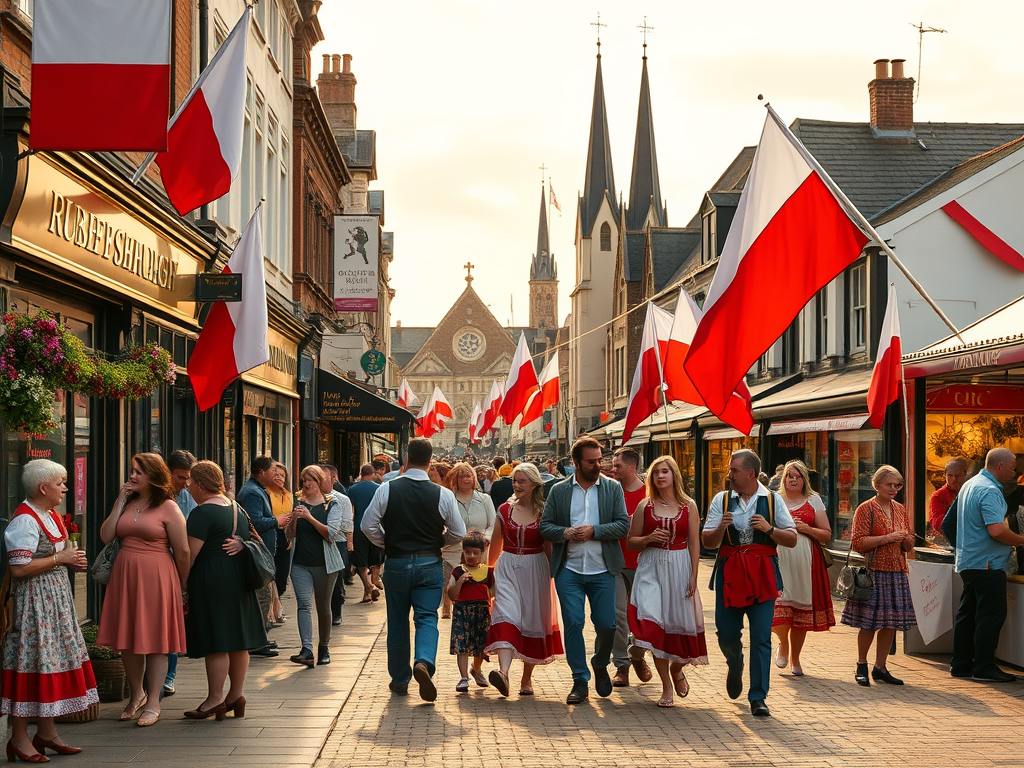
Birmingham is home to a long-standing and diverse Polish community, whose presence in the city spans more than a century. Shaped by war, political upheaval and economic migration, the Polish community has made a lasting contribution to Birmingham’s cultural, social and economic life.
Early Polish presence in Birmingham
Polish connections with Birmingham can be traced back to the late nineteenth and early twentieth centuries, when small numbers of Polish workers and political exiles settled in Britain. However, it was the events of the Second World War that marked the first significant Polish settlement in the city.
Thousands of Polish servicemen fought alongside British forces during the war. When Poland fell under communist control after 1945, many were unable or unwilling to return home. Britain offered resettlement, and Birmingham, with its strong industrial base, became one of the cities where Polish veterans and their families made new lives.
Post-war settlement and community building
During the late 1940s and 1950s, Polish families settled in areas close to employment opportunities, particularly in engineering, manufacturing and construction. Like many migrant communities, early Polish settlers relied heavily on mutual support networks and community organisations.
Polish clubs, social halls and churches played a crucial role in preserving language, culture and identity. These institutions provided not only spiritual and social support, but also practical assistance for newcomers adapting to life in Britain.
The Catholic Church and cultural identity
Religion has been central to the Polish community in Birmingham, with the Roman Catholic Church acting as both a spiritual and cultural anchor. Polish-language services, festivals and community events have long helped maintain traditions and a sense of belonging.
Polish Saturday schools were established to teach children the Polish language, history and culture, ensuring continuity across generations. These institutions remain important today, even as younger generations become fully integrated into British society.
The post-2004 migration wave
A major new chapter in the history of Birmingham’s Polish community began after Poland joined the European Union in 2004. Freedom of movement led to a large influx of Polish migrants seeking work and opportunity in the UK.
Birmingham attracted many of these new arrivals due to its size, employment prospects and existing Polish networks. Unlike earlier generations, many post-2004 migrants arrived as young adults or families and settled quickly, taking up work across construction, manufacturing, logistics, healthcare, retail and hospitality.
Community life and everyday culture
Polish culture is highly visible in Birmingham today. Polish shops, delicatessens and food outlets supply traditional products and act as informal community hubs. Polish cuisine, celebrations and customs are widely maintained within families and community groups.
National events such as Polish Independence Day, religious holidays and cultural festivals continue to be observed, while social media and community organisations help maintain strong connections both locally and with Poland.
Language remains an important part of identity, with Polish widely spoken alongside English, particularly within families and community settings.
Business and economic contribution
Entrepreneurship has become a strong feature of the Polish presence in Birmingham. Many Polish-owned businesses have been established across the city, ranging from construction firms and trades to retail outlets, professional services and transport companies.
These enterprises have contributed to local employment, skills development and economic activity, particularly in areas undergoing regeneration.
Integration and civic life
Over time, the Polish community has become increasingly integrated into Birmingham’s wider social fabric. Children educated in local schools have gone on to higher education and professional careers, bridging Polish and British identities.
Polish community organisations, charities and advocacy groups work to support newcomers, address employment and housing issues, and promote understanding between communities.
Life today
Today, Birmingham’s Polish community is multi-generational, dynamic and well established. While shaped by a history of displacement and migration, it is also forward-looking, contributing actively to the city’s workforce, culture and neighbourhood life.
The Polish community continues to enrich Birmingham through its resilience, traditions and strong work ethic, forming an important part of the city’s multicultural story.






Leave a Reply