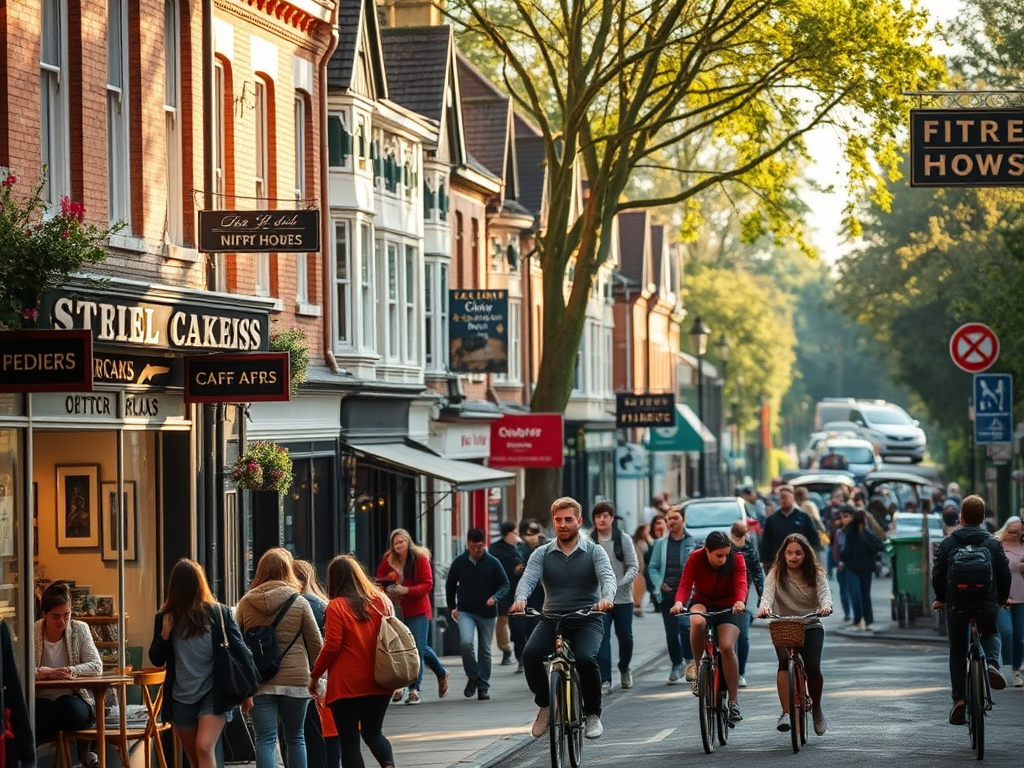
Selly Oak is a busy and distinctive district of south-west Birmingham, lying between Edgbaston, Bournville, Northfield and Harborne, and centred on the long sweep of the Bristol Road, one of the city’s main routes in and out of the centre. Although today it is best known as a lively student area, Selly Oak has very deep roots, being mentioned in the Domesday Book of 1086 as “Escelie”, with the land recorded as belonging to William Fitz-Ansculf of Dudley Castle. Archaeological evidence also points to Roman-era activity in the area, making Selly Oak one of the city’s oldest continuously settled places.
For much of its history Selly Oak was a small rural village surrounded by fields, woodland and scattered farms, with the Bristol Road acting as a historic route linking Birmingham to the south-west of England. This rural character began to disappear in the nineteenth century as Birmingham’s rapid industrial growth pushed outwards, swallowing up surrounding countryside and transforming Selly Oak into a suburban district. Much of the housing that defines the area today was built during the late Victorian and Edwardian periods around the turn of the twentieth century, with rows of solid red-brick terraces and larger villas laid out close to the main road and on the streets behind it.
One of the most important influences on Selly Oak in the modern era has been the University of Birmingham, which lies immediately to the north. Its presence has created a large and constantly changing student population, and many of the Victorian houses around the Bristol Road and surrounding streets are now used as student accommodation. This gives the area a youthful, energetic feel, with a steady turnover of residents and a strong demand for cafés, takeaways, shops and services geared towards student life.
The Bristol Road itself is the heart of Selly Oak, forming a long, busy high street lined with shops, supermarkets, cafés, restaurants and small businesses. Alongside this is a retail park and a range of local amenities that serve both students and long-term residents, while frequent bus and rail links provide easy access to Birmingham city centre and the wider region. This constant flow of people and traffic makes Selly Oak one of the most active and fast-moving parts of the city.
Selly Oak also sits close to some of Birmingham’s most important historic and cultural sites. To the south lies Bournville and the Cadbury Village Trust, with its carefully planned streets, green spaces and model village character, created by the Cadbury family as a better environment for workers. Nearby is Cadbury World, one of Birmingham’s major tourist attractions, drawing visitors from across the UK and abroad. Selly Oak Manor, a late medieval timber-framed building, also survives as a reminder of the area’s pre-industrial past and forms part of a group of historic buildings linked to the old manor of Selly.
Today Selly Oak is a place where ancient settlement, Victorian suburb and modern student district all overlap. Its long history, from Roman times through medieval records and into the era of industrial and educational expansion, is reflected in its buildings, its streets and its constantly changing population. Despite the loss of its original countryside, Selly Oak remains a vital and characterful part of Birmingham, shaped by its past but always evolving with the life of the city.







Leave a Reply