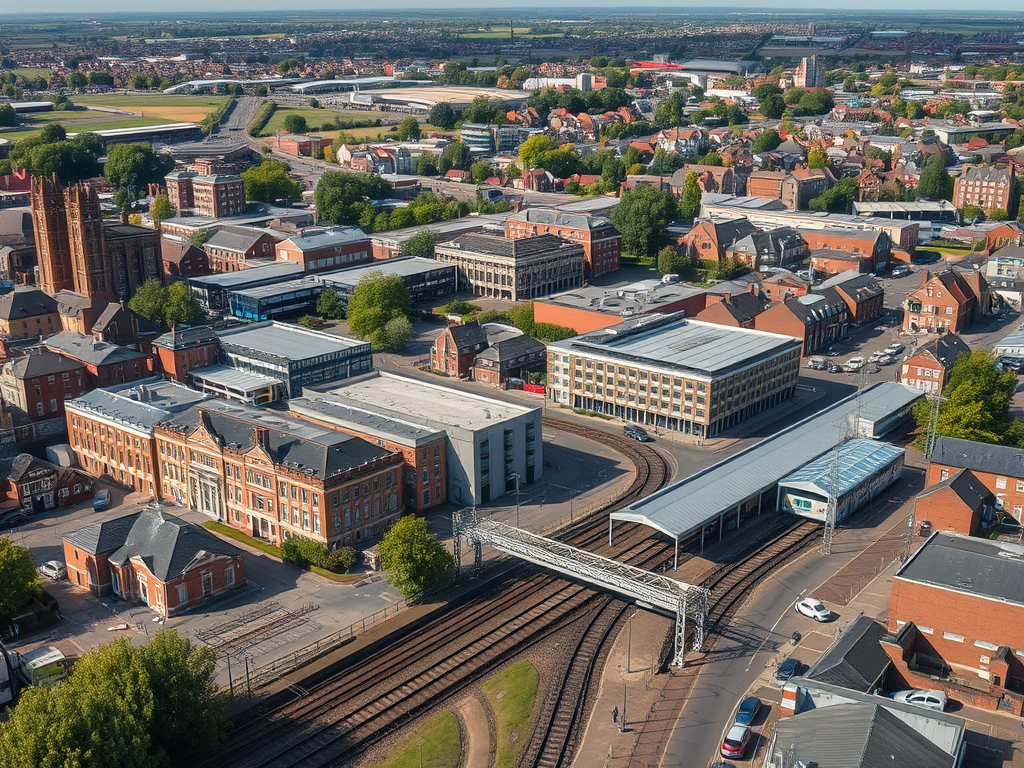
Nechells is one of Birmingham’s oldest industrial districts, lying to the north-east of the city centre between Aston, Duddeston and the River Tame. Records show that there has been a community in the area for more than 800 years, long before it became part of the modern city. Originally Nechells was a small rural settlement of fields, mills and cottages along the river valley.
Nechells became part of Birmingham in 1838, and from that point it expanded rapidly as the city’s industry spread eastwards. Its position beside the River Tame, the Birmingham Canal Navigations and later the railway made it ideal for heavy industry. By the Victorian era the area was dominated by brass foundries, button factories, gun making, metal trades and hardware production, supplying Birmingham’s famous manufacturing economy.

One of the most important sites was the Nechells Power Station, which supplied electricity to large parts of Birmingham and helped drive the city’s industrial growth. The district was also closely linked to major companies such as Dunlop, GEC and the engineering works of Aston and Witton, making it one of the most intensely industrialised parts of the city. Thousands of workers lived in dense streets of terraced housing close to their factories.
Nechells was also one of Birmingham’s most overcrowded areas, and by the mid-twentieth century much of its housing was classed as slum property. In the 1960s, large parts of the old streets were cleared and replaced by tower blocks and modern estates in an attempt to improve living conditions. In recent decades many of these blocks have themselves been demolished as the council continues to redevelop the area and raise housing standards.
Modern-day Nechells is very different from the district that existed a century ago. It is now an inner-city suburb shaped by industrial parks, railways and major roads, which separate it from neighbouring areas such as Saltley and Bordesley Village. Despite this, Nechells remains an important working district, with warehouses, depots and small factories continuing its long tradition of production and logistics.
One of the most striking symbols of Nechells’ modern redevelopment is Star City, the large leisure and entertainment complex built on former industrial land. It represents a shift from heavy industry to retail, leisure and service employment, showing how Nechells continues to adapt to changing economic conditions.
Today Nechells stands as a place shaped by centuries of work, rebuilding and renewal. Beneath its modern roads and industrial estates lies a deep history of manufacturing, migration and community life that helped make Birmingham the city it is.






Leave a Reply