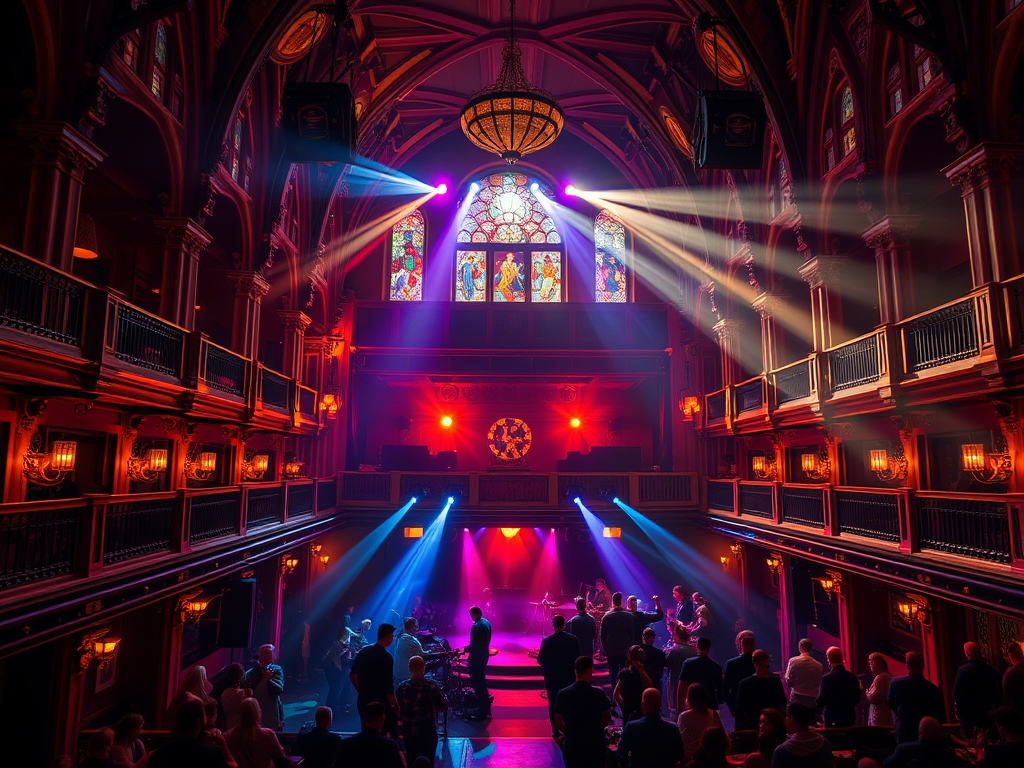
The Que Club was one of Birmingham’s most important and influential music venues, occupying the vast former Methodist Central Hall on Corporation Street, just a short walk from the city’s main shopping and business districts. The building itself dated from 1903–1904 and had originally been designed as a place of worship and community gathering, with a huge main hall and dozens of smaller rooms. By the late 1980s the building had fallen out of religious use, and in 1989 it was reborn as the Que Club, a transformation that would turn it into one of the most famous nightlife spaces in Britain.
From the moment it opened, the Que Club was different from any other venue in Birmingham. Its cathedral-like interior, balconies and maze of side rooms allowed it to host multiple music scenes at the same time. This made it ideal for the explosion of club culture that swept through the UK in the late 1980s and 1990s. The Que quickly became a home for acid house, techno, jungle, drum and bass, rave and later Britpop and alternative rock, drawing crowds not just from Birmingham but from across the Midlands and beyond.
Over the years the Que Club built a formidable reputation for both live performances and club nights. International artists such as David Bowie, Blur, Massive Attack, The Chemical Brothers, Run-DMC and Daft Punk all performed there, alongside countless DJs who went on to define electronic music in the UK. One of Daft Punk’s most famous early live recordings was made at the Que in 1997, helping to cement the club’s place in dance music history. Weekly and monthly nights such as House of God, Atomic Jam, Flashback, Spacehopper and many others made the Que a meeting point for different tribes of music fans, from hardcore ravers to indie kids and electronic music purists.
For nearly three decades the Que Club was more than just a venue. It was a cultural landmark, a place where people discovered new music, new styles and new communities. Its vast, slightly rough-edged interior gave it a freedom that smaller, more polished clubs could never quite replicate, and for many people in Birmingham it became a defining part of their youth.
The Que Club finally closed in 2017. Its end was not marked by a single dramatic event but by the slow pressures that affect many large independent venues: rising costs, changing patterns of nightlife, and the difficulties of maintaining such a huge historic building. Once the music stopped, the former Central Hall was left empty again, and concerns were soon raised about the future of the listed structure.
Although the Que is now silent, its legacy is still very much alive. Documentaries, exhibitions and reunion events continue to celebrate what it meant to Birmingham and to British club culture more widely. For thousands of people, the Que Club remains a symbol of a time when the city was at the cutting edge of music, nightlife and youth culture, and when a former church on Corporation Street became one of the most legendary dance floors in the country.


Leave a Reply