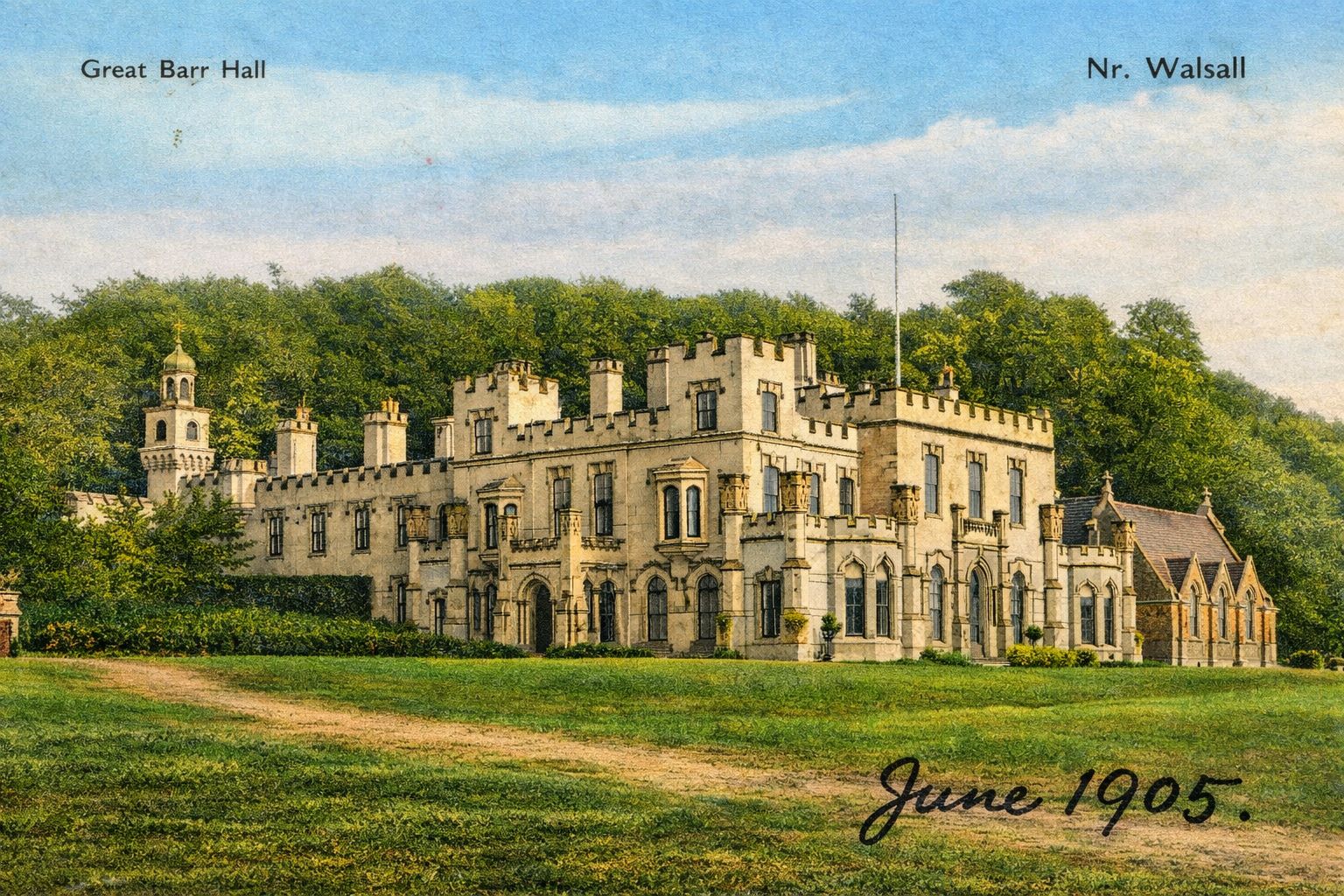
Great Barr Hall was one of the grandest country houses ever to stand within the modern boundaries of Birmingham. It lies in the district of Great Barr on the north-west edge of the city, near Perry Barr and Kingstanding, overlooking the valley of the River Tame. Far from being completely lost, the hall still survives today as a dramatic and heavily derelict ruin, hidden within woodland and parkland that once formed part of its great estate.
The hall was built in the late eighteenth century for the Scott family, who were major landowners in the area. Designed in the fashionable Gothic Revival style, it replaced an earlier house on the site and was set within an extensive landscaped park, complete with lakes, winding drives and ornamental woodland. For generations it was one of the most important country houses in Staffordshire, standing in open countryside long before Birmingham’s suburbs expanded towards it.
During the Industrial Revolution the Scott family became deeply connected with Birmingham’s commercial and political life. Family members were involved in banking, manufacturing and local government, and Great Barr Hall became a place where industrialists, politicians and landed society mixed. Despite the rapid growth of Birmingham nearby, the estate remained a secluded and prestigious private domain, buffered from the city by its large park and farmland.
The hall’s role changed completely in the twentieth century. In 1920 Birmingham City Council purchased much of the estate as part of its ambitious housing expansion, which led to the creation of Kingstanding and the modern Great Barr estates. Rather than being demolished, the hall itself was retained and adapted for a very different purpose. It became part of the city’s mental health system, used as a psychiatric hospital and residential institution for patients, continuing a long tradition of large country houses being converted into asylums in the early twentieth century.
During and after the Second World War the building suffered increasing wear and neglect. In 1959 a serious fire caused major damage, leaving the structure badly weakened. Although there were discussions about restoration, the scale of the damage and the cost involved proved too great. The hospital closed, and the hall was left empty and unsecured. Over the following decades it was stripped, vandalised and further damaged by additional fires, accelerating its decline.
Despite this, Great Barr Hall was never fully demolished. Much of its outer structure, including sections of its walls, towers and Gothic detailing, still stands today as a haunting ruin. It is now a Grade II* listed building, recognised as being at serious risk but still of high architectural and historic importance. Parts of the surrounding parkland, including lakes and woodland, also survive, giving a glimpse of the estate that once dominated this part of north Birmingham.
Today Great Barr Hall remains one of the city’s most striking forgotten landmarks — not a vanished house beneath modern streets, but a surviving shell that tells a powerful story of aristocratic wealth, Victorian ambition, twentieth-century social care and long-term urban neglect. Hidden behind trees and fences, it stands as a rare reminder that this part of Birmingham was once shaped not by housing estates, but by one of the Midlands’ great country houses.





Leave a Reply