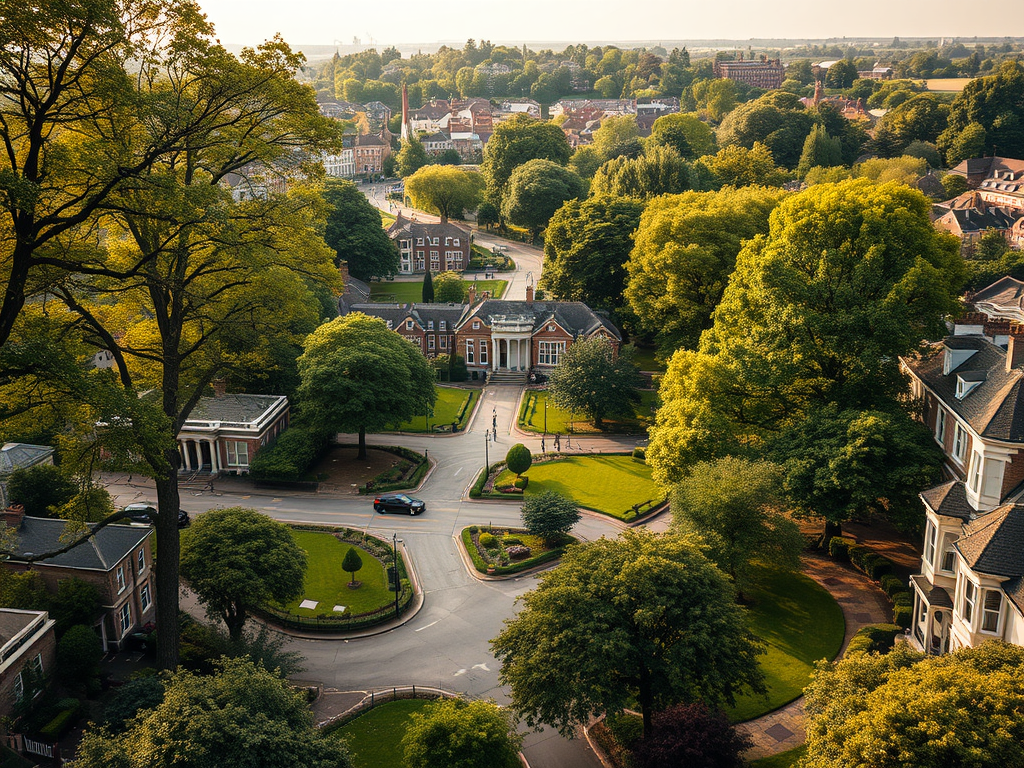
The Calthorpe Estate is one of the most important and influential landholdings in the history of Birmingham, and its impact on the shape of the modern city is difficult to overstate. Centred on Edgbaston, it was owned for centuries by the Gough-Calthorpe family, whose careful and often far-sighted management created a very different pattern of development from that seen elsewhere in Birmingham.
At a time when most of the city was growing through uncontrolled industrial expansion, the Calthorpes took a deliberate decision to protect their land from heavy industry and dense working-class housing. Instead, they planned Edgbaston and the surrounding estate as a place of large plots, tree-lined roads, parks and high-quality buildings. This ensured that the area developed as a residential and institutional district rather than a factory zone, creating a sharp contrast with the crowded industrial quarters to the east.
Throughout the nineteenth century, as Birmingham’s population exploded, the Calthorpe Estate became the city’s most desirable address. Wealthy merchants, industrialists, doctors and lawyers built homes on land leased from the estate, while churches, schools, clubs and hospitals were encouraged to settle there. This helped make Edgbaston not just a place to live but a centre of professional, cultural and civic life.
The estate also played a central role in bringing major institutions to Birmingham. The University of Birmingham was established on land that had been part of the Calthorpe holdings, as were several of the city’s major hospitals. By providing land for education and healthcare, the estate helped shape Birmingham’s future as a centre of learning and medicine as well as industry.
Unlike many old landowning families, the Calthorpes adapted to modern times. Their estate management continued into the twentieth and twenty-first centuries, evolving from a purely residential landlord into a major urban developer. Today the Calthorpe Estate still owns and manages large parts of Edgbaston Village and surrounding areas, overseeing new developments while maintaining the principles of quality, green space and long-term planning that have defined the estate for generations.
The legacy of the Calthorpe Estate can be seen across Birmingham in the wide streets, leafy parks, grand buildings and institutions of Edgbaston. By choosing to plan rather than exploit their land for short-term profit, the family left a lasting mark on the city, creating one of the most distinctive and influential districts in the Midlands.







Leave a Reply