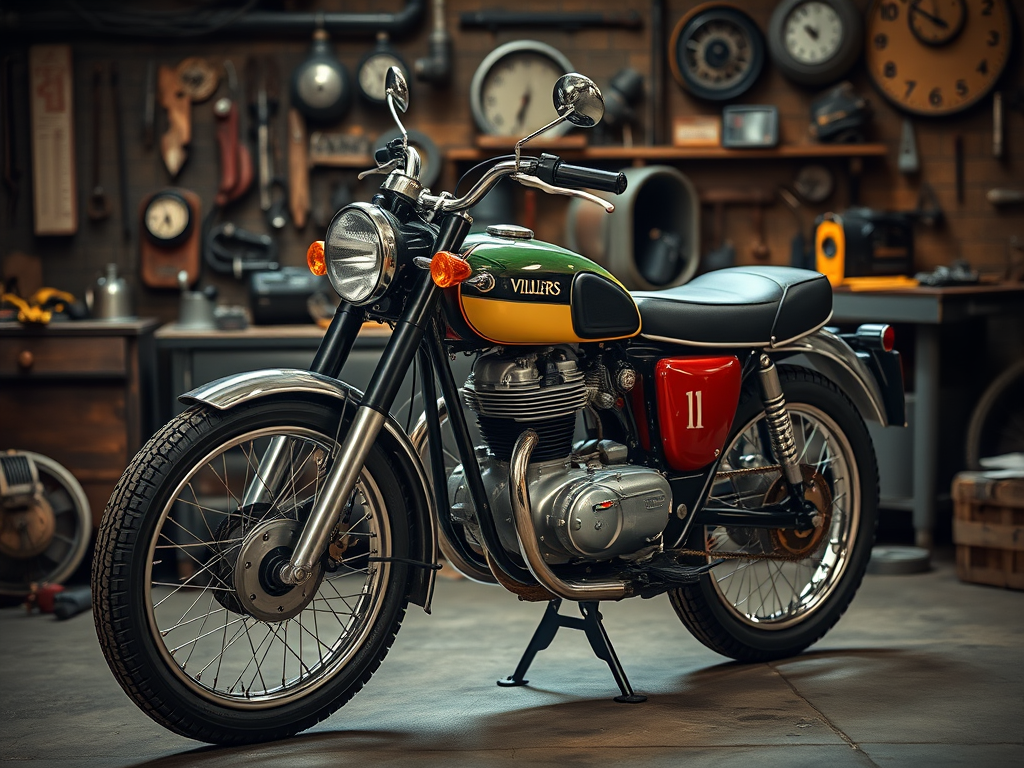
The Villiers–Associated Motor Cycles, usually known as Villiers-AMC, was a short-lived but significant attempt to rescue and rationalise Britain’s declining motorcycle industry during the 1960s. Formed at a time of intense competition and industrial difficulty, the company brought together two major strands of British engineering: Villiers’ long-established engine manufacturing expertise and Associated Motor Cycles’ portfolio of well-known motorcycle brands.
Villiers-AMC came into being in 1966, when the Villiers Engineering Company took control of Associated Motor Cycles, which was by then facing severe financial problems. Associated Motor Cycles had been one of Britain’s largest motorcycle groups, owning respected marques such as AJS, Matchless, Francis-Barnett and James, but by the mid-1960s it was struggling to compete with increasingly sophisticated and affordable motorcycles from Japan.
The merger was intended to create a stronger, more integrated business. Villiers brought with it decades of experience producing reliable small engines, while AMC contributed manufacturing capacity, established brands and an international dealer network. The hope was that consolidation would reduce duplication, cut costs and allow British manufacturers to modernise their products more effectively.
Villiers-AMC inherited production facilities in both London and the Midlands. AMC’s main motorcycle works at Plumstead in south-east London remained central to operations, while Villiers’ engine manufacturing base in Wolverhampton continued to supply power units. This geographical spread reflected the wider structure of Britain’s motorcycle industry, which had long been centred on Birmingham, the Black Country and London.
Despite these ambitions, Villiers-AMC faced enormous challenges almost from the outset. Many of the motorcycles it produced were based on ageing designs, and the investment needed to develop new engines and modern production techniques was substantial. At the same time, Japanese manufacturers such as Honda, Yamaha and Suzuki were producing machines that were lighter, faster, more reliable and easier to maintain. Industrial unrest and wider economic difficulties in Britain further undermined efforts to stabilise the business.
By the late 1960s, it became clear that Villiers-AMC alone could not reverse the decline of the British motorcycle industry. In 1969, the company became part of Norton Villiers Triumph, a government-backed grouping that also incorporated Norton and Triumph. This was a last major attempt to preserve large-scale motorcycle manufacturing in Britain through consolidation and state support.
Even this broader restructuring proved insufficient. Production was gradually scaled back, factories were closed, and by the mid-1970s most motorcycle manufacturing under the Villiers-AMC and NVT umbrella had ceased. The Villiers-AMC name disappeared entirely, surviving only in historical records and the memories of the industry.
Although short-lived, Villiers-AMC occupies an important place in British industrial history. It represents a final effort to save a once-dominant sector through merger and rationalisation, and its failure highlights the scale of change facing British manufacturing in the post-war period. Today, the legacy of Villiers-AMC lives on through classic motorcycles, preserved engines and enthusiast communities, serving as a reminder of both the strengths and the limitations of Britain’s mid-twentieth-century engineering industry.





Leave a Reply