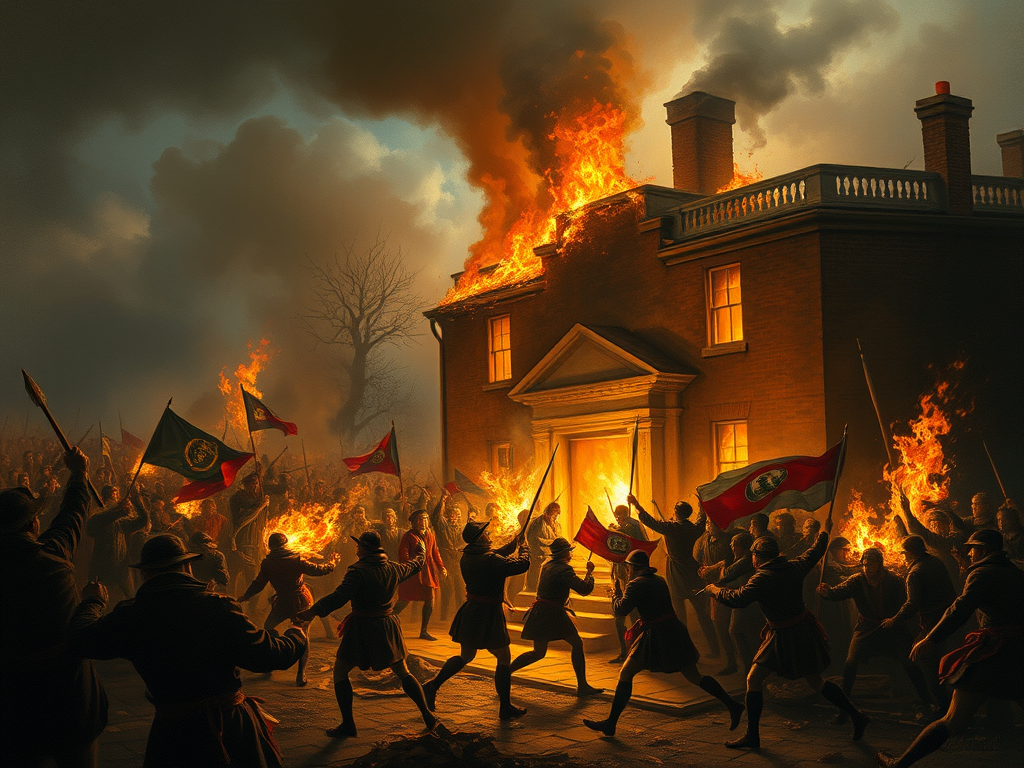
The Priestley Riots were one of the most significant and destructive episodes of civil unrest in Birmingham and took place in July 1791, at a time when the city was growing rapidly as an industrial and intellectual centre. Although Birmingham was not yet an incorporated city, it was already politically active, religiously diverse and deeply divided by tensions surrounding reform, religion and events unfolding in revolutionary France.
At the centre of the unrest was Joseph Priestley, a prominent scientist, theologian and political thinker who lived in Birmingham. Priestley was a leading figure among the city’s Protestant Dissenters and a supporter of political reform, religious tolerance and the principles associated with the French Revolution. These views made him deeply unpopular with conservative elements of society, particularly those loyal to the established Church and fearful that revolutionary ideas would spread to Britain.
The immediate trigger for the riots was a dinner held on 14 July 1791 to celebrate the second anniversary of the storming of the Bastille in France. Although the event itself passed peacefully, it inflamed existing tensions. Crowds gathered in the days that followed, and hostility quickly turned into organised violence directed at Dissenters and reformers, with Priestley becoming the primary target.
Mobs attacked and destroyed Priestley’s home and laboratory at Fair Hill, burning his books, manuscripts and scientific equipment. The violence then spread across Birmingham, with chapels, meeting houses and the homes of other Dissenters systematically targeted and looted. Buildings associated with religious nonconformity and political reform were singled out, suggesting that the riots were not entirely spontaneous but driven by deep-seated resentment and, possibly, tacit local support.
For several days, the authorities failed to intervene effectively. Local magistrates were criticised for their inaction, and troops were slow to arrive. By the time order was restored, large parts of the Dissenting community had suffered severe losses. Priestley himself fled Birmingham with his family, eventually leaving England altogether and settling in the United States, where he spent the remainder of his life.
The aftermath of the riots caused national outrage and debate. While some perpetrators were eventually tried, punishments were limited, reinforcing the perception that the authorities had been reluctant to protect reformers and religious minorities. The events damaged Birmingham’s reputation as a tolerant and progressive town and exposed the fragility of order in a rapidly changing industrial society.
In the longer term, the Priestley Riots became a defining moment in Birmingham’s history. They highlighted the intense social and political pressures of the late eighteenth century, where fears of revolution clashed with demands for reform and religious freedom. The riots marked the end of Priestley’s life in Birmingham but also left a lasting legacy, serving as a reminder of how ideas, fear and social division could erupt into violence in a city on the brink of modernity.






Leave a Reply