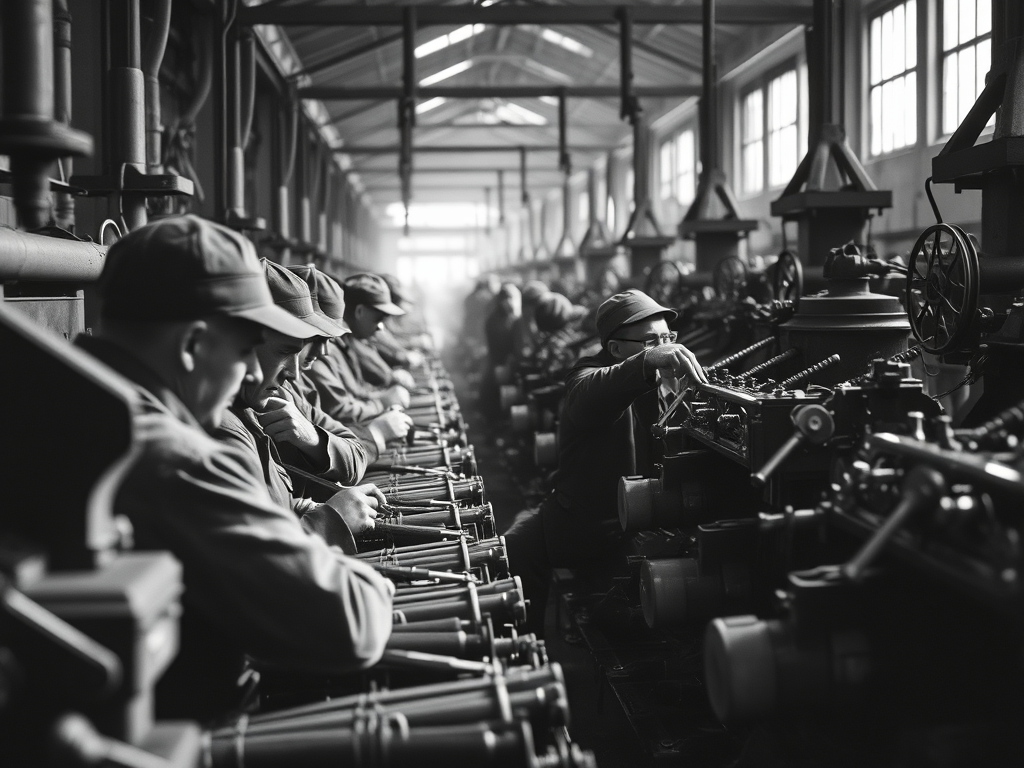
When Britain entered the First World War in August 1914, it did so with an army that would expand at unprecedented speed and a manufacturing system not yet organised for total war. Few places were better prepared to adapt than Birmingham and the wider West Midlands. Long before the conflict, the region had built its reputation on metalworking, precision engineering, machine tools, chemicals, vehicles and an extraordinary network of specialist firms. During the war, those strengths were redirected, intensified and coordinated, turning the Midlands into one of Britain’s principal industrial engines.
The First World War was not only fought in trenches. It was fought in factories, workshops, foundries and transport yards. Birmingham’s contribution lay in keeping the British Army and Navy supplied continuously and at scale as the conflict evolved into a war of attrition.
Why Birmingham could mobilise so quickly
Birmingham was not dominated by a single giant plant. Instead, it consisted of a dense ecosystem of small and medium sized manufacturers, many clustered around the historic Gun Quarter and adjoining engineering districts. These firms specialised in skills that modern warfare consumed in huge quantities, including precision machining, forging, springs, gauges, locks, screws, pressings and finishing.
When wartime demand surged, particularly after the 1915 shell shortage crisis, this industrial fabric proved invaluable. Workshops that had previously produced bicycles, motorcycles, tools or domestic goods were converted to shell components, weapon parts and vehicle fittings. Output could be increased rapidly by installing new machinery, extending shifts and coordinating subcontractors rather than waiting for entirely new factories to be built.
Manpower and sacrifice: Birmingham’s human contribution
Birmingham was not only a centre of production. It was also a city of enlistment. Around 150,000 men from Birmingham volunteered or were called up during the war. More than 12,000 were killed and around 35,000 returned home permanently disabled.
These figures reflect the double strain placed on the city. Skilled workers were drawn into the armed forces at the same time as industry needed labour more than ever. As the war progressed, priorities shifted. Men essential to munitions work were retained or recalled, while women, older men and newly trained workers filled the gaps. The war permanently altered Birmingham’s workforce and its social structure.
Weapons from Birmingham: rifles, machine guns and grenades
Birmingham Small Arms at Small Heath
One of the most important contributors was Birmingham Small Arms at Small Heath. Under government direction, BSA became a cornerstone of Britain’s small arms supply. It produced rifles and, crucially, the Lewis gun, a light machine gun that transformed British infantry tactics by providing mobile automatic fire at platoon level.
Weapons such as the Lewis gun were not simply products. They were tools that reshaped how the British Army fought and helped it adapt to the brutal realities of trench warfare.
The Mills bomb
Another iconic Birmingham contribution was the Mills bomb, Britain’s standard hand grenade for much of the war. Developed, patented and manufactured in Birmingham from 1915, it became a defining weapon of close quarters trench combat. Simple, robust and reliable, it reflected the city’s practical engineering culture and its ability to produce effective designs in vast numbers.
The wider West Midlands war economy
Coventry and heavy ordnance
The war effort extended far beyond Birmingham itself. Coventry emerged as a major armaments centre, producing artillery pieces and heavy ordnance. Guns manufactured in Coventry equipped British forces on land and at sea, making the city a key component of Britain’s heavy industrial war capacity.
Wolverhampton and the Black Country
Across the Black Country, towns such as Wolverhampton redirected engineering firms towards military vehicles, engines, components and machine tools. Lorry production, spare parts and precision machining were essential to keeping armies mobile and supplied. Many civilian manufacturers were placed under direct government control and converted entirely to wartime output.
Factories, conversion and industrial geography
One of the fastest ways to increase production was conversion rather than new construction. Existing industrial sites across Birmingham were adapted for munitions work, often at remarkable speed. Areas such as Washwood Heath and Ward End became part of the wartime manufacturing landscape.
Equally important were the thousands of subcontractors that supported larger works. Birmingham functioned as a living supply network. One firm produced shell casings, another machined fuses, another made gauges, and another inspected finished components. This distributed system made the city resilient and flexible under pressure.
Transport that sustained the war effort
The Midlands’ transport infrastructure underpinned its wartime success. Canals moved coal, steel and bulk materials, while railways carried finished weapons and vehicles to ports, depots and training camps. Birmingham’s central location reduced journey times and simplified coordination between factories and military supply chains.
Power and utilities
Reliable power supplies were essential. Continuous production required electricity for machinery and lighting, particularly for night shifts. Wartime investment accelerated improvements in power generation and industrial utilities that later benefited peacetime manufacturing.
Women in industry
One of the most significant changes was in labour. As men left for the front, women entered engineering and munitions work in unprecedented numbers. They operated lathes, presses and inspection benches and became indispensable to maintaining output. Their contribution challenged long standing assumptions about industrial labour and helped lay the foundations for post war social change.
Birmingham & West Midlands War Impact
Birmingham did not win the war on its own, but Britain could not have sustained the conflict without places like it. The city and the wider West Midlands supplied small arms and automatic weapons that shaped infantry tactics, grenades and munitions used daily on the front lines, artillery, vehicles and components produced across the region, and the industrial organisation that allowed Britain to recover from early shortages and ultimately out produce its enemies.
By 1918, Britain’s war effort had become a fully industrialised system, and Birmingham stood at its heart.
Legacy
The First World War left deep scars on Birmingham. Thousands of lives were lost and many more were permanently altered. Yet the war also reinforced the city’s reputation as a centre of innovation and adaptability. The skills developed, factories expanded and labour systems reorganised during the conflict shaped the region’s interwar economy and influenced its role in later wars.
Birmingham’s story in the First World War is not only one of weapons and factories. It is the story of a city and a region mobilised industrially, socially and humanly to meet the demands of modern warfare, and in doing so, to help determine the outcome of a global conflict.





Leave a Reply