Introduction
Birmingham is home to one of the oldest Jewish communities in provincial England. Although smaller today than at its peak, the Jewish community has played a significant role in the city’s commercial, religious, and social development for almost three centuries. From early Georgian Birmingham through industrial expansion and into the modern multicultural city, Jewish life has remained an enduring part of Birmingham’s story.
Early Jewish Settlement in Birmingham
Jewish settlement in Birmingham can be traced back to the early 18th century, when the town was rapidly expanding as a centre of manufacturing and trade. Jewish merchants, traders, and craftsmen were drawn to Birmingham’s relative religious tolerance and economic opportunity.
The earliest Jewish residents lived close to the town centre, particularly around what is now Hurst Street and New Street. Worship initially took place in private homes before the establishment of purpose-built synagogues. By the late 18th century, Birmingham had a formally organised Jewish congregation, making it one of the earliest provincial Jewish communities in England.
Growth During the 19th Century
The 19th century saw rapid growth in Birmingham’s Jewish population. Industrial expansion and immigration — particularly from Central and Eastern Europe — transformed the community both in size and character. Jewish families became involved in metalworking, jewellery, tailoring, pawnbroking, retail, and later professional occupations.
This period also saw the development of Jewish communal structures, including burial societies, charitable organisations, and schools. As the community expanded, residential patterns shifted south and west from the city centre towards areas such as Edgbaston, Moseley, and Kings Heath, a trend that would continue into the 20th century.
Historic Synagogues and Places of Worship
Singers Hill Synagogue
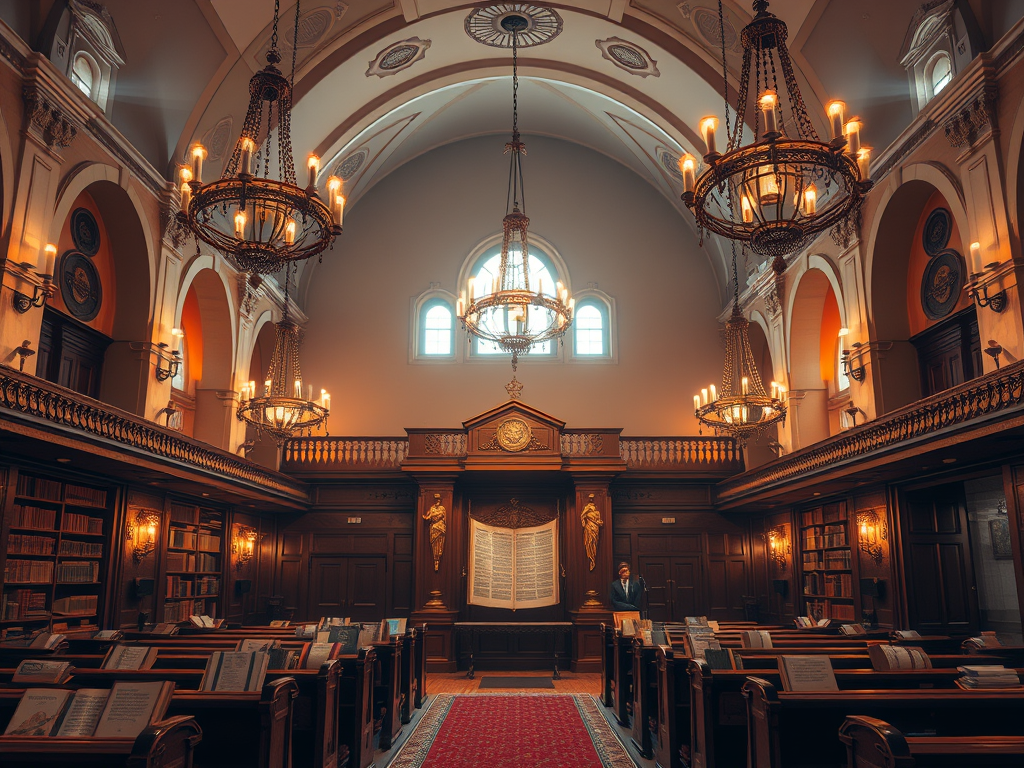
Singers Hill Synagogue is the oldest continuing Jewish congregation in Birmingham and remains its most historically significant place of worship. The current building, completed in the mid-19th century, is a striking architectural landmark and one of the finest synagogue buildings in the Midlands.
Often described as Birmingham’s “cathedral synagogue”, Singers Hill has served generations of Jewish families and continues to host regular religious services, festivals, and community events. It stands as a symbol of continuity and resilience in Jewish life in the city.
Severn Street Synagogue
An earlier synagogue was built on Severn Street in the early 19th century. Although it ceased to function as a synagogue in the mid-1800s, the building survives and remains an important part of Birmingham’s Jewish heritage. Its classical design reflects the confidence and stability of the community during that period.
Modern Jewish Congregations
Birmingham Central Synagogue
Located in Edgbaston, Birmingham Central Synagogue serves an Orthodox congregation and is a major focus of Jewish religious life in the city today. The modern complex provides not only worship space but also community facilities, educational programmes, and social activities. It also houses important regional facilities such as a mikveh, serving the wider Midlands Jewish population.
Birmingham Progressive Synagogue
Birmingham’s Progressive (Liberal/Reform) congregation offers an inclusive approach to Jewish worship and community life. Known for its emphasis on equality, education, and interfaith engagement, the synagogue plays an active role in dialogue with other faith communities across the city.
Solihull and District Hebrew Congregation
Serving Jewish families living to the south-east of Birmingham, this Orthodox congregation provides a traditional religious environment for worshippers in Solihull and surrounding areas.
Education, Welfare and Community Organisations
Jewish life in Birmingham has always extended beyond the synagogue. Community organisations support education, welfare, and social connection:
- Jewish primary education is provided through a long-established faith school integrating Jewish values with the national curriculum.
- Community care organisations offer practical and social support, particularly for elderly and vulnerable members of the community.
- Representative bodies coordinate cooperation between synagogues and liaise with local authorities on civic and cultural matters.
- Student groups and social networks help sustain Jewish life among younger generations studying at Birmingham’s universities.
Population and Demographic Change
The Jewish population of Birmingham reached its height in the early 20th century, when several thousand Jewish residents lived in the city. From the post-war period onward, numbers gradually declined due to suburbanisation, migration to larger Jewish centres, and emigration abroad.
Today, Birmingham’s Jewish community is relatively small but remains active, cohesive, and well-organised. Jewish residents form a very small percentage of the city’s population, yet maintain a strong communal identity supported by established institutions.
Jewish Life in Birmingham Today
Modern Jewish life in Birmingham reflects both tradition and adaptation. Synagogues remain centres for worship, festivals, and life-cycle events, while also serving as hubs for social, cultural, and educational activities. Community members participate fully in the wider civic life of Birmingham, contributing to business, academia, healthcare, education, and the arts.
Interfaith engagement has become an important feature of Jewish communal activity in the city, reflecting Birmingham’s diverse population and long tradition of religious coexistence.
Conclusion
The Jewish community in Birmingham has a history spanning nearly 300 years, shaped by migration, industry, faith, and civic participation. From early Georgian traders to modern professionals, Birmingham’s Jews have contributed significantly to the city’s cultural and economic life. Though smaller today than in the past, the community continues to preserve its heritage while remaining an active and respected part of Birmingham’s rich multicultural identity.







Leave a Reply