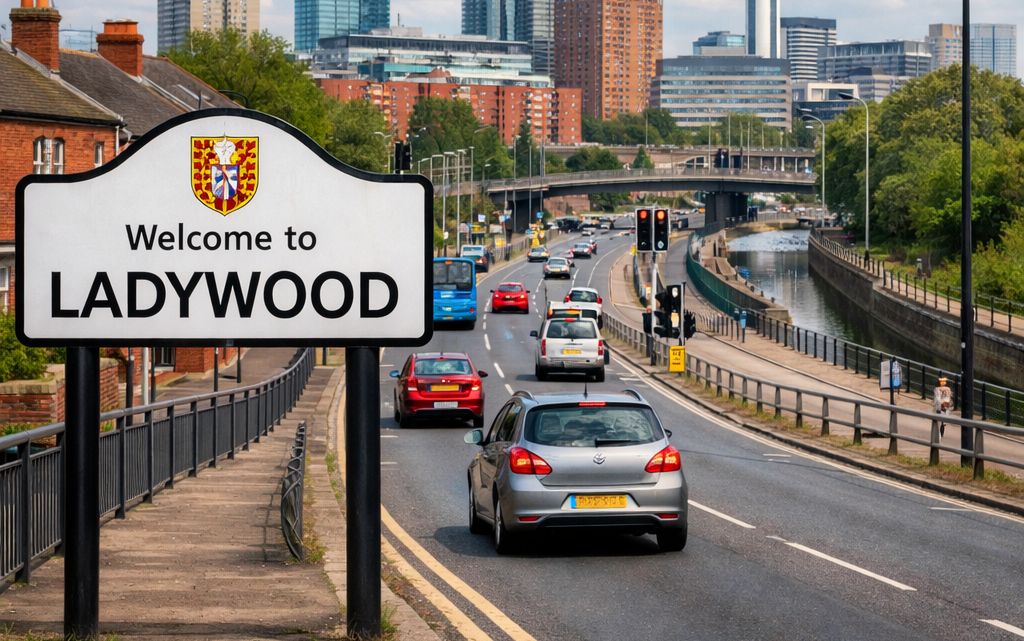
Ladywood is one of Birmingham’s most historically layered inner-city districts, lying immediately west of the city centre between Edgbaston, Hockley and the canal network. Long before it became urban, Ladywood was a rural manor and woodland on the edge of medieval Birmingham, and its name preserves that ancient past.
The name Ladywood is believed to come from a medieval wood belonging to the lord of the manor, sometimes known as “the Lady’s Wood”. This was once a landscape of trees, fields and small farms supplying Birmingham with timber, grazing land and food. As the town expanded during the eighteenth and nineteenth centuries, this countryside was steadily absorbed into the growing industrial city.
One of Ladywood’s earliest major landmarks was Ladywood Reservoir, built in the early nineteenth century to supply water to Birmingham’s homes and factories. Before modern piped water systems existed, this reservoir was vital to the city’s survival and growth. It lay close to where Five Ways and Broad Street now stand, and when newer waterworks made it obsolete, it was filled in and built over as the city expanded.
By the Victorian period Ladywood had become one of Birmingham’s most crowded and industrialised districts. Its canals, basins and wharves made it a major distribution point for coal, iron and raw materials arriving from the Black Country and beyond. Around these waterways grew dense clusters of metalworking shops, brass foundries and small engineering works, producing tools, fittings, lamps and components that were exported across Britain and overseas. These workshops formed part of the hidden industrial network that made Birmingham known as the “workshop of the world”.
Another key site was the Ladywood Gas Works, which supplied gas for street lighting, heating and cooking across large parts of Birmingham. This huge complex dominated sections of the canal side and employed hundreds of workers, making Ladywood a critical part of the city’s energy infrastructure.
The district was also home to a large working-class population living in courts and back-to-back houses, with streets packed tightly around factories and workshops. One of Ladywood’s most famous sons was Neville Chamberlain, who was born in the area and later became Prime Minister, a reminder that this crowded industrial district was also home to families who would shape national history.
After the Second World War, Ladywood was almost completely cleared as part of Birmingham’s slum clearance programme. Most of the Victorian housing and many of the old industrial buildings were demolished and replaced with tower blocks, maisonettes and new road layouts, dramatically altering the appearance of the area.
In the late twentieth and early twenty-first centuries Ladywood entered yet another phase of transformation. The construction of the National Indoor Arena (now the Utilita Arena Birmingham) and the development of Broad Street turned the area into one of the city’s main centres for entertainment, offices and high-rise living. Former industrial land and canal wharves became sites for apartments, hotels and cultural venues.
Today Ladywood stands as a powerful example of Birmingham’s ability to reinvent itself. Beneath its modern towers and busy roads lie layers of woodland, reservoirs, gasworks, foundries and working-class streets, making it one of the city’s most historically rich and continually changing districts.




Leave a Reply