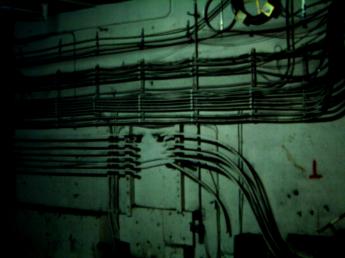
There are many people in Birmingham who will not have heard of the Anchor Exchange, a massive underground complex built in secrecy in the 1950s.
The largest of three such establishments (the other two being in Manchester and London), the exchange was designed to protect and maintain communications in the event of a nuclear war.
The idea behind these underground telephone exchanges was to ensure that, in the event of such a war, the communications system would still exist and continue to function. Originally they were planned to withstand an explosion (though not a direct hit) from atomic bombs of the size used in Japan.
Unfortunately, all the best-laid plans amounted to nothing as the structure became obsolete before it was fully completed. Advances in nuclear technology and the hydrogen bomb produced far larger and more devastating weapons of mass destruction.
The Anchor Exchange gets its name from the anchor symbol used by the Birmingham Assay Office, the anchor being the gold hallmark for Birmingham. The structure still exists today, with its tunnels and rooms lying around one hundred feet below Newhall Street.
Shrouded in secrecy, the general public were led to believe the building work was part of a new underground railway network. Construction commenced in 1953 and ended with its opening in November 1957, at which point the public were told the railway project was no longer viable.
The entrance to the Anchor Exchange is via a lift at the rear of the Telephone House building. There is also emergency access by ladder and staircase from Newhall Street.
The structure was built using blast-proof concrete and has its own 300-foot well for water supply, with sewage channelled into the city system via pumping equipment.
A massive steel door weighing several tonnes would have sealed the complex in the event of nuclear attack. The facility also had its own generators to provide an independent electricity supply.
During the Cuban Missile Crisis the facility was placed on alert and remained operational into the 1980s before finally being made redundant. Water is still pumped from the tunnels to protect underground cables, but for safety reasons the site is now out of bounds to British Telecom staff.
By the late 1960s secrecy surrounding the exchange was relaxed and it became a subject of interest for the local press. Journalists were permitted access and the site quickly became the focus of intrigue and conspiracy theories.
The underground rooms still contain rations and equipment, now rapidly deteriorating in the damp and crumbling environment.
The Anchor Exchange has never been open to the public in any significant capacity and cannot be visited today. One original air vent remains visible behind Telephone House as a reminder of the hidden chambers beneath the city.
More information can be found at: http://www.birminghamanchor.co.uk






Leave a Reply