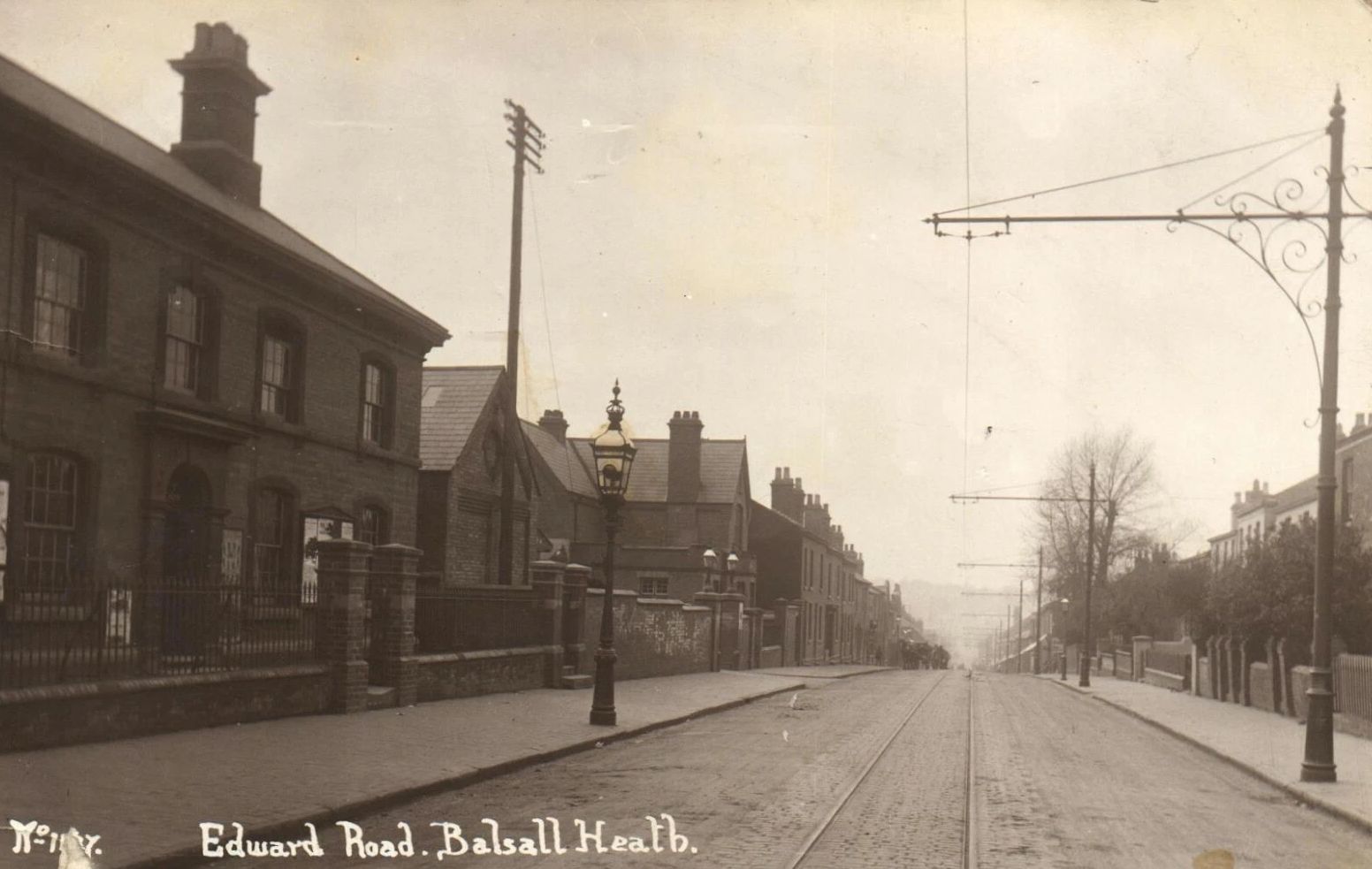
Balsall Heath is an inner-city district to the south of Birmingham, with a history that stretches from rural farmland to dense urban neighbourhood. The name derives from Old English, meaning a woodland clearing, and until the mid-19th century the area consisted largely of fields and scattered farms lying just beyond Birmingham’s built-up edge.
The district was absorbed into Birmingham during the Victorian period as the city expanded rapidly. Development accelerated from the 1840s onwards, marked by the construction of St Paul’s Church and the laying out of new streets with substantial housing. Initially, parts of Balsall Heath were a respectable middle-class suburb, with wider roads and larger houses than many inner-city districts, before later becoming more densely populated.
By the late 19th and early 20th centuries, Balsall Heath had transitioned into a predominantly working-class area, closely linked to Birmingham’s industrial economy. Residents found employment in nearby factories, workshops and service trades, while local shops, schools and places of worship helped establish a strong neighbourhood identity. The area also developed a reputation for entertainment and nightlife, with theatres, music halls and later cinemas contributing to its character.
From the mid-20th century onwards, Balsall Heath experienced significant social change as new communities settled in the area, particularly people of South Asian and Middle Eastern heritage. This reshaped the district culturally and economically, introducing new businesses, mosques and community institutions. In the late 20th century, Balsall Heath became nationally recognised for successful community-led regeneration, as local residents and faith groups worked together to address social problems and reclaim public space.
Today, Balsall Heath remains a densely populated and culturally diverse district. Its importance lies in the way medieval origins, Victorian urbanisation and modern community action sit together within a relatively compact area, reflecting Birmingham’s wider story of growth, change and resilience.






Leave a Reply